
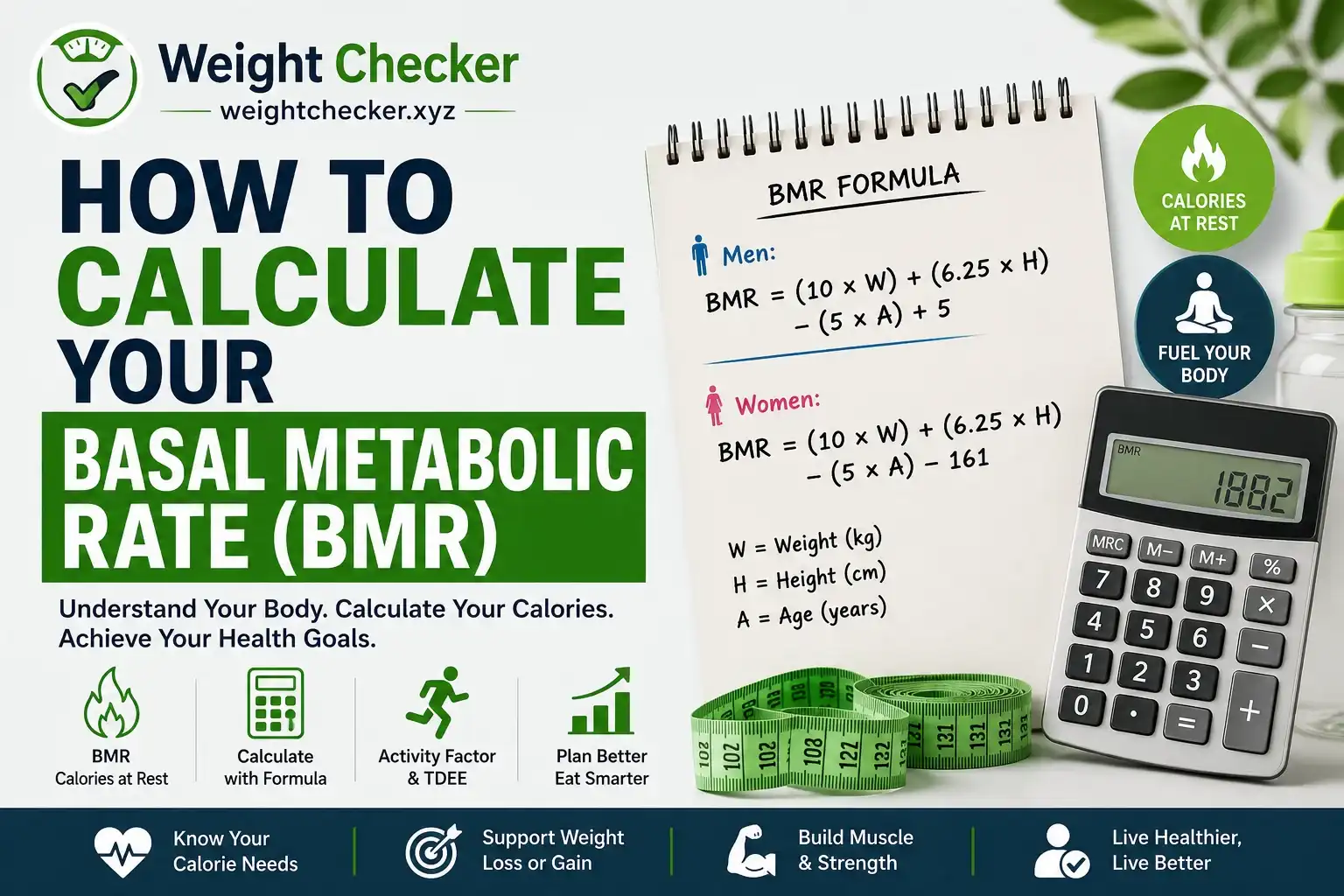
Knowing how to calculate your Basal Metabolic Rate (BMR) is one of the best ways to understand your body’s daily energy requirements. Your BMR represents the number of calories your body burns at rest to perform essential life-sustaining functions such as breathing, heart rate, blood flow, digestion, nutrient absorption, cell repair, and metabolism.
Whether your goal is weight loss, muscle gain, or weight maintenance, calculating your BMR provides a solid starting point for determining your daily calorie intake.
What Is Basal Metabolic Rate (BMR)?
Basal Metabolic Rate (BMR) is the minimum amount of energy your body requires to stay alive while completely at rest. Even when you’re sleeping or lying still, your body continues performing vital functions, including:
- Breathing
- Maintaining heart rate
- Blood circulation
- Digestion and nutrient absorption
- Cell growth and repair
- Hormone production
- Brain function
- Maintaining body temperature
These processes require calories even when no physical activity is involved.
Why Is BMR Important?
Your BMR forms the foundation of your daily calorie needs. Understanding it helps you:
- Estimate daily calorie requirements
- Plan healthy weight loss
- Maintain your current weight
- Build lean muscle mass
- Create an effective nutrition plan
- Calculate your Total Daily Energy Expenditure (TDEE)
- Monitor long-term metabolic health
Without knowing your BMR, it’s difficult to estimate how many calories your body truly needs each day.
How Is BMR Calculated?
There are several scientific methods used to calculate Basal Metabolic Rate.
1. Direct Calorimetry
Direct calorimetry is considered the most accurate method. It measures the heat your body produces while resting inside a specially designed calorimeter.
Although highly accurate, this method is expensive and mainly used in research laboratories.
2. Indirect Calorimetry
Indirect calorimetry estimates energy expenditure by measuring the amount of oxygen consumed and carbon dioxide produced.
Many hospitals, sports science laboratories, and clinics use this technique because it provides reliable metabolic measurements.
3. Mifflin-St. Jeor Equation
For most people, the Mifflin-St. Jeor equation is the easiest and most accurate way to estimate Basal Metabolic Rate without specialized equipment.
BMR Formula for Men
BMR = (10 × Weight in kg) + (6.25 × Height in cm) − (5 × Age) + 5
BMR Formula for Women
BMR = (10 × Weight in kg) + (6.25 × Height in cm) − (5 × Age) − 161
This equation uses four simple variables:
- Weight
- Height
- Age
- Sex
BMR Calculation Example
Male Example
Suppose a man is:
- Age: 35 years
- Weight: 90.7 kg
- Height: 183 cm
Using the formula:
BMR = (10 × 90.7) + (6.25 × 183) − (5 × 35) + 5
Estimated BMR:
≈ 1,882 calories per day
This means his body burns approximately 1,882 calories every day while resting.
Female Example
Suppose a woman is:
- Age: 35 years
- Weight: 68 kg
- Height: 170 cm
Using the female equation:
Estimated BMR:
≈ 1,409 calories per day
This represents the calories her body requires to maintain essential bodily functions at complete rest.
What Is the Difference Between BMR and RMR?
Although many people use these terms interchangeably, Basal Metabolic Rate (BMR) and Resting Metabolic Rate (RMR) are slightly different.
| BMR | RMR |
| Measures calories burned at complete rest | Measures calories burned with minimal movement |
| Tested under strict laboratory conditions | Easier to measure in clinical settings |
| More restrictive | More practical for everyday use |
For most health and fitness purposes, RMR provides a close estimate of BMR.
Calculate Your Total Daily Energy Expenditure (TDEE)
Your BMR only measures calories burned while resting.
To determine your total daily calorie needs, multiply your BMR by an activity factor.
Activity Factors
| Activity Level | Activity Factor |
| Sedentary (little or no exercise) | 1.2 |
| Lightly Active | 1.375 |
| Moderately Active | 1.55 |
| Very Active | 1.725 |
| Extra Active | 1.9 |
TDEE Formula
TDEE = BMR × Activity Factor
For example:
BMR = 1,882 calories
Moderately Active = 1.55
TDEE = 1,882 × 1.55 = 2,917 calories/day
This is the approximate number of calories required to maintain current body weight.
What Factors Affect Basal Metabolic Rate?
Several factors influence your metabolic rate.
Age
Metabolism naturally slows as people grow older.
Sex
Men generally have a higher BMR because they typically possess greater lean muscle mass.
Height
Taller individuals usually burn more calories at rest.
Weight
Larger bodies require more energy to support normal body functions.
Muscle Mass
Muscle tissue burns more calories than fat tissue, making lean muscle an important factor in increasing BMR.
Body Composition
The ratio of fat mass to muscle mass significantly affects resting calorie expenditure.
Genetics
Inherited traits influence metabolism and overall energy expenditure.
Hormones
Hormones, especially thyroid hormones, play an essential role in regulating metabolic activity.
Medical Conditions
Conditions such as hyperthyroidism, hypothyroidism, and diabetes can affect BMR.
Can You Increase Your BMR?
While genetics and age cannot be changed, several healthy habits may help improve your metabolic rate.
Build Lean Muscle
Strength training increases muscle mass, which burns more calories throughout the day.
Stay Physically Active
Regular exercise helps maintain muscle tissue and supports a healthy metabolism.
Eat Enough Calories
Consuming too few calories for extended periods may trigger metabolic adaptation, causing your metabolism to slow down.
Prioritize Protein
Protein supports muscle growth and has a higher thermic effect compared to fats and carbohydrates.
Get Quality Sleep
Adequate sleep helps regulate hormones involved in metabolism.
Limitations of BMR Calculations
Although the Mifflin-St. Jeor equation is among the most accurate prediction formulas, it is still an estimate.
Keep these limitations in mind:
- Individual metabolism varies.
- Hormones can influence calorie expenditure.
- Body composition affects accuracy.
- Genetics play an important role.
- Medical conditions may change metabolic rate.
- Activity level is not included in the BMR formula.
- Results may vary by approximately 10%.
Because of these factors, BMR should be used as a guideline rather than an exact measurement.
Is Eating Only Your BMR Calories Safe?
No.
Your BMR represents only the calories needed for basic life-sustaining functions. Daily activities such as walking, working, exercising, and digestion require additional energy.
Consuming only your BMR calories for long periods may lead to:
- Low energy levels
- Muscle loss
- Nutrient deficiencies
- Slower metabolism
- Poor exercise performance
For healthy nutrition planning, calculate your TDEE instead of relying solely on your BMR.
When Should You Talk to a Healthcare Professional?
Consult a healthcare professional or registered dietitian if you:
- Experience unexplained weight gain or weight loss
- Suspect thyroid issues
- Have diabetes or hormonal disorders
- Need a personalized nutrition plan
- Want an accurate metabolic assessment
Professional guidance can help create a safe and effective calorie plan based on your health status.
Final Thoughts
Calculating your Basal Metabolic Rate (BMR) is the first step toward understanding your body’s energy needs. By using the Mifflin-St. Jeor equation and combining your result with an appropriate activity factor, you can estimate your Total Daily Energy Expenditure (TDEE) and make more informed decisions about nutrition, weight management, and overall health. For the most personalized guidance, consult a qualified healthcare professional or registered dietitian.
Frequently Asked Questions (FAQs)
What is Basal Metabolic Rate (BMR)?
Basal Metabolic Rate (BMR) is the number of calories your body burns at complete rest to perform essential functions like breathing, circulation, digestion, and cell repair.
How do I calculate my BMR?
You can calculate your BMR using the Mifflin-St. Jeor equation, which considers your weight, height, age, and sex.
What is the most accurate way to measure BMR?
Direct calorimetry is the most accurate scientific method, while indirect calorimetry also provides highly reliable results. For everyday use, the Mifflin-St. Jeor equation offers an excellent estimate.
Is BMR the same as RMR?
No. BMR measures calories burned under complete resting conditions, while RMR measures calories burned with minimal movement. However, RMR is generally considered a close estimate of BMR.
What is TDEE?
Total Daily Energy Expenditure (TDEE) is the total number of calories your body burns each day after accounting for physical activity. It is calculated by multiplying your BMR by your activity factor.
Can I increase my Basal Metabolic Rate?
Yes. Building lean muscle, staying physically active, eating enough calories, consuming sufficient protein, and maintaining healthy sleep habits can help support a higher metabolic rate.
Does age affect BMR?
Yes. Basal Metabolic Rate generally decreases with age because muscle mass tends to decline and metabolism naturally slows over time.
Why isn’t my BMR equal to my daily calorie needs?
BMR only includes the calories needed for essential body functions at rest. Daily activities, exercise, digestion, and movement require additional energy, which is why your TDEE is higher than your BMR.
Is the Mifflin-St. Jeor equation accurate?
Yes. The Mifflin-St. Jeor equation is widely regarded as one of the most accurate methods for estimating BMR in healthy adults, though it remains an estimate rather than an exact measurement.