

If you’ve ever wondered how many calories your body burns in a day, the answer lies in your Total Daily Energy Expenditure (TDEE). Understanding your TDEE is one of the most effective ways to lose weight, maintain your current weight, or build muscle.
Your TDEE represents the total number of calories your body burns over 24 hours, including everything from breathing and digestion to walking, exercising, and everyday activities. Once you know your TDEE, you can create an effective nutrition plan based on real numbers instead of guesswork.
At Weight Checker (weightchecker.xyz), our free TDEE Calculator helps you estimate your daily calorie needs in seconds.
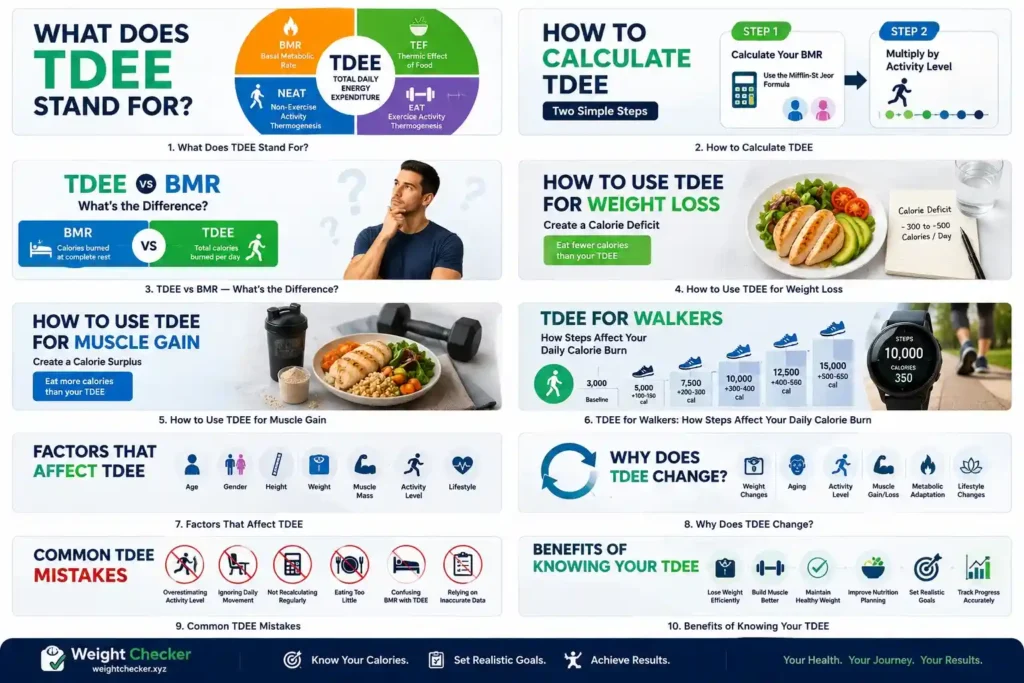
What Does TDEE Stand For?
TDEE stands for Total Daily Energy Expenditure.
It refers to the total amount of energy (calories) your body uses every day to perform both essential body functions and physical activities.
Your TDEE includes:
- Basal Metabolic Rate (BMR)
- Thermic Effect of Food (TEF)
- Non-Exercise Activity Thermogenesis (NEAT)
- Exercise Activity Thermogenesis (EAT)
Together, these components determine how many calories your body needs each day.
Why Is TDEE Important?
Knowing your TDEE helps you make smarter nutrition and fitness decisions.
Whether your goal is:
- Lose body fat
- Build lean muscle
- Maintain your current weight
- Improve athletic performance
- Plan your calorie intake
Your TDEE provides the starting point for every calorie-based goal.
Without knowing your TDEE, it’s difficult to know whether you’re eating too much, too little, or just enough.
How Does TDEE Work?
Every day, your body burns calories for different reasons.
Basal Metabolic Rate (BMR)
BMR is the energy your body uses while completely at rest.
It supports:
- Breathing
- Blood circulation
- Brain function
- Organ function
- Body temperature
- Cell repair
For most adults, BMR accounts for approximately 60–70% of total daily calorie expenditure.
Thermic Effect of Food (TEF)
Your body burns calories while digesting, absorbing, and processing food.
This is called the Thermic Effect of Food (TEF).
Typically, TEF represents around 10% of your daily calorie intake.
Higher-protein meals generally require more energy to digest than fats or carbohydrates.
Non-Exercise Activity Thermogenesis (NEAT)
NEAT includes every movement you make outside structured exercise.
Examples include:
- Walking
- Standing
- Cleaning
- Gardening
- Shopping
- Typing
- Cooking
- Climbing stairs
- Household chores
- Fidgeting
Increasing your daily steps is one of the easiest ways to raise your TDEE naturally.
Exercise Activity Thermogenesis (EAT)
EAT refers to calories burned during intentional exercise.
Examples include:
- Running
- Weight training
- Cycling
- Swimming
- Yoga
- HIIT workouts
- Sports
Although exercise contributes significantly to calorie burn, many people underestimate the impact of daily movement (NEAT).
How to Calculate TDEE
Calculating TDEE requires two steps.
Step 1: Calculate Your BMR
The most widely used equation is the Mifflin-St Jeor Formula.
For Men
BMR = (10 × weight in kg) + (6.25 × height in cm) − (5 × age) + 5
For Women
BMR = (10 × weight in kg) + (6.25 × height in cm) − (5 × age) − 161
Step 2: Multiply by Your Activity Level
| Activity Level | Multiplier |
| Sedentary | 1.2 |
| Lightly Active | 1.375 |
| Moderately Active | 1.55 |
| Very Active | 1.725 |
| Extra Active | 1.9 |
Your result is your estimated Total Daily Energy Expenditure.
TDEE vs BMR
Many people confuse TDEE with BMR.
| BMR | TDEE |
| Calories burned at complete rest | Total calories burned per day |
| No activity included | Includes all activity |
| Medical baseline | Practical calorie planning |
| Lowest energy requirement | Complete daily energy expenditure |
Simply put:
BMR is your resting calorie burn.
TDEE is your total daily calorie burn.
How to Use TDEE for Weight Loss
To lose body fat, consume fewer calories than your TDEE.
Most experts recommend creating a calorie deficit of 300–500 calories per day.
This gradual approach helps preserve:
- Muscle mass
- Energy levels
- Metabolism
- Long-term sustainability
Avoid creating extremely large calorie deficits unless advised by a healthcare professional.
How to Use TDEE for Muscle Gain
Building muscle requires eating above your TDEE.
A moderate calorie surplus of approximately 200–300 calories daily is often recommended.
For the best results:
- Follow progressive strength training
- Consume enough protein
- Prioritize recovery
- Sleep adequately
TDEE for Walking and Daily Activity
Walking is one of the easiest ways to increase your Total Daily Energy Expenditure.
As your daily step count increases, your NEAT also increases.
Approximate calorie differences:
| Daily Steps | Estimated Extra Calories Burned |
| 3,000 | Baseline |
| 5,000 | +100–150 |
| 7,500 | +200–300 |
| 10,000 | +300–400 |
| 12,500 | +400–500 |
| 15,000 | +500–650 |
Consistently walking more can significantly increase calorie expenditure over weeks and months.
Factors That Affect TDEE
Several factors influence your Total Daily Energy Expenditure.
Age
Metabolism generally slows with age.
Gender
Men often have higher TDEE because they usually possess more lean muscle mass.
Height
Taller individuals generally burn more calories.
Body Weight
Heavier individuals usually expend more energy.
Muscle Mass
More muscle increases resting calorie burn.
Activity Level
More movement means higher daily energy expenditure.
Lifestyle
Jobs, hobbies, and daily routines all affect calorie burn.
Why Does TDEE Change?
Your TDEE is not fixed.
It changes because of:
- Weight loss
- Weight gain
- Muscle gain
- Aging
- Lifestyle changes
- Exercise habits
- Daily activity
- Metabolic adaptation
- Health conditions
Recalculating your TDEE every few weeks helps maintain accurate calorie targets.
Common TDEE Mistakes
Avoid these common errors:
- Overestimating activity level
- Ignoring daily walking
- Forgetting to recalculate after weight changes
- Eating below healthy calorie levels
- Confusing BMR with TDEE
- Assuming online calculators are perfectly accurate
- Ignoring body composition
Benefits of Knowing Your TDEE
Understanding your TDEE helps you:
- Lose weight efficiently
- Gain muscle with less fat
- Maintain healthy body weight
- Improve nutrition planning
- Track calorie intake accurately
- Set realistic fitness goals
- Monitor metabolism
- Create sustainable diet plans
Tips to Increase Your TDEE Naturally
You can increase your daily calorie burn by:
- Walking more
- Strength training
- Building muscle
- Taking the stairs
- Standing more often
- Staying active throughout the day
- Doing household chores
- Cycling
- Swimming
- Improving sleep quality
- Eating enough protein
Small lifestyle changes can noticeably increase your TDEE over time.
Final Thoughts
Understanding Total Daily Energy Expenditure (TDEE) is the foundation of successful weight management. Whether your goal is losing fat, gaining muscle, or maintaining your current weight, knowing how many calories your body burns each day allows you to make informed nutrition decisions.
Use the Weight Checker TDEE Calculator at weightchecker.xyz to estimate your calorie needs, track your progress, and build a personalized plan that supports your long-term health and fitness goals.
Frequently Asked Questions (FAQs)
What is TDEE?
TDEE (Total Daily Energy Expenditure) is the total number of calories your body burns in a 24-hour period, including resting metabolism, digestion, daily movement, and exercise.
Is TDEE the same as BMR?
No. BMR measures calories burned at complete rest, while TDEE includes all daily activities and exercise.
How accurate is a TDEE calculator?
A TDEE calculator provides a reliable estimate based on your age, gender, height, weight, and activity level. Actual calorie needs may vary depending on genetics, muscle mass, hormones, and lifestyle.
How often should I calculate my TDEE?
Recalculate your TDEE every 4–6 weeks or after significant changes in body weight, activity level, or fitness goals.
Can I lose weight using TDEE?
Yes. Eating fewer calories than your TDEE creates a calorie deficit, which promotes fat loss over time.
Does walking increase TDEE?
Yes. Walking increases Non-Exercise Activity Thermogenesis (NEAT), which raises your total daily calorie expenditure.
Can TDEE change over time?
Yes. Your TDEE changes with age, weight, muscle mass, activity level, and overall lifestyle.
What is a healthy calorie deficit?
A daily deficit of 300–500 calories is generally considered sustainable for gradual and healthy weight loss.