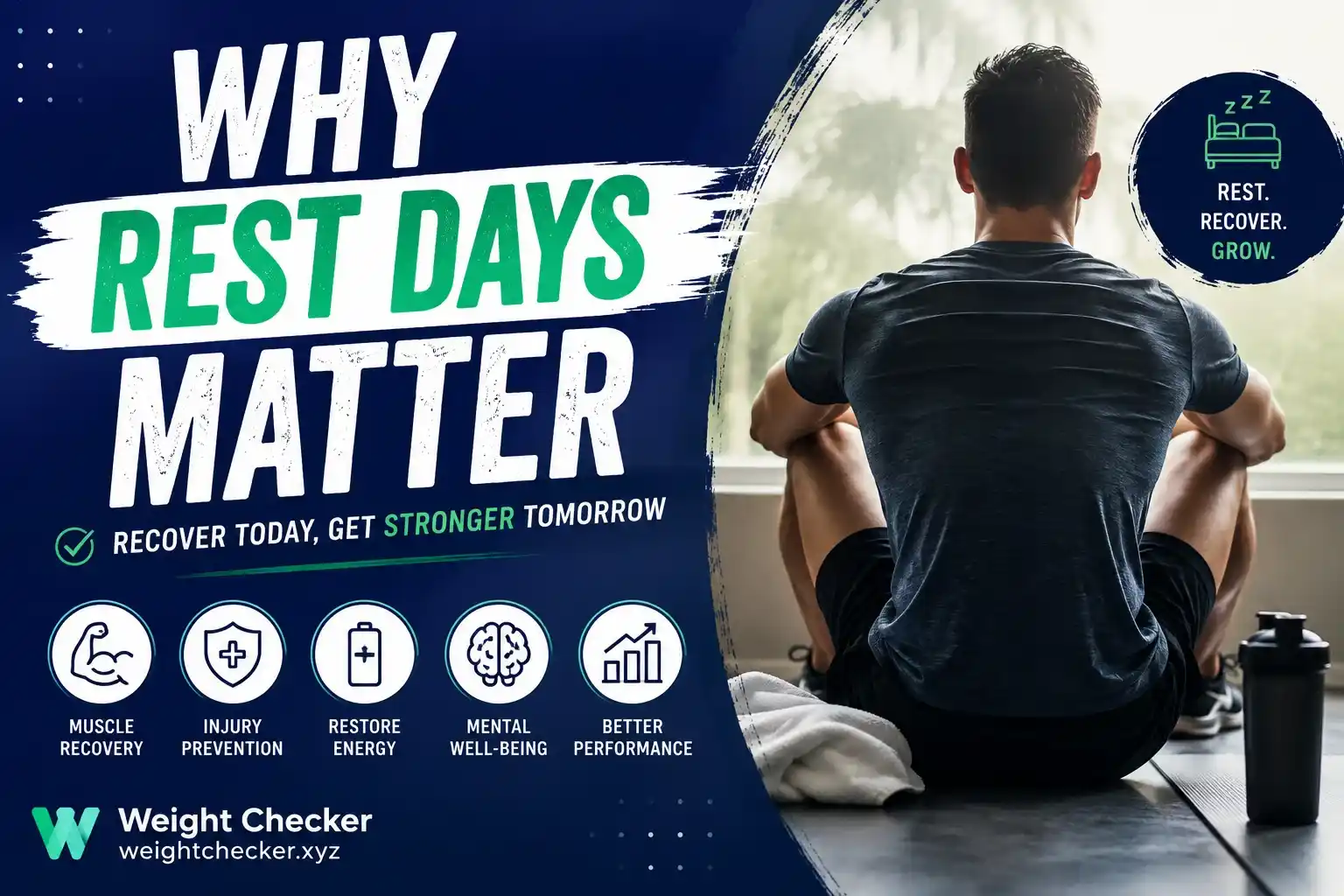
Rest days matter because your body needs time to recover and adapt after exercise. Training places stress on your muscles, connective tissues, nervous system, and energy stores. Recovery gives your body an opportunity to repair itself, restore energy, and prepare for your next workout.
In simple terms: you don’t build your best body only during workouts, you also build it while you recover.
Regular rest and recovery can help you:
- Repair and rebuild muscles
- Reduce excessive muscle soreness
- Restore energy levels
- Maintain workout performance
- Reduce the risk of overuse injuries
- Support long-term strength and muscle growth
- Improve motivation and workout consistency
For people who exercise regularly, rest isn’t a sign of laziness or weakness. It is an important part of a well-designed training program.
What Is a Rest Day?
A rest day is a planned period when you take a break from intense exercise to allow your body to recover.
A rest day does not necessarily mean staying in bed all day. Depending on your training status and how your body feels, it can involve either:
- Complete rest: No structured exercise.
- Active recovery: Very light movement such as walking, gentle stretching, yoga, or easy cycling.
The right choice depends on your workout intensity, fitness level, sleep, soreness, nutrition, and overall recovery.
If you’re sick, injured, severely fatigued, or experiencing significant pain, complete rest may be more appropriate than active recovery.

Why Is Recovery Important After Exercise?
Exercise is a form of physical stress. During challenging workouts especially resistance training your muscles and other tissues are placed under load. Your body then needs time to adapt to that stress.
Recovery is the process that allows your body to return toward its normal state and adapt to the training stimulus.
Research summarized by the American College of Sports Medicine shows that resistance training can improve strength, muscle size, power, endurance, and other aspects of physical function. However, training programs need to account for the individual’s goals, fitness level, and training status.
This is why an effective fitness routine isn’t simply about exercising as often as possible. It is about finding the right balance between training stress and recovery.
7 Major Benefits of Rest Days
1. Rest Days Support Muscle Recovery
One of the biggest reasons rest days matter is muscle recovery.
Strength training creates a training stimulus that your body must adapt to. When you repeatedly train the same muscles without allowing adequate recovery, fatigue can accumulate.
During recovery, your body works to repair and adapt to the stress from previous workouts.
This is especially important if your goal is to:
- Build muscle
- Increase strength
- Improve workout performance
- Progressively lift heavier weights
- Recover from demanding training sessions
Muscle recovery doesn’t mean you should avoid exercise altogether. It means your training schedule should give heavily worked muscle groups sufficient time to recover.
2. Rest Can Help Reduce Injury Risk
Training too hard for too long without adequate recovery can increase the risk of overuse problems and injuries.
When you’re fatigued, maintaining good exercise technique can become more difficult. Continuing to push through significant fatigue or pain may place additional stress on muscles, joints, and connective tissues.
Cleveland Clinic notes that excessive training without enough recovery can contribute to overtraining and recommends giving the body time to rest and recover after intense physical activity.
Rest days can therefore be an important part of injury-prevention strategy.
3. Rest Days Can Improve Your Workout Performance
It might seem logical that exercising every day would produce faster results.
However, more training isn’t automatically better.
If you consistently train while fatigued, you may notice:
- Lower strength
- Fewer repetitions
- Reduced endurance
- Poorer exercise technique
- Less motivation
- Heavier-feeling workouts
A properly scheduled recovery day can help you return to your next workout feeling more prepared.
The goal isn’t to maximize the number of workouts you complete. The goal is to maximize the quality and consistency of your training over time.
4. Rest Helps Restore Energy
Hard workouts use energy, and your body needs time and adequate nutrition to replenish its energy stores.
If you combine frequent intense exercise with inadequate food, carbohydrates, protein, fluids, or sleep, recovery can become more difficult.
This is why recovery should be considered alongside:
- Calories
- Protein
- Carbohydrates
- Hydration
- Sleep
- Training volume
- Training intensity
Your body needs both the stimulus to adapt and the resources to recover.
5. Rest Days Can Support Muscle Growth
If your goal is muscle growth, you might think that training a muscle every day will make it grow faster.
That’s not necessarily true.
Muscle growth requires an appropriate training stimulus combined with recovery and adequate nutrition.
During recovery, your body repairs and adapts to the stress created by training. Repeatedly stressing the same muscle before it has adequately recovered can interfere with training quality and may increase fatigue.
Therefore, rest is not the opposite of muscle growth, it is part of the process that supports it.
6. Rest Can Improve Mental Recovery
Exercise can be excellent for mental health, but training can also become mentally exhausting when every day feels like a performance test.
Taking planned recovery days can help you:
- Reduce training fatigue
- Refresh your motivation
- Avoid feeling burned out
- Enjoy exercise more
- Maintain a sustainable routine
Fitness should be something you can continue for months and years not something that leaves you exhausted after a few weeks.
7. Rest Helps You Stay Consistent
Consistency is one of the most important factors in long-term fitness.
If you train intensely every day and eventually become exhausted, injured, or burned out, you may be forced to stop exercising altogether.
A balanced program that includes recovery can make it easier to maintain your routine.
The best workout program is one you can recover from and consistently follow.
What Happens If You Don’t Take Rest Days?
Not taking enough recovery time can cause fatigue to accumulate.
Some possible signs that you’re not recovering well include:
- Persistent muscle soreness
- Unusual fatigue
- Declining workout performance
- Reduced motivation
- Poor sleep
- Irritability
- Feeling unusually weak during workouts
- Increased aches or pain
- Taking longer to recover between sessions
Overtraining syndrome is more serious than normal post workout fatigue. It can occur when someone exercises too frequently or intensely for long enough that performance and health are negatively affected.
If you have persistent pain, extreme fatigue, or a significant and unexplained drop in performance, consider speaking with a qualified healthcare professional.
How Many Rest Days Do You Need?
There is no single number of rest days that is perfect for everyone.
Your recovery needs depend on:
- Workout intensity
- Training frequency
- Exercise type
- Fitness level
- Age
- Sleep
- Nutrition
- Stress
- Previous injuries
- Your overall health
For example, a beginner who recently started strength training may need more recovery than an experienced athlete following a carefully structured program.
If you train the same muscle group heavily, allowing adequate recovery before training it intensely again is generally important.
A Simple Beginner Example
A beginner might use a schedule such as:
| Day | Workout |
| Monday | Full-body strength training |
| Tuesday | Active recovery |
| Wednesday | Full-body strength training |
| Thursday | Rest |
| Friday | Full-body strength training |
| Saturday | Light activity |
| Sunday | Rest |
This is only an example. Your ideal schedule should be adjusted according to your goals and recovery.
Rest Day vs. Active Recovery Day
Rest days and active recovery days are related, but they aren’t exactly the same.
Rest Day
A rest day involves taking a break from structured or intense exercise.
Examples include:
- Relaxing
- Normal daily activities
- Getting adequate sleep
- Light walking if desired
Active Recovery Day
An active recovery day involves gentle movement that is significantly easier than your normal training.
Examples include:
- Easy walking
- Gentle cycling
- Light swimming
- Mobility exercises
- Gentle stretching
- Easy yoga
Cleveland Clinic describes active recovery as low-intensity physical activity performed during periods when you would normally rest. It may help with soreness, circulation, mobility, stiffness, and recovery while keeping you lightly active.
However, active recovery should still be easy. If your “recovery workout” becomes another intense workout, you’re no longer giving your body much of a break.
What Should You Do on a Rest Day?
A good rest day should support recovery rather than create additional fatigue.
1. Prioritize Sleep
Sleep is one of the most important parts of recovery.
Aim for a consistent sleep schedule and give your body enough time to recover overnight.
Many adults need approximately 7–9 hours of sleep per night, although individual needs can vary.
2. Eat Enough Protein
Protein provides amino acids that your body uses to build and repair tissues.
Good protein sources include:
- Eggs
- Chicken
- Fish
- Lean meat
- Milk
- Yogurt
- Cottage cheese
- Beans
- Lentils
- Tofu
Your total daily protein intake matters more than trying to consume a huge amount at one specific time.
3. Stay Hydrated
Don’t stop drinking water just because you’re not training that day.
Your hydration needs depend on factors such as body size, climate, activity level, and how much you sweat.
A rest day is still part of your overall fitness routine, so maintaining normal hydration is important.
4. Eat a Balanced Diet
A recovery day isn’t a “junk food day.”
Continue eating a balanced diet containing appropriate amounts of:
- Protein
- Carbohydrates
- Healthy fats
- Fruits
- Vegetables
- Whole grains
- Fluids
If you’re tracking calories for weight loss or muscle gain, your overall calorie intake across your plan matters more than treating rest days as a reason to drastically change your diet.
5. Move Gently
If you feel good, light movement can be useful.
Try:
- A relaxed walk
- Gentle stretching
- Mobility exercises
- Easy cycling
- Light yoga
But remember: recovery should feel easy.
Should You Work Out When You’re Sore?
It depends on the severity of your soreness.
Mild muscle soreness after exercise can be normal, particularly after a new or challenging workout. This is often referred to as delayed onset muscle soreness (DOMS).
If the soreness is mild, you may be able to perform light activity or train a different muscle group.
However, if you have significant pain or your normal movement is affected, avoid strenuous exercise until you have recovered. Cleveland Clinic recommends not pushing through significant pain and notes that rest is often helpful for DOMS.
Simple Rule
Mild soreness: Consider light activity or train another muscle group.
Severe soreness or pain: Rest and recover.
Sharp, persistent, or unusual pain: Consider getting medical advice.
Do Rest Days Make You Lose Muscle?
No. A normal rest day does not make you lose muscle.
Taking a day or two away from intense training does not suddenly erase your progress.
In fact, recovery is an important component of a productive training program.
Muscle loss is generally associated with longer-term factors such as prolonged inactivity, inadequate nutrition, illness, or other physiological conditions not simply taking an occasional rest day.
If you’re worried that resting will slow your progress, remember:
One recovery day is far less important than your overall training consistency over weeks and months.
Can You Take a Rest Day While Trying to Lose Weight?
Yes. You can absolutely take rest days while trying to lose weight.
Weight loss primarily depends on maintaining an appropriate calorie deficit over time, while exercise can support energy expenditure, fitness, muscle retention, and overall health.
Rest days don’t automatically stop fat loss.
Your focus should remain on:
- Appropriate calorie intake
- Adequate protein
- Regular physical activity
- Strength training when appropriate
- Sleep
- Hydration
- Consistency
If you use a calorie or TDEE calculator, remember that your estimated energy needs can vary between individuals and should be treated as a starting point rather than a perfect measurement.
Do You Need Rest Days for Cardio?
Rest is also relevant to cardio training.
Low-intensity activities such as walking may be performed frequently by many healthy people, while high-intensity running, cycling, HIIT, or sports sessions can require more recovery.
The harder and longer the workout, the more important recovery becomes.
For example, doing an easy walk on a recovery day is very different from completing another high-intensity interval training session.
What Is a Deload Week?
A deload week is a planned period where you temporarily reduce your normal training volume or intensity.
Unlike a complete rest week, you may continue exercising during a deload but at a lower workload.
For example, you could:
- Reduce the weight you’re lifting
- Perform fewer sets
- Reduce repetitions
- Reduce workout duration
- Train fewer days
- Use easier forms of exercise
Cleveland Clinic notes that deloading can help address accumulated fatigue and may be useful for people training at high intensity.
A deload is particularly relevant for people who train consistently at high volumes or intensities. Beginners may simply need appropriately scheduled rest days rather than a formal deload strategy.
Rest Days for Muscle Gain vs. Weight Loss
Rest days are useful regardless of your fitness goal, but your overall strategy can differ.
If Your Goal Is Muscle Gain
Prioritize:
- Progressive resistance training
- Adequate protein
- Sufficient calories
- Quality sleep
- Recovery between demanding sessions
- Consistent training
If Your Goal Is Weight Loss
Prioritize:
- Sustainable calorie deficit
- Adequate protein
- Strength training
- Regular movement
- Cardiovascular exercise
- Recovery and sleep
In both cases, recovery helps you maintain the consistency needed to reach your goal.
7 Signs You May Need an Extra Rest Day
Sometimes your planned schedule doesn’t match what your body needs.
Consider taking additional recovery time if you experience:
- Persistent muscle soreness
- Unusual fatigue
- A noticeable drop in strength
- Poor workout performance
- Poor sleep
- Lack of motivation to exercise
- Pain that is getting worse rather than better
Your workout schedule is a framework not a rule that you must follow regardless of how you feel.
Listening to your body can help you adjust training before minor fatigue becomes a bigger problem.
Common Rest Day Mistakes
Mistake 1: Turning Every Rest Day Into a Hard Workout
If you’re supposed to recover but complete a difficult HIIT workout, heavy lifting session, or long run, you may not actually be recovering.
Mistake 2: Eating Excessively Because It’s a Rest Day
A rest day doesn’t mean you need to abandon your nutrition plan.
Continue following an appropriate diet for your goals.
Mistake 3: Ignoring Pain
Soreness and pain aren’t always the same thing.
Don’t automatically assume that severe or persistent pain is a normal part of fitness.
Mistake 4: Sleeping Too Little
You can have a perfectly designed training program and still struggle to recover if you consistently neglect sleep.
Mistake 5: Feeling Guilty About Rest
Rest is part of training.
You don’t need to “earn” a recovery day.
How to Build Rest Days Into Your Workout Routine
A simple approach is to alternate demanding workouts with easier days.
For example:
Monday: Strength training
Tuesday: Light cardio or active recovery
Wednesday: Strength training
Thursday: Rest
Friday: Strength training
Saturday: Light cardio or recreational activity
Sunday: Rest
If you’re a beginner, start conservatively and increase training gradually.
If you’re an advanced athlete, your schedule may look completely different because training volume, intensity, sport-specific demands, and recovery capacity are different.
The Bottom Line: Why Rest Days Matter
Rest days matter because recovery allows your body to adapt to exercise.
Training provides the stimulus. Nutrition provides the building blocks and energy. Sleep and recovery provide the opportunity for your body to repair and adapt.
A successful fitness routine therefore isn’t:
Workout → Workout → Workout → Workout
It’s closer to:
Train → Recover → Adapt → Train again
Whether your goal is losing weight, building muscle, increasing strength, improving endurance, or simply becoming healthier, recovery should be part of your plan.
Don’t measure your progress by how many days you can exercise without stopping. Measure it by how consistently you can train, recover, and improve over time.
Final Takeaway
Rest days matter because your body needs recovery to turn training into progress.
If you want better workouts, stronger muscles, sustainable weight management, and long-term fitness, don’t focus only on how hard you can train.
Focus on the complete equation:
Exercise + Nutrition + Sleep + Recovery = Sustainable Progress
For more practical information about calories, nutrition, body composition, and fitness, explore the guides and tools available on Weight Checker at weightchecker.xyz.
This article is for educational purposes and isn’t a substitute for individualized medical or fitness advice. If you have an injury, persistent pain, unusual fatigue, or a medical condition, consult an appropriately qualified healthcare professional before changing your exercise routine.
Frequently Asked Questions About Rest Days
1. Why are rest days important?
Rest days are important because they give your body time to recover from exercise-related stress. They can support muscle repair, restore energy, reduce accumulated fatigue, and help you maintain workout performance.
How many rest days should I take per week?
There is no universal number. Many beginners can benefit from several recovery periods throughout the week, while advanced athletes may use more structured training and recovery schedules. Your workout intensity, volume, fitness level, sleep, nutrition, and goals all matter.
Can I work out every day?
You can be physically active every day, but that doesn’t mean every day should involve intense exercise. Alternating hard workouts with easier activity or rest can help provide the recovery your body needs.
Do rest days help build muscle?
Yes. Rest and recovery are important parts of the muscle-building process because your body needs time to repair and adapt after resistance training.
Should I eat less on rest days?
Not necessarily. Your calorie needs may be somewhat different depending on your activity level, but you shouldn’t automatically drastically reduce your food intake. Maintain adequate protein and a balanced diet that supports your overall goal.
What should I do on a rest day?
You can rest completely or perform gentle activities such as walking, stretching, mobility work, or easy cycling. The activity should be low intensity and shouldn’t leave you feeling more fatigued.
Is it okay to take a rest day when I’m sore?
Yes. If you’re significantly sore or your movement is affected, taking a rest day can be appropriate. Mild soreness may allow light activity, but significant pain should not be ignored.
Can rest days help prevent overtraining?
Adequate recovery can help reduce excessive training fatigue and is an important part of preventing overtraining. Persistent symptoms such as severe fatigue, declining performance, or ongoing pain may require professional evaluation.
Will I lose muscle if I take two rest days?
No. Taking two normal rest days does not suddenly cause muscle loss. Recovery days can actually help you return to training better recovered and able to perform effectively.
What is the difference between rest and active recovery?
A rest day involves taking a break from structured exercise, while active recovery uses very light physical activity such as walking, gentle cycling, stretching, or yoga.