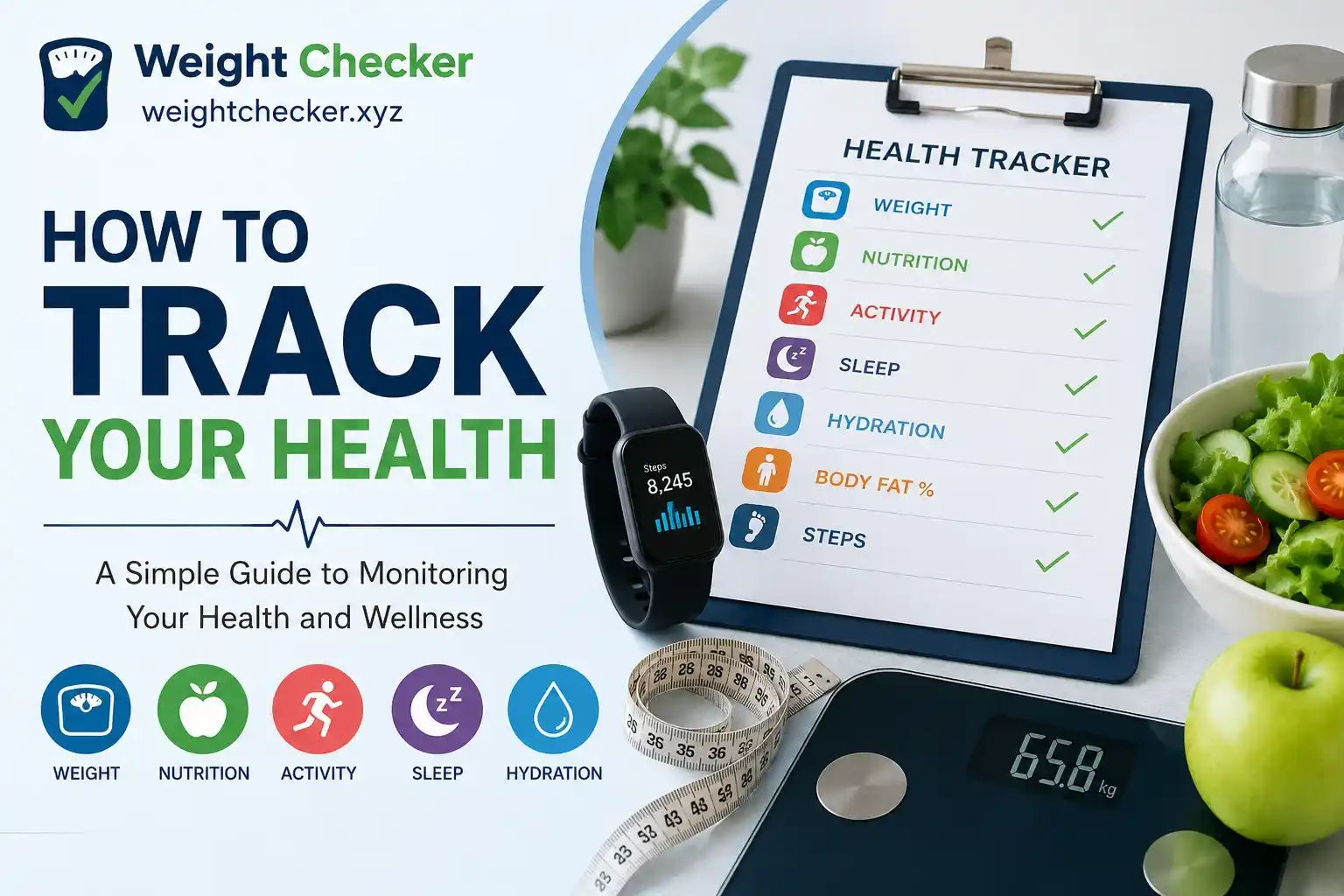
Tracking your health means regularly monitoring important areas of your physical and mental well-being, such as body weight, nutrition, physical activity, sleep, hydration, body composition, and other health measurements. Keeping track of these factors can help you understand your habits, identify trends, measure progress, and make informed lifestyle changes.
You do not need to track every health metric every day. A simple system that focuses on the measurements most relevant to your goals can be more useful and sustainable.
At Weight Checker, we make health tracking easier with free calculators for BMI, BMR, TDEE, calories, body fat, protein, macros, water intake, weight loss, waist-to-height ratio, and lean body mass.
What Is Health Tracking?
Health tracking is the process of recording and reviewing information about your health and lifestyle over time.
Depending on your goals, you might track:
- Body weight
- BMI
- Waist circumference
- Body fat percentage
- Daily calorie intake
- Protein intake
- Macronutrients
- Water intake
- Physical activity
- Daily steps
- Strength-training sessions
- Cardio
- Sleep duration and quality
- Energy levels
- Stress
- Rest and recovery
The purpose is not to become obsessed with numbers. Instead, health tracking helps you recognize patterns and make better decisions.
For example, if your goal is weight loss, tracking your weight, food intake, physical activity, sleep, and calorie needs can give you a better picture of your progress than looking at the scale alone.
Why Is Tracking Your Health Important?
Tracking your health can help you understand how your daily habits affect your overall well being.
The CDC recommends tracking areas such as nutrition, physical activity, sleep, and stress when working toward healthier habits and weight management.
Benefits of tracking your health include:
- Measuring progress: See whether you are moving toward your goals.
- Identifying patterns: Discover how food, exercise, sleep, or stress affect you.
- Improving accountability: Written records can make your habits more visible.
- Setting realistic goals: Measurements can help you establish achievable targets.
- Making informed decisions: Data can help you adjust your nutrition and activity habits.
- Maintaining healthy weight: Regular monitoring can help you notice changes over time.
- Building consistency: Tracking can encourage you to stick with healthy habits.
Remember that health is more than a number on a scale. A useful health-tracking routine should consider multiple aspects of wellness.
What Health Metrics Should You Track?
The best health metrics to track depend on your personal goals, age, lifestyle, and health needs.
For many adults, the following measurements provide a useful starting point.
1. Track Your Body Weight
Body weight is one of the easiest health measurements to monitor.
If your goal is weight loss or weight maintenance, you can weigh yourself regularly under similar conditions, such as:
- In the morning
- After using the bathroom
- Before eating
- Wearing similar clothing
- Using the same scale
Do not worry about small day-to-day changes. Body weight can naturally fluctuate because of hydration, food intake, sodium, exercise, and other factors.
Instead of focusing on one measurement, look at the long term trend.
For weight-loss goals, combining weight tracking with measurements such as waist circumference, activity, nutrition, and body composition can provide a more complete picture.
2. Track Your BMI
BMI, or Body Mass Index, is a screening measurement based on your weight relative to your height.
BMI can be useful for identifying broad weight categories in adults, but it does not directly measure body fat or distinguish between muscle and fat.
You can use the free BMI Calculator from Weight Checker to calculate your BMI quickly.
Weight Checker BMI Calculator
Because BMI is only one screening tool, it should not be treated as a complete measure of individual health. Factors such as muscle mass, age, body composition, and overall health also matter.
3. Track Your Waist Circumference
Waist circumference can provide additional information about body fat distribution.
To track it consistently:
- Stand upright and relax your abdomen.
- Place a measuring tape around your waist.
- Keep the tape level and comfortably snug.
- Take the measurement without pulling the tape tightly.
- Record the result.
Measuring your waist periodically can be particularly useful if your goal is to monitor changes in body composition.
You can also use the Waist-to-Height Ratio Calculator available through Weight Checker.
4. Track Your Body Fat Percentage
Body fat percentage estimates how much of your total body weight consists of fat.
Tracking body fat may be useful when your goal is:
- Fat loss
- Muscle gain
- Body recomposition
- Fitness improvement
- Monitoring changes in body composition
Keep in mind that home body-fat measurements can vary depending on the method and conditions. For better trend tracking, use the same method consistently.
You can estimate your body fat percentage using the Weight Checker Body Fat Calculator.
5. Track Your Daily Calories
Calories provide energy from food and beverages.
If you are trying to manage your weight, understanding your calorie intake can be useful.
Start by recording:
- Breakfast
- Lunch
- Dinner
- Snacks
- Drinks
- Sauces and condiments
- Other foods and beverages
You do not necessarily need to count calories forever. Some people use calorie tracking temporarily to understand portions and eating patterns.
Your calorie needs depend on factors such as age, sex, height, weight, and physical activity level.
Weight Checker provides a Calorie Calculator to help estimate daily calorie needs.
Weight Checker Calorie Calculator
6. Track Your Protein Intake
Protein is an important nutrient involved in muscle maintenance, growth, and many other functions in the body.
If you exercise regularly, strength train, or have a specific nutrition goal, monitoring protein intake may be useful.
Protein rich foods include:
- Eggs
- Chicken
- Fish
- Lean meat
- Greek yogurt
- Milk
- Beans
- Lentils
- Tofu
- Cottage cheese
Your ideal protein intake can vary depending on your body size, activity level, age, and goals.
Use the Weight Checker Protein Calculator to estimate your daily protein needs.
Weight Checker Protein Calculator
7. Track Your Macronutrients
Macronutrients are the nutrients your body needs in larger amounts:
- Protein
- Carbohydrates
- Fat
Tracking macros can help people who want a more detailed approach to nutrition.
For example, someone who is trying to build muscle may pay particular attention to protein, while someone managing their calorie intake may focus on both total calories and macronutrient balance.
Weight Checker also provides a Macro Calculator to help estimate your macronutrient needs.
8. Track Your Water Intake
Hydration is another important part of health tracking.
Your fluid needs can vary depending on factors such as:
- Activity level
- Weather
- Body size
- Diet
- Sweating
- Exercise
- Individual circumstances
Instead of trying to follow one universal number, consider your personal needs and circumstances.
You can use the Weight Checker Water Intake Calculator for an estimate of your daily water needs.
9. Track Physical Activity
Physical activity is one of the most important health behaviors to monitor.
You can track:
- Daily steps
- Walking
- Running
- Cycling
- Swimming
- Cardio workouts
- Strength training
- Workout duration
- Exercise frequency
For general health, CDC guidance recommends adults get at least 150 minutes of moderate intensity aerobic activity each week, or 75 minutes of vigorous activity, along with muscle strengthening activities on at least two days per week.
You do not have to achieve everything immediately. Start with an amount you can maintain consistently and gradually build your activity level.
10. Track Your Sleep
Sleep is an important part of overall health and recovery.
Track:
- Bedtime
- Wake up time
- Total sleep duration
- Sleep consistency
- How rested you feel
- Nighttime awakenings
A sleep tracker can help you identify patterns, but wearable device sleep data should not be treated as a medical diagnosis.
If you consistently have difficulty sleeping or experience significant daytime sleepiness, consider discussing the issue with a qualified healthcare professional.
11. Track Stress and Mental Well Being
Health tracking should not focus only on physical measurements.
You can also monitor:
- Stress levels
- Mood
- Energy
- Motivation
- Work-life balance
- Time spent relaxing
- Social connection
A simple daily rating from 1 to 10 can help you notice patterns.
For example, you might discover that your energy is consistently lower after several nights of poor sleep or during particularly stressful periods.
How to Track Your Health Step by Step
You can create a simple health tracking system without using complicated technology.
Step 1: Choose Your Main Goal
First, decide what you want to improve.
Your goal might be:
- Lose body fat
- Maintain weight
- Gain muscle
- Improve fitness
- Eat more balanced meals
- Increase physical activity
- Improve hydration
- Improve sleep
- Build healthier habits
Your goal determines which measurements matter most.
Step 2: Establish Your Starting Point
Record your current measurements.
Depending on your goal, this might include:
- Weight
- Height
- BMI
- Waist circumference
- Body fat estimate
- Daily calorie intake
- Protein intake
- Activity level
- Sleep duration
This gives you a baseline against which you can compare future results.
Step 3: Pick a Few Metrics
Do not try to measure everything.
Choose approximately 3–6 metrics that directly relate to your goal.
For example:
Weight loss goal:
- Weight
- Waist circumference
- Calories
- Physical activity
- Sleep
Muscle building goal:
- Body weight
- Protein intake
- Strength training sessions
- Workout performance
- Sleep
General wellness goal:
- Physical activity
- Sleep
- Water intake
- Weight
- Mood or stress
Step 4: Record Your Data Consistently
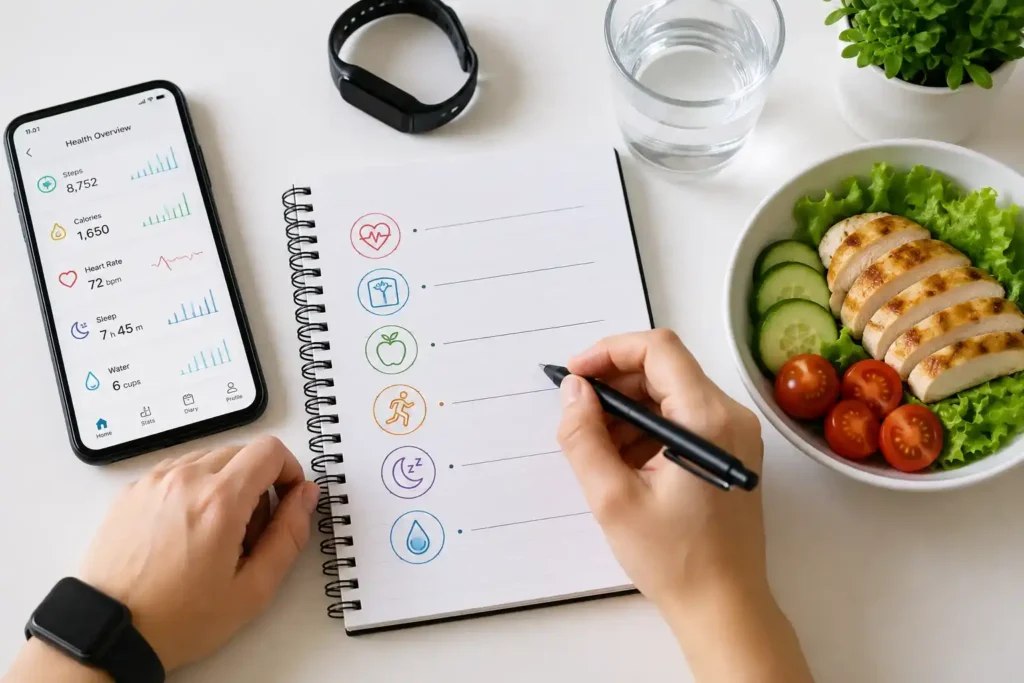
Use whichever method you are most likely to maintain:
- Smartphone notes
- Spreadsheet
- Fitness app
- Health app
- Paper journal
- Wearable device
Consistency is more important than using the most advanced technology.
Step 5: Review Trends Instead of Single Numbers
One day rarely tells the whole story.
Look for patterns over several weeks.
For example:
“My weight increased slightly this week.”
is less informative than:
“My average weight has increased gradually for six weeks.”
The second observation may indicate a longer-term trend worth addressing.
Step 6: Adjust Your Habits
Use your information to make practical changes.
For example:
- If your activity is low, add more walking.
- If your protein intake is consistently low, add protein-rich foods.
- If you regularly sleep too little, create a consistent bedtime routine.
- If your calorie intake is higher than intended, review portion sizes.
- If your weight is changing unexpectedly, consider other factors and seek professional advice when appropriate.
How Often Should You Track Your Health?
There is no single schedule that works for everyone.
A practical approach is:
| Health Metric | Suggested Tracking Frequency |
| Body weight | Several times per week or weekly |
| Waist circumference | Every few weeks or monthly |
| BMI | Occasionally |
| Body fat | Every few weeks or monthly |
| Calories | Daily when actively monitoring intake |
| Protein | Daily when it is a specific goal |
| Water intake | Daily |
| Physical activity | Daily or per workout |
| Steps | Daily |
| Sleep | Daily |
| Stress/mood | Daily or several times per week |
The most important factor is consistency.
For example, if checking your weight every day causes unnecessary stress, weekly measurements may be more appropriate.
Should You Use a Health App or Fitness Tracker?
Health apps and wearable fitness trackers can make tracking easier.
They may help you monitor:
- Steps
- Heart rate
- Exercise
- Sleep
- Calories
- Weight
- Workout duration
- Activity trends
However, technology is a tool not a replacement for professional medical care.
Wearable devices can also produce estimates rather than exact measurements. Use them primarily to identify trends and support healthy habits.
How Weight Checker Can Help You Track Your Health
Weight Checker is designed to make health and weight related calculations easier.
The website currently provides calculators covering several areas of health and wellness, including BMI, BMR, TDEE, calories, ideal weight, body fat, protein, macros, water intake, weight loss, weight gain, calories burned, waist-to-height ratio, and lean body mass.
These tools can help you establish a baseline and better understand different aspects of your health and fitness goals.
You can explore the complete collection of Weight Checker Health Calculators here:
Weight Checker Health Calculators
For example, you can use:
- BMI Calculator — estimate BMI from height and weight.
- BMR Calculator — estimate calories your body burns at rest.
- TDEE Calculator — estimate daily energy expenditure.
- Calorie Calculator — estimate daily calorie requirements.
- Body Fat Calculator — estimate body-fat percentage.
- Protein Calculator — estimate daily protein needs.
- Macro Calculator — estimate protein, carbohydrates, and fat targets.
- Water Intake Calculator — estimate daily water needs.
- Weight Loss Calculator — estimate calorie needs for weight loss.
- Lean Body Mass Calculator — estimate lean body mass.
- Waist-to-Height Ratio Calculator — assess waist-to-height measurements.
Common Mistakes When Tracking Health
Health tracking can be helpful, but some mistakes can make it less useful.
1. Tracking Too Many Things
You do not need to record dozens of metrics every day.
Focus on the measurements connected to your goals.
2. Obsessing Over Daily Changes
Weight, hydration, energy, and other measurements naturally fluctuate.
Focus on trends rather than isolated readings.
3. Using One Number to Define Your Health
A healthy lifestyle cannot be reduced to BMI, weight, calories, or any other single measurement.
Consider several factors together.
4. Ignoring Lifestyle Habits
Numbers are useful, but habits matter too.
Pay attention to:
- Nutrition quality
- Physical activity
- Sleep
- Stress
- Recovery
- Hydration
- Consistency
Healthy weight management generally involves healthy eating, physical activity, adequate sleep, and stress management.
5. Making Extreme Changes
If your data shows that something needs improvement, avoid making drastic changes without a good reason.
Small, sustainable adjustments are often easier to maintain.
A Simple Weekly Health Tracking Routine
If you want a straightforward system, try this:
Every day
- Record your physical activity.
- Monitor your water intake.
- Track food if it supports your goal.
- Record sleep duration.
- Check how you feel physically and mentally.
Several times per week
- Check your body weight if appropriate for you.
- Review your calorie and protein intake if you are actively monitoring nutrition.
Every few weeks
- Measure your waist.
- Review your progress.
- Look for patterns in your activity, nutrition, sleep, and weight.
Every month
Ask yourself:
- What has improved?
- What did not improve?
- What habits were easiest to maintain?
- What caused setbacks?
- What should I change next month?
This approach turns health tracking into a tool for learning rather than simply collecting numbers.
What Is the Best Way to Track Your Health?
The best way to track your health is to monitor a small number of meaningful measurements consistently and review their trends over time.
For most people, a practical starting point is to track:
- Body weight
- Waist measurement
- Physical activity
- Nutrition
- Sleep
- Hydration
- A goal specific measurement such as protein intake or body fat
The exact combination should depend on your personal goals and circumstances.
Final Thoughts
Learning how to track your health does not have to be complicated. Start with a few measurements that match your goals, record them consistently, and focus on trends instead of individual numbers.
For many people, a useful health tracking system includes weight, waist measurement, nutrition, physical activity, sleep, hydration, and body composition.
The goal is not to chase perfect numbers. The goal is to understand your habits, measure meaningful progress, and make sustainable improvements.
Weight Checker can help you get started with free health calculators for BMI, BMR, TDEE, calories, body fat, protein, macros, water intake, weight loss, and other health measurements.
Explore Weight Checker Health Calculators
Medical Disclaimer: The information in this article is provided for general educational purposes only. Health calculators provide estimates and should not be considered medical advice, diagnosis, or treatment. If you have a medical concern or need individualized health guidance, consult a qualified healthcare professional.
Frequently Asked Questions About Tracking Your Health
What should I track to monitor my health?
You can track body weight, BMI, waist circumference, body fat, nutrition, calories, protein, water intake, physical activity, steps, sleep, stress, and other measurements relevant to your goals.
How often should I check my weight?
Many people can monitor their weight several times per week or once weekly. The best frequency is the one you can use consistently without becoming overly focused on daily fluctuations.
Is BMI enough to measure my health?
No. BMI is a screening measurement, not a complete assessment of health. It should be considered alongside factors such as waist circumference, body composition, lifestyle, and overall health.
What is the most important health metric?
There is no single health metric that is most important for everyone. Your most useful measurements depend on your goal. For weight management, weight, waist circumference, nutrition, physical activity, sleep, and other relevant factors can be useful together.
Can I track my health without a smartwatch?
Yes. You can track many health behaviors with a notebook, spreadsheet, smartphone, or simple health journal. A smartwatch is optional.
How can I track my health for weight loss?
For weight loss, consider tracking body weight, waist circumference, food intake, calorie intake, physical activity, sleep, and other relevant lifestyle habits. Monitoring your progress can help you identify patterns and make adjustments.
Should I track calories every day?
Not necessarily. Daily calorie tracking can be useful for learning about your eating habits or working toward a specific nutrition goal, but some people prefer simpler approaches such as portion awareness and balanced meals.
How do I track my fitness progress?
Track measurable factors such as workout frequency, exercise duration, steps, running distance, repetitions, resistance used, or other performance indicators. Improvements in strength, endurance, and daily function can be useful signs of progress.
How do I track my health at home?
You can track your health at home using a scale, measuring tape, food journal, activity tracker, sleep tracker, and health calculators. However, some health measurements require professional equipment or medical evaluation.
When should I talk to a doctor about my health measurements?
Speak with a qualified healthcare professional if you have concerning symptoms, unusually high or low measurements, unexplained changes in weight or health, or questions about a medical condition. Health calculators provide estimates or screening information and should not replace professional medical diagnosis or treatment.