When I first started helping people understand their health numbers, I noticed that many focused only on the number on the scale.
Over time, I learned that Body Mass Index, often called BMI, is a much better starting point because it compares height with weight. It is not a perfect answer, but it gives a useful picture before looking deeper.
The body mass index is a commonly used, straightforward tool that works as both a measuring tool and a screening tool.
Doctors, fitness professionals, and researchers use it to categorise, categorize, classify, and support the classification of people into different weight categories. While it cannot tell everything about a person’s body, it is one of the fastest ways to begin a basic assessment of overall health.
For every woman, the goal is not to chase the lowest number but to stay within a healthy weight and a healthy BMI that supports long-term wellness.
The same system is also used for women and men, although factors like gender, muscle mass, age, and ethnicity can influence how accurately the result reflects actual body fat.
How the BMI calculation Works
The BMI calculation is based on a simple mathematical calculation. It can be calculated manually or by using a BMI calculator or online calculator.
The standard BMI formula is:
BMI = body weight (kg) ÷ height (m)²
In simple terms, you:
- Measure your body weight in kilograms (kg).
- Measure your height in metres (m).
- Find the square of your height.
- Divide your weight by that squared value.
If you normally use feet and inches or centimetres and pounds, most calculators automatically convert those values before completing the calculation.
To use an online calculator, simply enter your height measurements and weight amounts. Within seconds, you can find out your healthy BMI rating and your associated weight category.
Understanding weight category Ratings
Once your BMI has been calculated, it falls into a specific weight category based on internationally accepted guidelines and parameters.
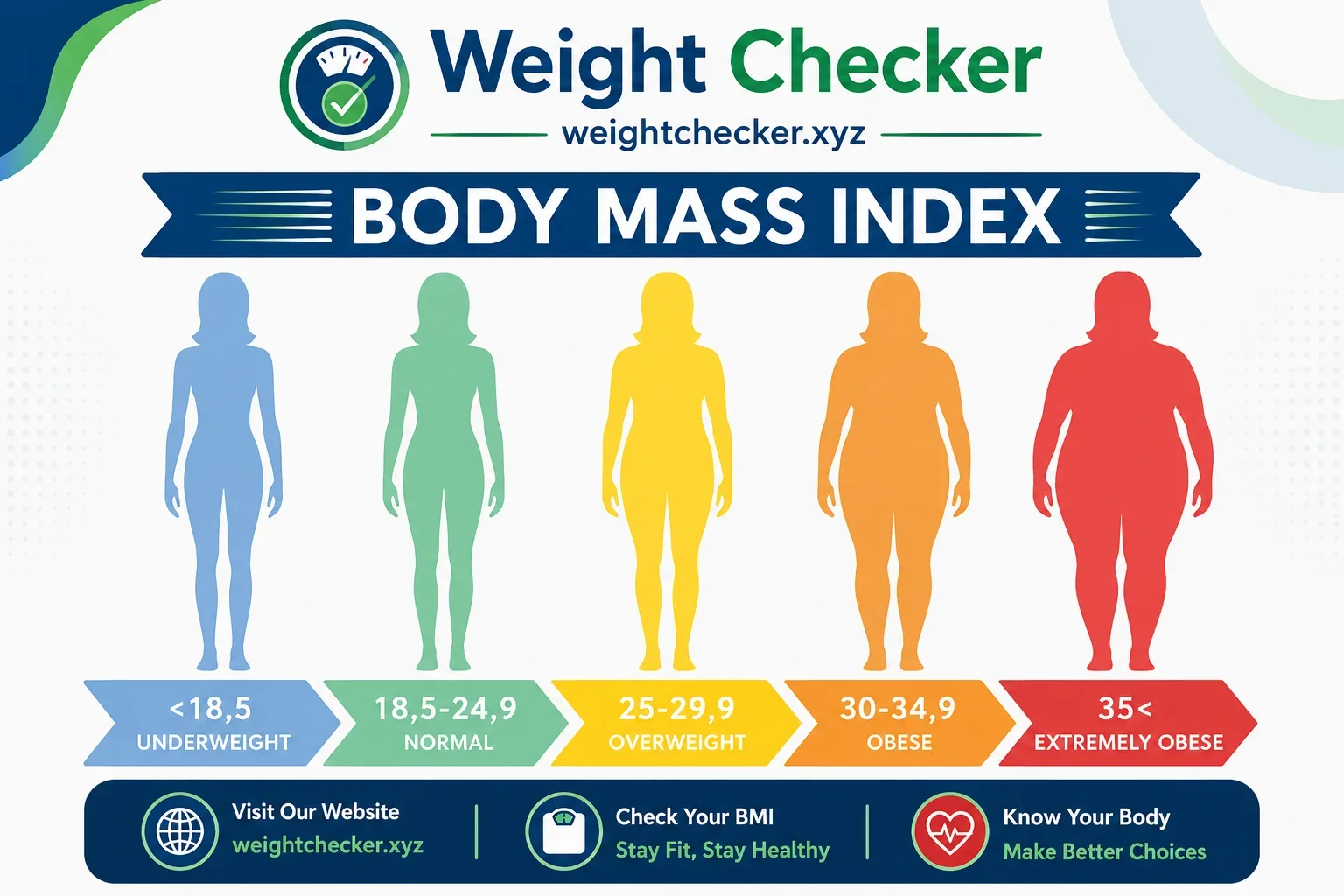
The common ranges include:
- Below 18.5 – underweight
- 18.5 to 24.9 – normal weight
- 25.0 to 29.9 – overweight
- 30.0 and above – obese
These measurements provide a rating that helps identify whether someone is within the healthy weight range. Many professionals refer to 18.5 to 24.9 as the ideal BMI, while others describe it as the ideal average BMI because it is linked with lower health risks for many adults.
Using a BMI chart, BMI graphs, and tables
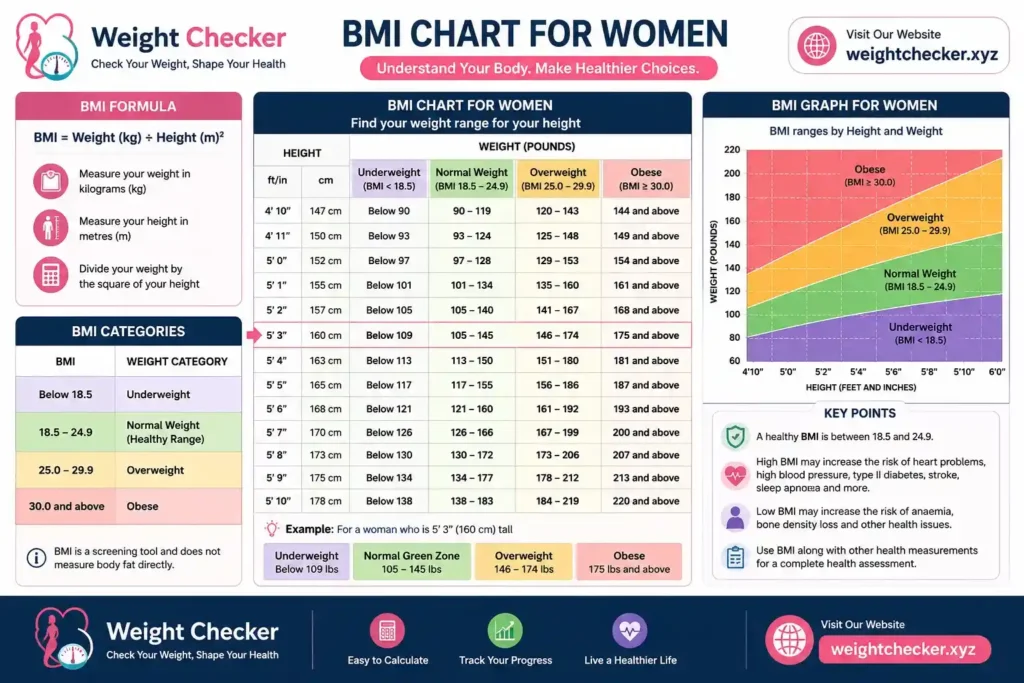
Many people understand numbers better when they can see them visually. That’s where a BMI chart, BMI graphs, graphs, tables, and charts become useful.
A typical chart includes a height column and a horizontal axis showing weight, while the vertical axis represents height. The normal green zone highlights the recommended range.
For example, the average UK height for women is around 5 foot 3 inches. On many charts, a woman of this height may see examples such as 105 pounds, 140 pounds, 145 pounds, and 165 pounds to understand where different BMI ranges begin and end.
These visual guides make it easier to identify a suitable weight range without performing the math yourself.
What BMI Can and Cannot predict
One mistake people often make is believing that BMI directly measures body fat. It does not.
Instead, it is designed to predict the likelihood of certain health outcomes at a population level rather than for every individual. This means it works well across a large population, but it becomes less accurate when looking at one person.
A high BMI is linked with an increased risk of several conditions, including:
- high blood pressure
- type II diabetes
- coronary heart disease
- stroke
- sleep apnoea
- heart problems
On the other hand, a low BMI may also affect health by increasing the chance of:
- bone density loss
- anaemia
This is why healthcare providers use BMI as a screening tool instead of a final diagnosis. It helps with prediction and deciding whether additional tests are needed.
Why body fat levels Matter More Than BMI Alone
From my experience, I have seen athletic women receive surprisingly high BMI scores because they have more muscle mass, not excess fat. I have also seen women with a normal BMI carry higher body fat levels than expected.
BMI cannot measure body fat distribution, and that is one of its biggest limitations.
Fat stored around the abdomen often creates a greater risk than fat stored elsewhere, yet BMI treats both situations the same. Likewise, people with higher muscle mass may appear overweight even though they are in excellent physical condition.
This explains why healthcare professionals often combine BMI with waist measurements, lifestyle information, and other tests before making decisions.
Factors That Influence BMI in Women
Several personal factors influence how BMI should be interpreted.
Age plays an important role because older women often have lower muscle mass, making BMI slightly underestimating actual body fat levels. Meanwhile, younger women may have different body compositions that affect their readings.
Pregnancy is another important situation where BMI should be interpreted carefully because natural weight gain supports a growing baby rather than indicating excess body fat.
Differences in ethnicity also matter because certain ethnic groups may experience health risks at different BMI values. This is one reason why healthcare professionals look beyond BMI before making recommendations.
The Role of the World Health Organization and WHO Standards
The World Health Organization, commonly known as the WHO, established internationally recognised BMI guidelines that are now used in many countries.
These standards make it easier for healthcare providers to compare BMI data, monitor trends across the population, and improve public health planning.
Although individual circumstances vary, using one consistent system allows researchers to better assess obesity trends and understand changes in national health over time.
Using BMI to maintain or achieve Better Health
BMI is best viewed as a starting point rather than a final answer. Whether your goal is to maintain your current fitness or achieve a healthier lifestyle, BMI can help track progress over time.
Regularly checking your BMI alongside healthy eating habits, physical activity, medical advice, and other health assessment methods provides a more complete picture of your wellbeing.
Rather than focusing only on a single number, combine BMI with lifestyle choices and professional guidance to support lasting health.
Frequently Asked Questions
Is BMI the same for males and females?
Yes. The BMI for adult men and women is calculated using the same BMI formula. You simply divide your body weight by the square of your height. Both sexes are placed into the same weight categories, including underweight, normal weight, overweight, and obese. However, BMI is only a screening tool and does not directly measure body fat.
Does BMI change based on gender?
No. The Body Mass Index formula does not change based on gender. Whether you are a woman or a man, the BMI calculation remains the same. However, women generally have higher body fat levels and lower muscle mass than men with the same BMI. Because of this, BMI may not always accurately reflect an individual’s body composition and should be used alongside other health assessment methods.
What is a healthy BMI for women?
A healthy BMI for women falls between 18.5 and 24.9. This range is considered a healthy weight range and is associated with a lower risk of many health problems. A BMI below 18.5 is classified as underweight, while a BMI of 25.0 or higher indicates overweight, and 30.0 or above is classified as obese.
Maintaining a healthy weight can help reduce the risk of conditions such as high blood pressure, type II diabetes, and coronary heart disease.