
For men, knowing your BMI or Body Mass Index is one of the easiest ways to check your health and wellness. As a non-gender-specific and gender-neutral screening tool, it is designed for both adults, including adult men and adult women, as well as women and every male or man who wants a quick assessment of body weight.
In my experience reviewing health resources, many people assume BMI is only about weight, but it actually compares your height and body weight to help calculate your weight status, body size, and overall body measurement in a simple, practical way.
Whether you are calculating your BMI for the first time or monitoring changes over time, the result helps identify your weight category, such as underweight, normal weight, healthy weight, overweight, or obese, and shows whether you fall within the recommended healthy weight range.
While BMI is not a complete diagnosis, it offers a reliable starting point for understanding your current physical condition and deciding if further health advice or lifestyle changes may be worthwhile.
What Can Your BMI Really Tell You?
A BMI or Body Mass Index gives an estimate of whether your body weight matches a healthy body weight and healthy weight for your height. It also provides a body fat estimate by looking at the proportion of total body fat to overall body weight, helping with assessment, evaluation, and the ability to assess your risk of developing weight-related diseases.
From my experience reading clinical guidance, BMI works best as a first step because it highlights possible health risk, disease risk, and serious health risks, including heart problems, heart disease, cardiovascular disease, diabetes, loss of bone density, and other health conditions that can be linked to excess or very low body fat.
It can also indicate whether an adult may be overweight, obese, or affected by obesity, making it a practical tool for many people and different groups of people.
At the same time, it is important to understand the BMI limitations. BMI calculations cannot distinguish between fat and muscle, so their accuracy may be less accurate for body builders, weight lifters, high-performance athletes, and other athletes, where BMI can overestimate body fat.
On the other hand, it may underestimate body fat in the elderly, older adults, or someone with a physical disability and muscle loss. For this reason, many health professionals also measure waist circumference to evaluate overall health more accurately before making decisions about a person’s health status.
How to Calculate BMI for Men
Calculate BMI Using the Standard BMI Formula
The most reliable way to calculate BMI is by using the internationally accepted BMI formula. The BMI formula for men is exactly the same as the BMI formula for women, making it suitable for both men and women.
From my experience working with health content, understanding the calculation helps readers interpret their results with greater confidence instead of simply relying on a number.
- Use the standard formula: Weight (kg) / Height (m)² = BMI.
- Divide Weight (kg) by the square of height, also called height squared.
- Measure height in Height (m) using metres or meters.
- Record weight in kilogram or kg.
- The equation works with the metric system, metric units, and can also be adapted for imperial units.
- Every BMI calculation provides a standardized BMI measurement based on the relation between your weight and relation to height.
Use a BMI Calculator or BMI Chart for Quick Assessment
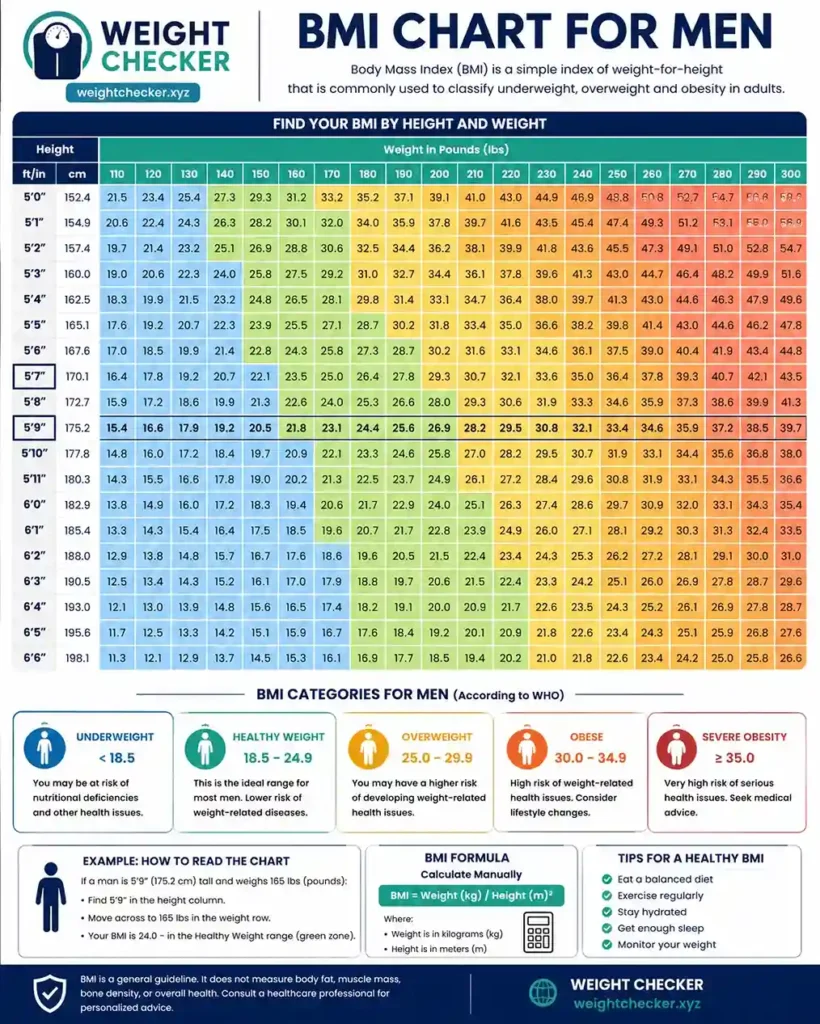
If you prefer a faster method, a BMI calculator, online BMI calculator, or online calculator can calculate your BMI instantly. Alternatively, a BMI chart, BMI chart for men, weight chart for men, BMI graph, chart, or graph offers a visual way to find your BMI rating, normal BMI, normal BMI rating, and weight category without performing a manual calculation.
Example
- A man in the UK with an average UK height of 5 foot 9 inches (5’9″) can follow the correct height column.
- The green zone, also known as the normal zone, shows the recommended parameters for a healthy weight.
- A weight between 130 pounds and 165 pounds is generally considered within the normal range.
- A weight between 170 pounds and 200 pounds is commonly classified as overweight.
- Values below or above these ranges may indicate underweight, obese, or obesity.
- These tools help users achieve a better understanding of their weight status before seeking further medical guidance.
What Is the Ideal Average BMI for Men?
Understanding the Healthy BMI Range
A BMI (Body Mass Index) is a practical screening method for estimating whether a man has a healthy weight in relation to their height. The ideal BMI and average BMI are based on the same standards for men and women, meaning the healthy BMI for men is identical to the healthy BMI for women.
According to the World Health Organisation (WHO), BMI values are used to categorize individuals into recognised BMI categories through a standard BMI classification.
In my experience reviewing clinical guidance, BMI is most useful when it is viewed as a starting point rather than a complete health diagnosis, especially for people with higher muscle mass or average muscle mass, where a high BMI may reflect additional muscle instead of excess body weight.
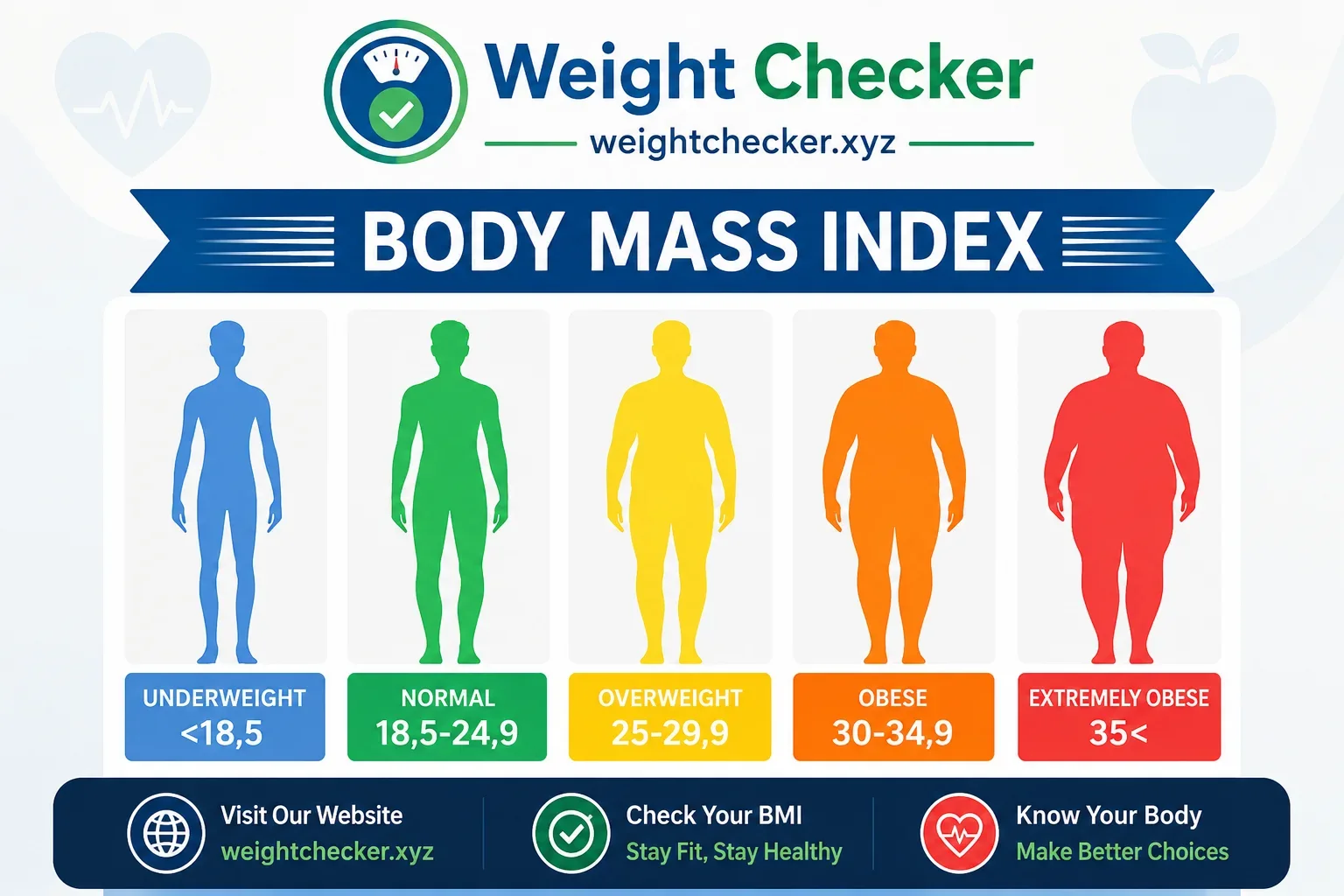
- A BMI range below 18.5 is classified as underweight.
- A BMI between 18.5 to 24.9 is considered the healthy weight category, representing a healthy BMI, healthy range, and normal weight.
- A BMI from 25.0 to 29.9 falls into the overweight category.
- A BMI of 30.0 or 30.0 and above is classified as obese and may indicate obesity.
Why BMI Should Be Considered Alongside Overall Health
Although BMI is a valuable indicator, it should always be interpreted alongside other health factors. A person’s weight, weight range, and body composition can influence the result, particularly when greater muscle mass is present.
Health professionals often recommend considering BMI together with medical history and lifestyle habits to better understand long-term health.
- A BMI outside the healthy range may increase the risk of weight-related health issues and other health issues.
- These may include high blood pressure (hypertension), type II diabetes, diabetes, heart disease, cardiovascular disease, loss of bone density, reduced bone density, stroke, sleep apnoea, breathing problems, and other respiratory problems.
- Monitoring your BMI over time can help identify changes early and support informed health decisions.
Frequently Asked Questions (FAQs)
1. What Is BMI for Men?
BMI for Men is a screening tool that estimates whether a man’s weight is healthy for his height. It is calculated by dividing weight in kilograms by height in metres squared (kg/m²). While BMI provides a quick way to assess weight status, it does not directly measure body fat or muscle mass.
2. Is BMI the Same for Men and Women?
Yes. The BMI formula is the same for both men and women, and the same BMI categories are used. You calculate BMI by dividing your weight by the square of your height. However, men and women naturally have different body compositions, so BMI should be interpreted alongside other health measurements when needed.
3. Does BMI Differ Between Men and Women?
Although the BMI calculation is identical for men and women, body composition differs between the sexes. Women generally have a higher percentage of body fat than men at the same BMI, while men often have more muscle mass. For this reason, BMI is a useful screening tool but should not be the only measure of overall health.
4. How Accurate Is BMI for Men?
BMI is generally accurate for most adult men as a screening tool for healthy weight. However, it does not distinguish between muscle and fat. Men with higher muscle mass, such as athletes or bodybuilders, may have a higher BMI despite having a healthy body fat percentage. For a more complete assessment, consider waist circumference and body fat measurements alongside BMI.
5. What Is the Average Weight for Men?
The average weight for men varies by age, ethnicity, and country. In many populations, the average adult male weighs around 85 kg (187 lbs), but this figure is only a general reference. Instead of comparing yourself with the average weight, aim for a healthy BMI between 18.5 and 24.9, which provides a more personalized assessment based on your height and weight.