
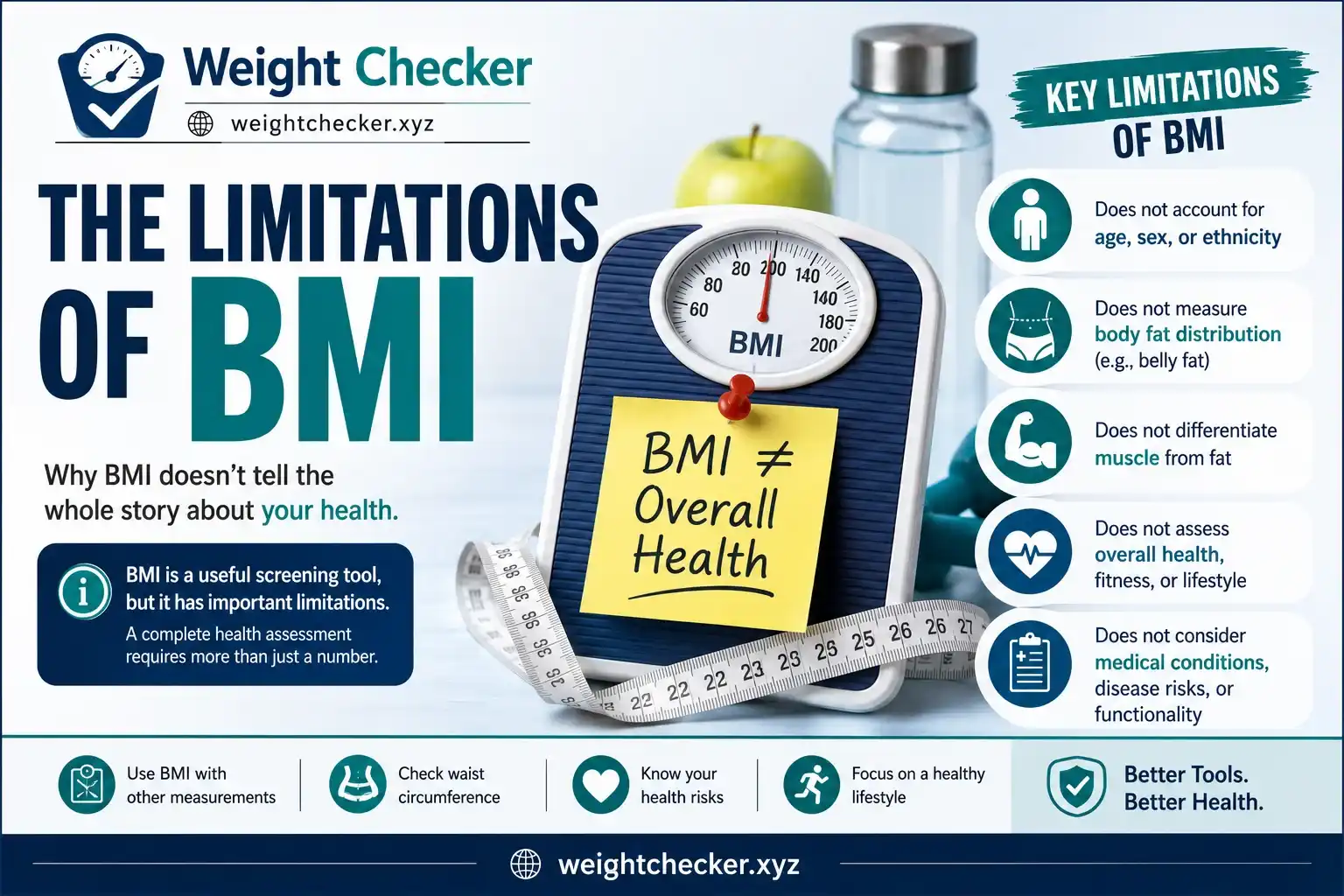
Body Mass Index (BMI) is one of the most widely used tools for assessing body weight and determining whether a person falls within a healthy weight range.
Healthcare professionals, researchers, and organizations such as the National Heart, Lung, and Blood Institute (NHLBI) and the Centers for Disease Control and Prevention (CDC) use BMI as a quick screening method for identifying potential health risks associated with overweight and obesity.
BMI is calculated using a person’s weight and height, making it a simple and inexpensive measurement. However, despite its popularity, BMI has several important limitations. It does not measure body composition, body fat percentage, fat distribution, or other factors that can significantly affect health outcomes.
In this guide, we will explore the major limitations of BMI, explain why BMI may not always accurately reflect health status, and discuss additional measurements that can provide a more complete picture of overall health.
What Is BMI?
Body Mass Index (BMI) is an anthropometric measurement that estimates whether a person’s weight is appropriate for their height.
BMI Formula
- BMI = Weight (kg) ÷ Height² (m²)
BMI categories commonly include:
- Underweight
- Healthy weight
- Overweight
- Obesity
While BMI is useful for population-level studies and initial health assessments, it should not be considered a complete indicator of health.
BMI Does Not Consider Age and Sex
One of the most significant limitations of BMI is that it does not fully account for differences in age and sex.
Why Age Matters
As people age:
- Body fat tends to increase.
- Lean tissue and muscle mass may decrease.
- Body composition changes naturally.
An older person may have a higher percentage of body fat than a younger person with the same BMI.
Why Sex Matters
BMI also ignores differences between males and females.
For example:
- A woman generally has more body fat than a man with the same BMI.
- Hormonal differences influence body composition.
- Fat storage patterns differ between genders.
Because BMI does not consider these factors, it may not accurately reflect a person’s actual health status.
BMI Cannot Measure Body Composition
BMI only uses height and weight. It does not evaluate body composition.
What BMI Cannot Measure
BMI cannot determine:
- Body fat percentage
- Muscle mass
- Bone density
- Lean tissue
- Fat tissue distribution
Two people may have the same BMI while having completely different body compositions.
Example
Consider:
- An athlete with high muscle mass.
- An inactive person with low muscle mass and high body fat.
Both individuals may have the same BMI, yet their health profiles can be dramatically different.
BMI Does Not Show Fat Distribution
The location of body fat is often more important than total body weight.
Why Fat Distribution Matters
Research shows that abdominal fat and visceral fat around the abdominal organs are associated with increased health risks.
People with excess fat around the waist may have a higher risk of:
- Heart disease
- Type 2 diabetes
- Hypertension
- Cardiovascular disease
- Metabolic disorders
BMI does not identify whether fat is stored around:
- The waist
- The hips
- The thighs
- Internal organs
This is a major limitation when evaluating obesity-related risks.
Waist Circumference Often Provides Additional Insight
Because BMI does not assess fat distribution, many healthcare professionals also use waist circumference.
Waist Circumference Risk Thresholds
According to CDC guidelines:
- Greater than 35 inches for non-pregnant women may indicate increased risk.
- Greater than 40 inches for men may indicate increased risk.
Benefits of Measuring Waist Circumference
Waist measurements help identify:
- Central obesity
- Abdominal fat accumulation
- Cardiovascular risk
- Type 2 diabetes risk
Combining BMI with waist circumference provides a more accurate health assessment.
BMI Can Misclassify Athletes and Muscular Individuals
BMI often categorizes highly muscular individuals as overweight or obese.
Why This Happens
Muscle weighs more than fat.
As a result:
- Athletes may have a high BMI.
- Bodybuilders may fall into obesity categories.
- Healthy muscular individuals may appear overweight according to BMI standards.
However, these individuals often have:
- Low body fat percentages
- Excellent cardiovascular health
- Strong physical fitness levels
This demonstrates that BMI alone cannot accurately assess health.
BMI Can Misclassify Athletes and Muscular Individuals
BMI often categorizes highly muscular individuals as overweight or obese.
Why This Happens
Muscle weighs more than fat.
As a result:
- Athletes may have a high BMI.
- Bodybuilders may fall into obesity categories.
- Healthy muscular individuals may appear overweight according to BMI standards.
However, these individuals often have:
- Low body fat percentages
- Excellent cardiovascular health
- Strong physical fitness levels
This demonstrates that BMI alone cannot accurately assess health.
BMI Is Less Accurate During Certain Life Stages
BMI calculations may not accurately represent health during specific stages of development.
Examples Include
- Pregnancy
- Breastfeeding
- Childhood
- Adolescence
- Rapid growth periods
Children and teens require age-specific and sex-specific BMI assessments because their bodies are still developing.
Population Differences
BMI norms can also vary among:
- Different races
- Ethnicities
- Population groups
This means the same BMI value may not carry identical health implications for every individual.
Additional Risk Factors BMI Cannot Measure
BMI does not account for many important risk factors associated with obesity-related conditions.
Important Health Risk Factors
- High blood pressure (hypertension)
- High LDL (bad cholesterol)
- Low HDL (good cholesterol)
- High triglycerides
- High blood sugar levels
- Family history of early heart disease
- Physical inactivity
- Cigarette smoking
- Excessive alcohol consumption
These factors often influence health outcomes more directly than BMI alone.
How Healthcare Professionals Make BMI More Accurate
Experts recommend combining BMI with other measurements.
Common Assessment Tools
- BMI assessment
- Waist circumference
- Body fat percentage analysis
- Body composition assessment
- Blood pressure testing
- Cholesterol screening
- Blood sugar testing
- Medical history evaluation
- Physical activity assessment
Using multiple indicators provides a more complete understanding of overall health.
Should You Rely on BMI Alone?
The simple answer is no.
BMI is a useful screening tool, but it should not be used as the sole indicator of health.
Better Health Assessment Includes
- Body composition
- Waist circumference
- Physical fitness
- Metabolic health
- Blood pressure
- Cholesterol levels
- Blood sugar levels
- Lifestyle habits
A comprehensive evaluation gives a much clearer picture of a person’s actual health status.
Key Takeaway
BMI remains a valuable tool for identifying potential weight-related concerns, but it has important limitations. It does not measure body composition, body fat percentage, fat distribution, muscle mass, or several critical health risk factors.
To obtain a more accurate assessment of health, BMI should be combined with waist circumference, body composition analysis, physical activity levels, and other medical assessments. Whether your goal is weight management, disease prevention, or improving overall wellness, relying solely on BMI can lead to incomplete conclusions.
For the most reliable results, consider BMI as one piece of a broader health assessment rather than the final measure of your health.
Frequently Asked Questions
1. What are the limits of BMI?
BMI is commonly classified into the following categories:
- BMI below 17.0: Moderate and severe thinness
- BMI below 18.5: Underweight
- BMI 18.5–24.9: Normal or healthy weight
- BMI 25.0 and above: Overweight
- BMI 30.0 and above: Obesity
These BMI ranges are used as a screening tool to estimate weight status but do not provide a complete picture of overall health.
2. How much BMI is considered risky?
A BMI of 25.0 or higher is generally associated with an increased risk of obesity-related health conditions. The risk increases as BMI rises.
Common BMI risk categories include:
- BMI 25.0–29.9: Overweight (not obese)
- BMI 30.0–34.9: Class 1 (low-risk) obesity
- Higher BMI values: Greater risk of conditions such as heart disease, type 2 diabetes, and hypertension.
However, BMI should always be considered alongside other health indicators, such as waist circumference, body composition, and lifestyle factors.
3. What are the three main limitations of BMI?
The three major limitations of BMI are:
- It does not account for age, sex, or ethnicity, even though these factors affect body composition and health risks.
- It does not measure body fat distribution, such as abdominal fat, which is an important predictor of health problems.
- It does not evaluate overall health, including comorbid conditions, disease risk, physical fitness, or body composition.
Because of these limitations, BMI should be used as a screening tool rather than a complete measure of an individual’s health.