
Whether your goal is weight loss, muscle gain, or maintaining your current weight, understanding BMR vs TDEE is one of the most important steps in creating a successful nutrition plan.
Many people calculate their Basal Metabolic Rate (BMR) but forget about their Total Daily Energy Expenditure (TDEE), leading to inaccurate calorie goals and slow progress.
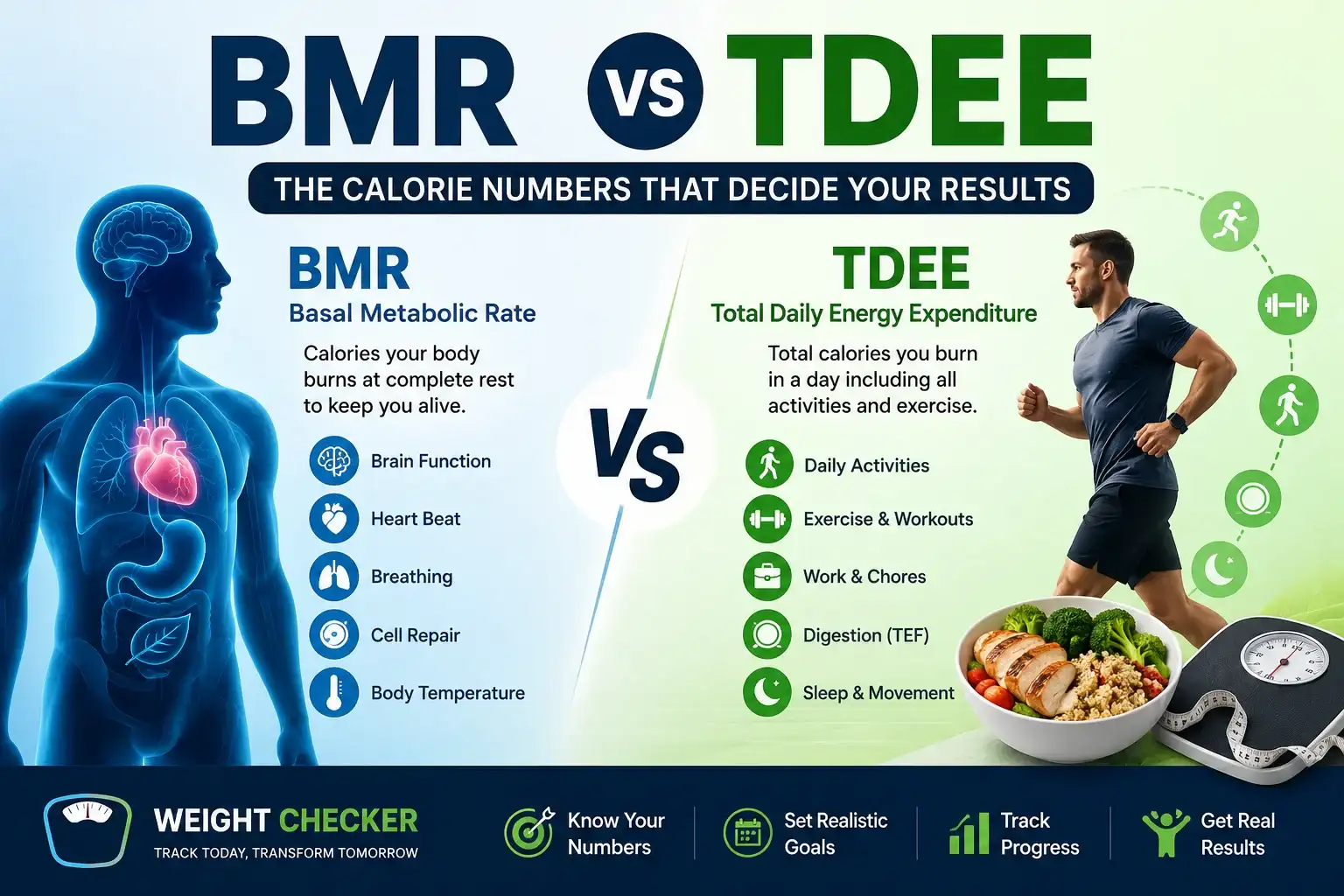
Your BMR represents the minimum number of calories your body burns at complete rest to support essential functions like breathing, circulation, cell repair, and organ function.
Your TDEE builds on that number by adding the calories burned through walking, working, workouts, digestion, household tasks, and all other daily activities.
Simply put:
- BMR = Calories burned at complete rest
- TDEE = Total calories burned throughout the day
Knowing both numbers helps you stop guessing and start making science-backed decisions about calorie intake, fat loss, muscle growth, and overall health.
Table of Contents
- What Is BMR?
- What Is TDEE?
- BMR vs TDEE: Key Differences
- BMR vs RMR vs TDEE
- Why BMR and TDEE Matter
- Factors That Affect BMR
- Factors That Affect TDEE
- BMR vs Sedentary TDEE
- BMR vs TDEE Chart
- Which Number Should You Use?
- BMR vs TDEE for Weight Loss
- BMR vs TDEE for Muscle Gain
- How to Calculate BMR
- How to Calculate TDEE
- Common Mistakes
- Expert Tips
- Frequently Asked Questions
What Is BMR?
Basal Metabolic Rate (BMR) is the amount of energy your body needs to stay alive while at complete rest.
These calories support essential body functions including:
- Breathing
- Blood circulation
- Brain activity
- Heart function
- Cell repair
- Organ function
- Body temperature regulation
- Hormone production
Imagine lying in bed all day without moving. Even then, your body continues burning calories to keep you alive.
For most adults, BMR accounts for 60–75% of total daily calorie burn, making it the largest contributor to energy expenditure.
What Is TDEE?
Total Daily Energy Expenditure (TDEE) is the total number of calories your body burns in an entire day.
It includes your:
- Basal Metabolic Rate (BMR)
- Daily movement
- Walking
- Household chores
- Work activities
- Exercise
- Digestion (Thermic Effect of Food)
- Non-exercise activities (NEAT)
Because it includes every calorie burned throughout the day, TDEE is the number that should guide your calorie intake.
BMR vs TDEE: What’s the Difference?
| BMR | TDEE |
| Calories burned at complete rest | Total calories burned in one day |
| Supports basic body functions | Includes all daily activities |
| Doesn’t include exercise | Includes workouts and movement |
| Lower number | Higher number |
| Used as a metabolic baseline | Used for calorie planning |
In simple words:
BMR is your body’s minimum calorie requirement.
TDEE is your body’s total calorie requirement.
BMR vs RMR vs TDEE
Many people confuse BMR, RMR, and TDEE.
BMR (Basal Metabolic Rate)
Measured under strict laboratory conditions after complete rest and fasting.
RMR (Resting Metabolic Rate)
Measured under less controlled conditions and is generally 5–10% higher than BMR.
TDEE (Total Daily Energy Expenditure)
Includes BMR or RMR plus all physical activity and digestion.
Relationship:
BMR < RMR < TDEE
For everyday calorie planning, the small difference between BMR and RMR usually doesn’t matter.
Why BMR and TDEE Matter
Knowing these numbers allows you to:
- Set realistic calorie goals
- Lose fat efficiently
- Build lean muscle
- Maintain healthy body weight
- Avoid crash dieting
- Improve workout performance
- Support healthy metabolism
- Prevent muscle loss
Without understanding your TDEE, you may unknowingly eat too much or too little.
Factors That Affect BMR
Your BMR isn’t the same as someone else’s.
Major factors include:
Age
Metabolism naturally slows with age.
Gender
Men usually have a higher BMR because of greater lean muscle mass.
Height
Taller people generally burn more calories.
Weight
Heavier individuals usually have higher energy needs.
Lean Muscle Mass
Muscle burns more calories than fat, even while resting.
Genetics
Your inherited metabolism influences calorie burn.
Hormones
Hormonal disorders can increase or decrease metabolic rate.
Factors That Affect TDEE
Unlike BMR, TDEE changes daily.
Important factors include:
- Activity level
- Walking
- Exercise
- Work
- Household chores
- Sports
- Muscle mass
- Body weight
- Diet
- Sleep
- Recovery
- Lifestyle
The more active you are, the higher your TDEE becomes.
BMR vs Sedentary TDEE
Many people mistakenly think they should eat according to their BMR.
That’s incorrect.
Even someone with a desk job still burns calories by:
- Walking
- Standing
- Cooking
- Typing
- Shopping
- Cleaning
- Climbing stairs
A sedentary lifestyle generally uses an activity multiplier of 1.2.
Example:
- BMR = 1,600 calories
- Sedentary TDEE = 1,920 calories
Eating below BMR for long periods may lead to:
- Fatigue
- Muscle loss
- Poor recovery
- Hunger
- Reduced workout performance
- Slower progress
BMR vs TDEE Activity Chart
| BMR | Sedentary (1.2) | Light (1.375) | Moderate (1.55) | Very Active (1.725) |
| 1300 | 1560 | 1788 | 2015 | 2243 |
| 1500 | 1800 | 2063 | 2325 | 2588 |
| 1700 | 2040 | 2338 | 2635 | 2933 |
| 1900 | 2280 | 2613 | 2945 | 3278 |
This chart shows how activity level dramatically changes your daily calorie needs.
Which Number Should You Use?
Your goal determines which number matters most.
For Weight Loss
Use TDEE and create a calorie deficit of 300–500 calories per day.
For Weight Maintenance
Eat close to your TDEE.
For Muscle Gain
Consume approximately 200–300 calories above TDEE while following a resistance training program.
Your BMR should never become your long-term calorie target unless supervised by a healthcare professional.
How to Calculate BMR
One of the most accurate methods is the Mifflin-St Jeor Equation.
Men
BMR = (10 × weight in kg) + (6.25 × height in cm) − (5 × age) + 5
Women
BMR = (10 × weight in kg) + (6.25 × height in cm) − (5 × age) − 161
Once calculated, multiply your BMR by your activity level to estimate TDEE.
Activity Multipliers
| Activity Level | Multiplier |
| Sedentary | 1.2 |
| Light Exercise | 1.375 |
| Moderate Exercise | 1.55 |
| Very Active | 1.725 |
| Athlete or Physical Job | 1.9 |
Example Calculation
Suppose:
- Age: 30 years
- Weight: 75 kg
- Height: 175 cm
- Activity: Moderate
BMR ≈ 1,700 calories
TDEE:
1,700 × 1.55 = 2,635 calories/day
For weight loss:
2,635 − 500 = 2,135 calories/day
Common Mistakes People Make
- Eating only their BMR
- Overestimating activity level
- Ignoring calorie tracking
- Forgetting snacks and drinks
- Choosing the wrong activity multiplier
- Expecting immediate results
- Crash dieting
- Not adjusting calories after weight changes
- Ignoring muscle loss during dieting
Avoiding these mistakes can significantly improve long-term success.
Expert Tips for Better Results
- Calculate both BMR and TDEE before changing your diet.
- Track your calorie intake consistently.
- Recalculate every time your weight changes significantly.
- Increase daily movement instead of relying only on workouts.
- Prioritize lean protein to support muscle maintenance.
- Sleep 7–9 hours each night.
- Stay hydrated.
- Monitor progress for at least 2–3 weeks before making adjustments.
- Focus on consistency rather than perfection.
Final Thoughts
Understanding BMR vs TDEE gives you a solid foundation for making smarter nutrition and fitness decisions. While BMR tells you how many calories your body needs to perform essential functions at rest, TDEE reveals the total calories you burn through everyday life and physical activity.
Whether your goal is fat loss, muscle gain, or weight maintenance, using your TDEE as the basis for calorie planning is far more effective than relying on BMR alone. Calculate your numbers honestly, choose the correct activity multiplier, monitor your progress, and adjust your calorie intake gradually.
At Weight Checker (weightchecker.xyz), you can use our free BMR Calculator, TDEE Calculator, BMI Calculator, and other health tools to better understand your body, set realistic goals, and build a sustainable plan for long-term success.
Frequently Asked Questions (FAQ’s)
Is BMR the same as TDEE?
No. BMR is the calories your body burns at complete rest, while TDEE includes all daily activities and exercise.
Should I eat my BMR or my TDEE?
Most people should base calorie intake on TDEE, not BMR.
Is TDEE accurate?
TDEE is an estimate. Tracking your body weight, energy levels, and progress over several weeks helps refine your calorie target.
Does building muscle increase BMR?
Yes. More lean muscle mass increases the calories your body burns at rest.
Can I lose weight by eating below my BMR?
Consistently eating below BMR is generally not recommended because it may increase fatigue, muscle loss, and make your diet harder to sustain.
Which is more important for weight loss?
TDEE is more important because it reflects your total daily calorie expenditure and helps create an appropriate calorie deficit.
How often should I recalculate BMR and TDEE?
Recalculate every time your body weight, activity level, or fitness routine changes significantly.