
If you’re trying to lose fat, understanding your Basal Metabolic Rate (BMR) is one of the smartest places to start. Your BMR represents the number of calories your body burns while at complete rest to support essential body functions like breathing, circulation, and maintaining body temperature.
Since it accounts for most of your daily energy expenditure, knowing your BMR helps you build an effective weight loss plan.
At Weight Checker (weightchecker.xyz), we believe successful weight management starts with accurate numbers rather than guesswork. By understanding your baseline energy budget, calorie needs, and Total Daily Energy Expenditure (TDEE), you can create a sustainable calorie deficit that promotes healthy fat loss while preserving lean muscle mass.
What Is BMR?
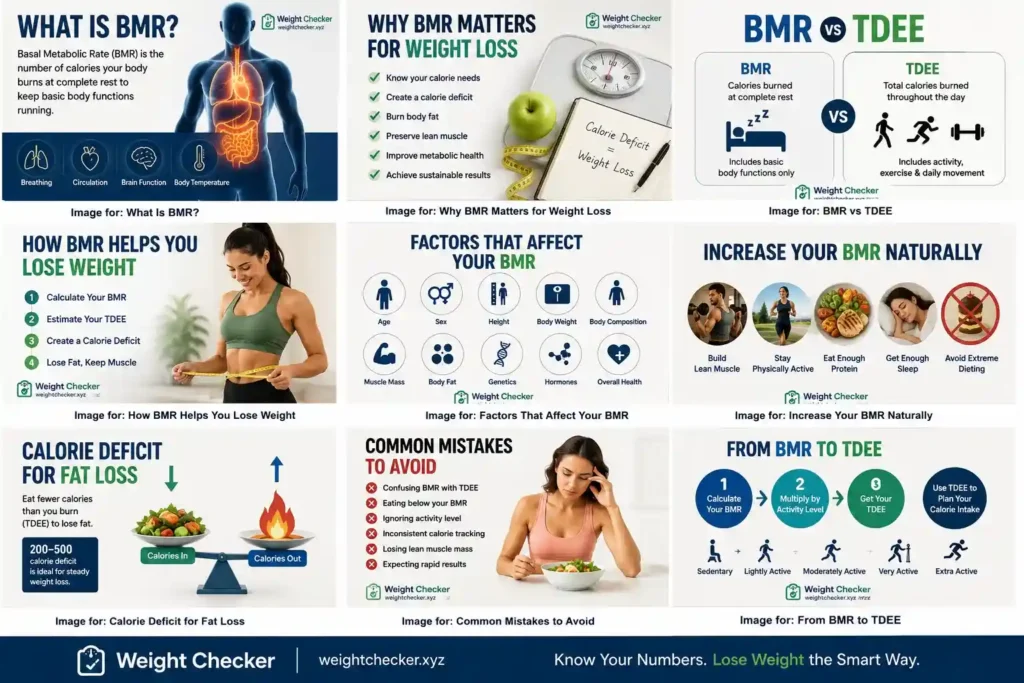
Basal Metabolic Rate (BMR) is the minimum amount of energy your body needs to stay alive while resting. It includes calories used for:
- Breathing
- Blood circulation
- Cell production
- Brain function
- Organ function
- Hormone regulation
- Maintaining body temperature
Unlike calories burned during physical activity, your BMR only measures your body’s resting metabolism.
Why BMR Matters for Weight Loss
Your BMR forms the foundation of your daily calorie burn. Every person burns calories simply by existing, even while sleeping or relaxing.
When combined with your daily activity level, your BMR helps calculate your Total Daily Energy Expenditure (TDEE).
Knowing both numbers allows you to:
- Calculate accurate maintenance calories
- Create a safe calorie deficit
- Burn more body fat
- Preserve lean muscle
- Improve long-term metabolic health
- Achieve sustainable weight loss
BMR vs TDEE
Many people confuse BMR with TDEE, but they measure different things.
| BMR | TDEE |
| Calories burned at complete rest | Total calories burned throughout the day |
| Includes basic body functions | Includes exercise, movement, and daily activities |
| Baseline energy requirement | Total daily calorie requirement |
Think of your BMR as your body’s minimum fuel requirement, while TDEE represents your total daily energy expenditure.
How BMR Helps You Lose Weight
The key to fat loss is maintaining a consistent calorie deficit.
This simply means consuming fewer calories than your TDEE.
Step 1: Calculate Your BMR
Your Basal Metabolic Rate estimates how many calories your body burns at rest.
Step 2: Estimate Your TDEE
Multiply your BMR by your daily activity level to estimate your Total Daily Energy Expenditure (TDEE).
Step 3: Create a Calorie Deficit
Once you know your TDEE, reduce your daily calorie intake by approximately 200–500 calories.
A moderate calorie deficit generally supports gradual, sustainable weight loss while helping preserve muscle mass.
Why You Shouldn’t Eat Below Your BMR
Many people believe eating as little as possible speeds up fat loss, but that’s a common mistake.
Eating below your Basal Metabolic Rate may:
- Slow your metabolism
- Reduce energy
- Increase muscle loss
- Lower your metabolic rate
- Make long-term weight management more difficult
Instead, aim for a moderate calorie deficit based on your TDEE, not your BMR.
Factors That Affect Your BMR
Several factors influence your Basal Metabolic Rate, including:
- Age
- Sex
- Height
- Body weight
- Body composition
- Lean muscle mass
- Body fat
- Genetics
- Hormones
- Overall health
Among these, increasing lean muscle is one of the most effective ways to naturally increase your BMR.
Increase Your BMR Naturally
Although genetics play a role, several lifestyle habits can improve your resting metabolism.
Build Lean Muscle
More lean muscle mass requires more energy, increasing your daily calorie burn.
Stay Physically Active
Regular exercise and physical activity increase total daily energy expenditure.
Eat Enough Protein
Protein supports muscle gain, recovery, and helps maintain lean body tissue during weight loss.
Get Enough Sleep
Poor sleep may negatively affect metabolic health, hormones, and appetite regulation.
Avoid Extreme Dieting
Very low-calorie diets can reduce your baseline calories, slowing your body’s natural metabolism.
Common Mistakes When Using BMR for Weight Loss
Avoid these common mistakes:
- Confusing BMR with TDEE
- Ignoring your activity level
- Eating below your BMR
- Tracking calories inconsistently
- Losing lean muscle mass
- Expecting rapid results
- Skipping strength training
- Not adjusting calorie intake after losing weight
Is BMR Accurate?
Your Basal Metabolic Rate is an estimate based on your age, sex, height, body weight, and body composition.
Modern BMR calculators provide reliable estimates for most healthy adults, making them excellent tools for planning nutrition, weight management, and calorie needs.
Should You Increase Your BMR?
A higher BMR means your body naturally burns more calories at rest.
The healthiest way to increase your Basal Metabolic Rate is by building lean muscle, staying active, eating a balanced diet, and maintaining good overall metabolic health.
Tips for Successful Weight Loss Using BMR
- Calculate your BMR first.
- Estimate your Total Daily Energy Expenditure (TDEE).
- Create a moderate calorie deficit.
- Prioritize fat loss, not rapid weight loss.
- Protect your lean muscle mass with strength training.
- Eat enough protein.
- Track your progress consistently.
- Adjust your calorie target as your body weight changes.
Final Thoughts
Understanding your Basal Metabolic Rate (BMR) gives you a scientific foundation for successful weight loss. By calculating your BMR, estimating your Total Daily Energy Expenditure (TDEE), and maintaining a healthy calorie deficit, you can lose body fat, preserve lean muscle mass, and improve your long-term metabolic health.
Use the free BMR Calculator on Weight Checker (weightchecker.xyz) to discover your daily calorie needs and build a smarter, healthier weight loss plan today.
Frequently Asked Questions (FAQs)
What is the best BMR for weight loss?
There isn’t a “best” BMR. A higher Basal Metabolic Rate simply means your body burns more calories at rest. Weight loss depends on maintaining a calorie deficit below your TDEE, not on having a specific BMR.
Can I lose weight by eating my BMR calories?
Eating only your BMR calories is generally not recommended because it may not provide enough energy for daily activities. Most weight loss plans should be based on your Total Daily Energy Expenditure (TDEE).
Does increasing muscle increase BMR?
Yes. Increasing lean muscle mass raises your Basal Metabolic Rate because muscle tissue burns more calories than body fat, even while resting.
How many calories should I cut for weight loss?
Most experts recommend a moderate calorie deficit of 200–500 calories below your TDEE for steady and sustainable fat loss.
Is BMR better than BMI for weight loss?
No. BMI and BMR measure different things. BMI estimates body weight relative to height, while BMR estimates how many calories your body burns at rest. For weight loss planning, BMR combined with TDEE is more useful for determining daily calorie needs.
How often should I recalculate my BMR?
You should recalculate your BMR whenever your body weight, body composition, or activity level changes significantly, especially after losing or gaining several kilograms.