
Losing body fat isn’t about following the latest diet trend, it’s about understanding how many calories your body needs every day. That’s where TDEE (Total Daily Energy Expenditure) comes in.
Knowing your TDEE for fat loss helps you create the right calorie deficit without starving yourself. Whether you’re trying to lose a few pounds or completely transform your body, calculating your TDEE gives you a science-backed starting point.
In this complete guide, you’ll learn what TDEE is, how to calculate it, how much of a calorie deficit you need, and how to use your TDEE to lose fat safely and effectively.
Table of Contents
- What Is TDEE?
- Why TDEE Matters for Fat Loss
- Understanding Calories and Fat Loss
- How to Calculate Your TDEE
- Step 1: Calculate Your BMR
- Step 2: Apply Your Activity Level
- TDEE Activity Multipliers
- How to Use TDEE for Fat Loss
- Best Calorie Deficit for Weight Loss
- Example TDEE Calculations
- TDEE vs BMR
- TDEE for Men and Women
- TDEE for Different Activity Levels
- Factors That Affect Your TDEE
- How Often Should You Recalculate TDEE?
- Common TDEE Mistakes
- Tips to Lose Fat Faster Without Losing Muscle
- Foods That Support Fat Loss
- Frequently Asked Questions
- Final Thoughts
What Is TDEE?
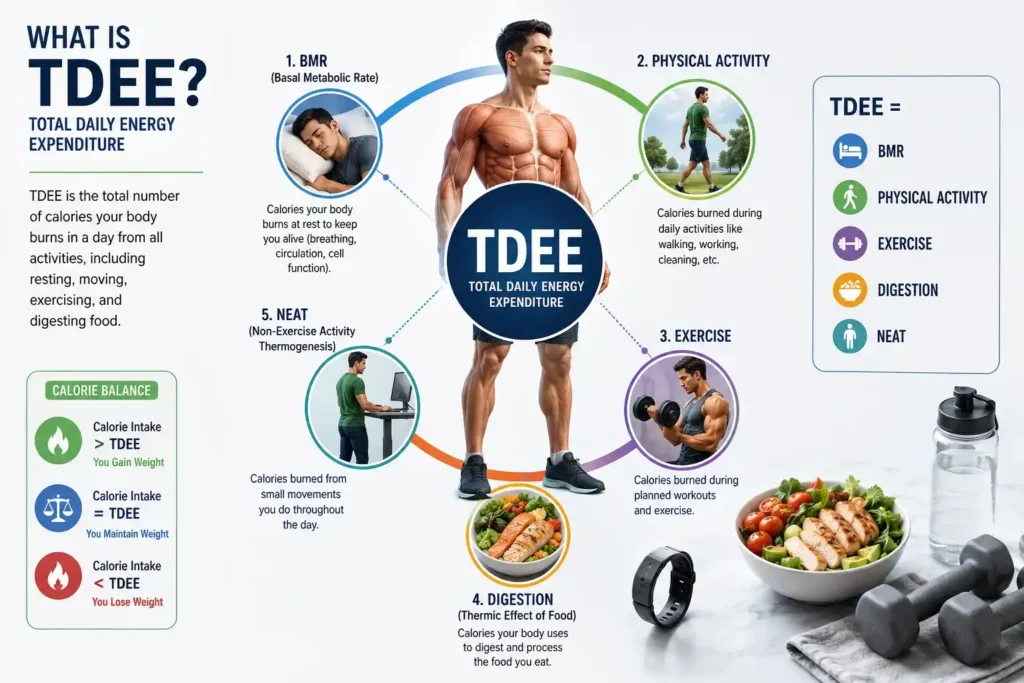
TDEE (Total Daily Energy Expenditure) is the total number of calories your body burns in one day. It includes every calorie your body uses from breathing and digestion to walking, exercising, and daily activities.
Your TDEE consists of several components:
- Basal Metabolic Rate (BMR)
- Physical activity
- Exercise
- Digestion (Thermic Effect of Food)
- Non-exercise movement (NEAT)
Think of TDEE as your daily calorie budget. If you eat:
- More than your TDEE → You gain weight.
- Equal to your TDEE → You maintain weight.
- Less than your TDEE → You lose fat.
This is why calculating TDEE is one of the most important steps in any successful weight-loss journey.
Why TDEE Matters for Fat Loss
Many people reduce calories without knowing how much they actually need. This often leads to:
- Slow progress
- Muscle loss
- Constant hunger
- Low energy
- Weight-loss plateaus
Knowing your TDEE allows you to:
- Create a realistic calorie deficit
- Lose body fat consistently
- Preserve lean muscle
- Improve long-term results
- Avoid crash diets
Instead of guessing, you’re making data-driven decisions.
Understanding Calories and Fat Loss
Body fat is stored energy.
When you consume fewer calories than your body burns, your body begins using stored fat for energy. This process is called a calorie deficit.
For example:
- TDEE = 2,500 calories
- Calories eaten = 2,000 calories
Daily deficit = 500 calories
A deficit of approximately 3,500 calories is often estimated to equal about 1 pound (0.45 kg) of body fat, although actual results vary depending on individual factors.
How to Calculate Your TDEE
Calculating TDEE involves two simple steps.
Step 1: Calculate Your BMR
BMR (Basal Metabolic Rate) is the calories your body burns while completely at rest.
The commonly used Mifflin-St Jeor Equation is:
Men
BMR = (10 × weight in kg) + (6.25 × height in cm) − (5 × age) + 5
Women
BMR = (10 × weight in kg) + (6.25 × height in cm) − (5 × age) − 161
Step 2: Multiply by Your Activity Level
Once you know your BMR, multiply it by your activity factor.
| Activity Level | Multiplier |
| Sedentary | 1.2 |
| Lightly Active | 1.375 |
| Moderately Active | 1.55 |
| Very Active | 1.725 |
| Extra Active | 1.9 |
Example:
- BMR = 1,700 calories
- Moderately Active
TDEE = 1,700 × 1.55 = 2,635 calories
How to Use TDEE for Fat Loss
Once you’ve calculated your TDEE, subtract calories to create a calorie deficit.
Small Deficit
- 250 calories/day
- Slower but easier to maintain
- Ideal for lean individuals
Moderate Deficit
- 500 calories/day
- Most recommended
- Sustainable
- Preserves muscle
Large Deficit
- 750–1,000 calories/day
- Faster weight loss
- More difficult to maintain
- Higher risk of muscle loss
For most people, a 500-calorie daily deficit strikes the best balance between effective fat loss and long-term sustainability.
Best Calorie Deficit for Weight Loss
Your calorie deficit depends on your goals.
| Goal | Daily Deficit |
| Slow Fat Loss | 250 Calories |
| Moderate Fat Loss | 500 Calories |
| Aggressive Fat Loss | 750 Calories |
General recommendations:
- Beginners: 300–500 calories
- Intermediate: 500 calories
- Advanced: Adjust based on body fat percentage
Avoid reducing calories too aggressively, as this can negatively affect metabolism, energy levels, and muscle retention.
TDEE Calculation Examples
Example 1
Male
- Age: 30
- Weight: 80 kg
- Height: 178 cm
- Activity: Moderate
BMR ≈ 1,780 calories
TDEE ≈ 2,759 calories
Fat-loss calories:
2,759 − 500 = 2,259 calories/day
Example 2
Female
- Age: 28
- Weight: 65 kg
- Height: 165 cm
- Activity: Light
BMR ≈ 1,370 calories
TDEE ≈ 1,884 calories
Fat-loss calories:
1,884 − 400 = 1,484 calories/day
TDEE vs BMR
Many people confuse TDEE and BMR.
| BMR | TDEE |
| Calories burned at rest | Total calories burned daily |
| Does not include activity | Includes all activities |
| Lower number | Higher number |
| Used to estimate metabolism | Used for calorie planning |
Your BMR is only one part of your TDEE.
TDEE for Men
Men generally have:
- Higher muscle mass
- Higher metabolism
- Higher calorie requirements
Average male TDEE ranges from:
- 2,200–3,200 calories/day
Actual needs vary based on age, weight, height, and activity level.
TDEE for Women
Women generally have:
- Lower muscle mass
- Lower calorie requirements
- Different hormonal influences
Average female TDEE ranges from:
- 1,700–2,500 calories/day
Individual needs can differ significantly.
TDEE Based on Activity Level
Sedentary
Ideal for:
- Office workers
- Minimal exercise
Weight loss requires careful calorie control because daily energy expenditure is relatively low.
Lightly Active
Includes:
- Walking
- Yoga
- Light workouts
Most beginners fall into this category.
Moderately Active
Examples:
- Gym 3–5 days/week
- Sports
- Regular cardio
This is one of the most common activity levels for active adults.
Very Active
Examples:
- Athletes
- Manual labor jobs
- Intense training
These individuals require substantially more calories to maintain performance and recovery.
Factors That Affect Your TDEE
Several variables influence how many calories you burn.
Age
Metabolism tends to slow gradually with age.
Weight
Heavier individuals usually burn more calories.
Height
Taller people generally have higher energy needs.
Muscle Mass
Muscle burns more calories than fat, even at rest.
Hormones
Conditions involving thyroid hormones and other endocrine factors can affect metabolism.
Daily Movement
Small activities like walking, standing, cleaning, and taking the stairs contribute to your daily calorie burn.
How Often Should You Recalculate Your TDEE?
As your body changes, your TDEE changes too.
Recalculate when:
- You lose 5–10 pounds (2–5 kg)
- Your activity level changes
- You start a new workout routine
- Your weight-loss progress stalls
Regular adjustments help keep your calorie target accurate.
Common TDEE Mistakes
Avoid these common errors:
- Guessing your activity level
- Eating too few calories
- Ignoring weekend overeating
- Not tracking food accurately
- Forgetting liquid calories
- Expecting instant results
- Never updating your TDEE
- Confusing weight loss with fat loss
Consistency matters more than perfection.
Tips to Lose Fat Faster Without Losing Muscle
The goal is to lose fat, not muscle.
Prioritize Protein
Aim for adequate daily protein intake to support muscle maintenance.
Lift Weights
Strength training signals your body to preserve lean muscle while losing fat.
Sleep Well
Most adults benefit from 7–9 hours of quality sleep each night.
Stay Hydrated
Water supports digestion, exercise performance, and appetite regulation.
Track Progress
Use:
- Weekly weigh-ins
- Waist measurements
- Progress photos
- Body-fat estimates (if available)
Be Patient
Healthy fat loss is gradual and more sustainable than rapid weight loss.
Foods That Support Fat Loss
While no food burns fat on its own, nutrient-dense foods can make a calorie deficit easier to maintain.
Choose:
- Lean chicken
- Fish
- Eggs
- Greek yogurt
- Cottage cheese
- Vegetables
- Fruits
- Whole grains
- Brown rice
- Oats
- Beans
- Lentils
- Healthy fats in moderation
- Nuts
- Seeds
- Olive oil
Limit:
- Sugary drinks
- Processed snacks
- Fried foods
- Excess alcohol
- High-calorie desserts
Focus on whole foods that keep you satisfied.
Tracking Your Progress
A TDEE calculation is a starting estimate, not a guarantee.
To stay on track:
- Weigh yourself at the same time each week.
- Monitor body measurements monthly.
- Keep a food diary or use a calorie-tracking app.
- Adjust calories if your weight hasn’t changed for 2–3 weeks.
- Celebrate non-scale victories like improved energy, strength, and fitness.
Small adjustments over time often lead to better long-term results than making drastic changes.
Conclusion
Understanding your TDEE for fat loss is one of the smartest steps you can take toward achieving your weight-loss goals. Instead of relying on guesswork or restrictive diets, TDEE gives you a personalized estimate of how many calories your body burns each day.
By calculating your TDEE, creating a sensible calorie deficit, eating a balanced diet rich in protein and whole foods, staying active, and tracking your progress consistently, you can lose fat in a sustainable way while supporting your overall health.
Remember that TDEE is an estimate, not a fixed number. As your weight, activity level, and lifestyle change, revisit your calculations and adjust your calorie intake accordingly. Consistency, patience, and healthy habits will always outperform quick fixes.
If you want an easier way to get started, use the TDEE Calculator on WeightChecker.xyz to estimate your daily calorie needs and build a fat-loss plan tailored to your goals.
Frequently Asked Questions (FAQs)
What is the best TDEE deficit for fat loss?
A daily deficit of 300–500 calories is generally considered sustainable for most people. It promotes steady fat loss while helping preserve muscle and energy levels.
Can I lose weight by eating my TDEE?
No. Eating at your TDEE typically maintains your current weight. To lose fat, you need to consume fewer calories than your TDEE.
How accurate is a TDEE calculator?
TDEE calculators provide estimates based on formulas and your activity level. They are useful starting points, but your actual calorie needs may differ slightly.
Should I recalculate my TDEE after losing weight?
Yes. As your body weight decreases, your calorie needs also decrease. Recalculating helps maintain an appropriate calorie target.
Is TDEE better than counting calories?
TDEE and calorie counting work together. Your TDEE tells you how many calories you burn, while calorie tracking helps ensure you stay within your target intake.
Can I eat below my BMR?
Regularly eating below your BMR is generally not recommended unless supervised by a qualified healthcare professional. Extremely low calorie intake can make it harder to meet nutrient needs and may increase the risk of muscle loss.
How much weight can I lose in a month?
Weight loss varies by individual. Many health organizations consider losing about 1–2 pounds (0.5 — 1 kg) per week to be a sustainable pace for many adults, though results depend on factors such as diet, activity, sleep, and overall health.
Does exercise increase my TDEE?
Yes. Physical activity increases your total daily energy expenditure. Increasing exercise or daily movement can raise your TDEE and allow for a larger calorie intake while maintaining the same deficit.