What is strength training? Strength training is a form of exercise that makes your muscles work against resistance to improve muscular strength, endurance, muscle size, power, and physical function. The resistance can come from free weights, machines, resistance bands, or even your own body weight.
You do not need to be a professional athlete or spend hours in a gym to benefit from strength training. A simple, consistent routine can help you become stronger, support healthy body composition, improve physical function, and make everyday activities easier.
According to the American College of Sports Medicine (ACSM), the latest 2026 resistance-training guidance emphasizes that consistency matters more than having a complicated workout program. Adults can benefit from training all major muscle groups at least twice per week, while the exact training approach should be adapted to individual goals and preferences.
What Is Strength Training?
Strength training, also called resistance training, is exercise in which your muscles work against an external or internal resistance.
The resistance may come from:
- Dumbbells
- Barbells
- Weight machines
- Resistance bands
- Kettlebells
- Medicine balls
- Your own body weight
- Other forms of resistance equipment
For example, when you perform a push-up, your muscles work against the resistance created by your body weight. When you perform a dumbbell curl, your biceps work against the weight of the dumbbell.
The goal is to provide enough resistance to challenge your muscles. Over time, your body adapts to that challenge, allowing you to perform movements with greater strength and control.
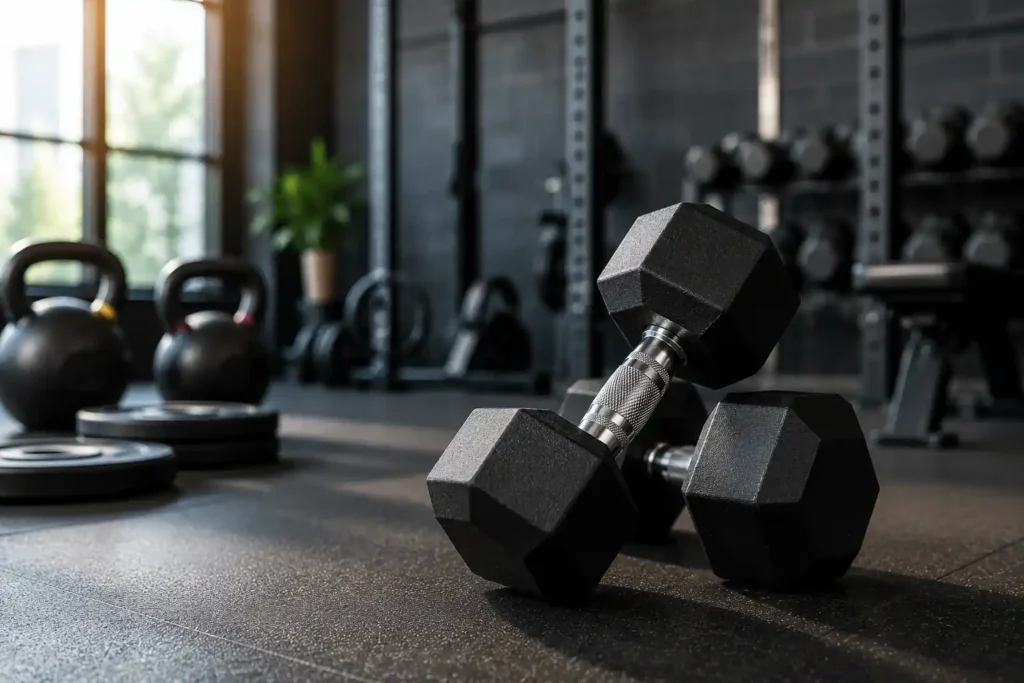
Strength Training vs. Weight Training
Strength training and weight training are related, but they are not exactly the same.
Strength training is the broader category. It includes exercises using body weight, resistance bands, machines, free weights, and other forms of resistance.
Weight training generally refers to strength exercises performed using weights.
In other words, weight training is one type of strength training.
How Does Strength Training Work?
When you perform a resistance exercise, your muscles are required to produce force against resistance. This creates a training stimulus that encourages your body to adapt.
For example, during a squat:
- Your muscles produce force to move your body.
- Your muscles control the movement as you lower yourself.
- Your muscles stabilize your joints and body position.
- Repeated training encourages your muscles and nervous system to become more efficient.
- Gradually increasing the challenge can lead to improvements in strength and other physical abilities.
Strength training can involve different types of muscle contractions, including concentric, eccentric, and isometric contractions.
The important principle for beginners is simple: challenge your muscles consistently and increase the difficulty gradually.
What Are the Benefits of Strength Training?
Strength training can provide benefits that go beyond building bigger muscles. Regular resistance exercise can support muscular fitness, bone health, physical function, body composition, balance, and overall health.
Here are some of the major benefits.
1. Builds Muscle Strength
The most obvious benefit is improved muscular strength.
As you consistently challenge your muscles, your body adapts to handle resistance more effectively. This can make activities such as carrying groceries, climbing stairs, lifting objects, or getting up from a chair easier.
2. Supports Muscle Growth
Strength training can stimulate muscle hypertrophy, which refers to an increase in muscle size.
Muscle growth depends on factors such as training volume, resistance, nutrition, recovery, genetics, and consistency.
You don’t necessarily need extremely heavy weights to start making progress. The ACSM’s 2026 guidance emphasizes that different forms of resistance training can be effective, including bodyweight exercises, resistance bands, and home-based workouts.
3. Helps Support Healthy Weight Management
Strength training can be useful as part of a weight-management strategy.
Building and maintaining muscle can contribute to a healthy body composition, while physical activity increases energy expenditure. For people trying to lose weight, resistance training can also be valuable for maintaining muscle while reducing body weight when combined with an appropriate nutrition plan.
For a broader understanding of your daily calorie needs, you can use the Weight Checker TDEE Calculator to estimate total daily energy expenditure.
4. Supports Bone Health
Resistance and weight-bearing exercise can place healthy stress on the skeletal system.
Regular strength training is associated with improvements in bone health and can be an important component of an active lifestyle, particularly as people get older.
5. Improves Physical Function
Being strong is useful outside the gym.
Strength helps with everyday movements such as:
- Walking
- Climbing stairs
- Carrying bags
- Picking things up
- Standing from a chair
- Maintaining balance
- Performing household activities
ACSM’s current guidance recognizes physical function including activities such as gait, balance, and stair climbing as an important outcome of resistance training.
6. May Improve Balance and Stability
Strengthening your legs, hips, core, and other muscle groups can help support balance and stability.
This can become particularly important as people age because maintaining muscular fitness can help support independence and everyday mobility.
7. Supports Metabolic Health
Regular resistance exercise can contribute to better metabolic health.
Strength training can help improve insulin sensitivity and blood-glucose regulation, making it a useful component of an overall healthy lifestyle.
8. Can Support Mental Well-Being
Exercise can also benefit mental well-being. Strength training gives people an opportunity to build physical confidence, establish a routine, and remain physically active.
However, strength training should complement, not replace professional care when someone is experiencing a mental or physical health condition.
What Are the Main Types of Strength Training?
There is no single way to perform strength training. Different methods can be used depending on your goals, available equipment, fitness level, and preferences.
Bodyweight Training
Bodyweight exercises use your own body as resistance.
Examples include:
- Push-ups
- Squats
- Lunges
- Planks
- Glute bridges
- Step-ups
- Pull-ups
Bodyweight training can be an excellent starting point for beginners because little or no equipment is required.
Free-Weight Training
Free weights include equipment such as:
- Dumbbells
- Barbells
- Kettlebells
Free weights allow you to perform many compound and isolation exercises and can be progressively loaded as your strength improves.
Machine-Based Training
Weight machines provide guided resistance and can make it easier to learn certain movements.
Examples include:
- Leg press
- Chest press
- Lat pulldown
- Leg curl
- Seated row
Machines can be particularly useful when someone wants additional stability while learning an exercise.
Resistance-Band Training
Resistance bands are portable, inexpensive, and versatile.
They can be used for exercises such as:
- Band rows
- Banded squats
- Chest presses
- Shoulder exercises
- Glute exercises
Importantly, you do not need a traditional gym to benefit from resistance training. Current ACSM guidance supports bodyweight exercises, elastic bands, and home-based resistance training as effective options.
What Are the Best Strength Training Exercises for Beginners?
Beginners should generally focus on learning basic movement patterns rather than immediately trying advanced exercises.
Useful beginner exercises include:
1. Squats
Squats primarily train the lower body, particularly the quadriceps and glutes, while also requiring core stability.
2. Push-Ups
Push-ups train the chest, shoulders, and triceps while requiring the core to stabilize the body.
Beginners can start with modified push-ups if standard push-ups are too difficult.
3. Rows
Rows train the muscles of the upper back and arms.
They can be performed with dumbbells, resistance bands, cables, or machines.
4. Lunges
Lunges are a lower-body exercise that challenges the legs and can also train balance and coordination.
5. Glute Bridges
Glute bridges target the glute muscles and can be performed without equipment.
6. Planks
Planks are an isometric exercise that challenges the muscles responsible for maintaining trunk stability.
7. Hip-Hinge Exercises
Movements such as Romanian deadlifts teach the hip-hinge pattern while training the posterior chain.
Beginners should prioritize technique and controlled movement before adding substantial resistance.
How Often Should You Do Strength Training?
For general health, adults should perform muscle-strengthening activities on at least two days per week.
The 2026 ACSM resistance-training guidance similarly recommends training all major muscle groups at least twice per week and emphasizes consistency over unnecessarily complicated routines.
A beginner could start with:
- 2 full-body workouts per week, or
- 3 full-body workouts per week with appropriate recovery between sessions.
The ideal frequency depends on your goals, experience, schedule, recovery, and overall exercise routine.
How Many Sets and Repetitions Should You Do?
There is no single number of sets and repetitions that works for everyone.
Your training variables should depend on your goal.
For example:
- Strength: generally requires relatively heavier resistance and focused sets.
- Muscle growth: usually benefits from sufficient weekly training volume.
- Muscular endurance: can involve lighter resistance and higher repetitions.
- Power: uses appropriate resistance with an emphasis on moving quickly.
The 2026 ACSM position stand suggests that healthy adults training specifically for strength may use heavier loads around 80% of one-repetition maximum for 2–3 sets per exercise, while hypertrophy programs may benefit from greater weekly volume. These are general evidence-based guidelines rather than requirements for every person.
For beginners, learning proper technique and establishing consistency should come before obsessing over exact numbers.
How Do You Progress in Strength Training?
To continue improving, your workouts generally need to become appropriately challenging over time. This concept is often called progressive overload.
Progress can come from:
- Increasing resistance
- Performing more repetitions
- Adding sets
- Improving exercise technique
- Increasing range of motion
- Improving control
- Choosing a more challenging exercise variation
- Gradually increasing training frequency when appropriate
You do not need to increase everything at once.
A simple approach is to master an exercise first and then gradually increase the challenge.
Strength Training for Beginners: How to Get Started
If you’re completely new to resistance exercise, keep your first workouts simple.
Step 1: Choose Basic Exercises
Start with movements that train major muscle groups.
A beginner routine might include:
- Squat
- Push-up
- Row
- Hip-hinge movement
- Glute bridge
- Plank
Step 2: Focus on Technique
Proper technique should be a priority.
Avoid sacrificing movement quality simply to lift heavier weight.
Step 3: Start With a Manageable Challenge
Your first workout does not need to leave you exhausted.
Choose resistance that allows you to perform the exercise with controlled technique.
Step 4: Progress Gradually
As an exercise becomes easier, gradually increase the challenge.
Step 5: Allow Recovery
Muscles need time to recover between demanding training sessions.
Sleep, nutrition, hydration, and rest all contribute to your ability to train consistently.
Step 6: Track Your Progress
Record exercises, sets, repetitions, resistance, and how the workout felt.
Tracking makes it easier to identify gradual improvements.
Can You Do Strength Training at Home?
Yes. You can strength train at home without a gym.
A home workout can use:
- Bodyweight
- Resistance bands
- Dumbbells
- Kettlebells
- Household items when appropriate
The latest ACSM guidance specifically notes that effective resistance training does not require expensive equipment or a traditional gym.
For beginners, a simple bodyweight routine can be enough to learn fundamental movement patterns before adding equipment.
Is Strength Training Good for Weight Loss?
Strength training can support weight loss, but it is not a magic fat-burning solution.
Successful weight loss generally involves maintaining an appropriate calorie balance over time. Strength training can complement a calorie-controlled diet by helping you become stronger, maintain or build muscle, and increase physical activity.
For people interested in weight management, it can be useful to understand:
- Daily calorie needs
- Protein intake
- Activity level
- Body composition
- Recovery
- Overall exercise habits
You can use the calculators available on Weight Checker to estimate metrics such as TDEE, calories, protein needs, body fat percentage, and lean body mass.
Strength Training vs. Cardio: What’s the Difference?
Strength training and cardiovascular exercise have different primary purposes, although both can contribute to overall fitness.
| Strength Training | Cardio |
| Focuses on muscular strength and resistance | Primarily challenges the cardiovascular system |
| Uses resistance | Often uses continuous rhythmic movement |
| Includes weights, bands, machines, or bodyweight | Includes walking, running, cycling, swimming, etc. |
| Can improve muscular fitness | Can improve cardiovascular endurance |
| Can support muscle growth | Can improve aerobic capacity |
You don’t necessarily have to choose one.
A balanced fitness routine can include both resistance training and cardiovascular activity.
Common Strength Training Mistakes to Avoid
Beginners often make progress more difficult by trying to do too much too soon.
Avoid these common mistakes:
- Lifting too much weight: Heavy resistance is not automatically better.
- Ignoring technique: Poor technique can reduce exercise quality and increase injury risk.
- Changing workouts constantly: Consistency makes progress easier to track.
- Skipping recovery: Your body needs time to adapt.
- Doing only one muscle group: Train the major muscle groups for balanced development.
- Expecting overnight results: Strength and muscle development take time.
- Copying advanced lifters: Your program should match your experience and goals.
ACSM’s 2026 guidance reinforces the idea that complicated training methods are not necessary for the average healthy adult. Consistent participation is more important than chasing a perfect program.
Who Can Benefit From Strength Training?
Strength training can be useful for people with different goals and fitness levels, including:
- Beginners
- Recreational exercisers
- Athletes
- People interested in building muscle
- People working on healthy weight management
- Adults looking to maintain physical function
- Older adults seeking to maintain strength and independence
However, people with injuries, significant medical conditions, or specific exercise limitations should speak with an appropriate healthcare or exercise professional before starting or changing a demanding exercise program.
Final Takeaway
Strength training is a form of resistance exercise designed to make your muscles stronger and improve physical performance and function. It can be performed with weights, machines, resistance bands, or simply your own body weight.
You do not need an advanced gym program to get started. The most important factors are consistency, appropriate resistance, good technique, gradual progression, and adequate recovery.
Current ACSM guidance makes the message especially clear: you don’t need a complicated routine or expensive equipment to benefit from resistance training. Start with a program you can realistically maintain and gradually build from there.
If your goal is improving strength while managing your body weight, nutrition and activity should work together. The Weight Checker collection of health calculators can help you estimate important metrics such as calories, TDEE, protein needs, body fat, and lean body mass as part of your overall fitness planning.
Important: This article is for general educational purposes and does not replace individualized medical or fitness advice. If you have an injury, medical condition, or concerns about exercising safely, consult a qualified healthcare or exercise professional.
Frequently Asked Questions About Strength Training
What is strength training in simple words?
Strength training is exercise that makes your muscles work against resistance. The resistance can come from weights, machines, bands, or your own body weight.
Is strength training the same as weightlifting?
Not exactly. Weightlifting is one form of resistance exercise, while strength training is a broader term that includes bodyweight exercises, resistance bands, machines, and free weights.
Can I build muscle without going to the gym?
Yes. You can build strength and muscle using bodyweight exercises, resistance bands, and home-based workouts. Equipment can provide additional ways to progressively increase resistance, but a gym is not required.
How many days a week should I strength train?
For general health, adults should perform muscle-strengthening activities on at least two days per week.
Is strength training good for beginners?
Yes. Beginners can start with simple exercises and relatively light resistance while focusing on proper technique and gradual progression.
Does strength training help you lose belly fat?
Strength training can support overall weight management and body composition, but you cannot reliably choose where your body loses fat. Reducing overall body fat through appropriate nutrition and physical activity may eventually reduce abdominal fat.
Can strength training make women bulky?
Strength training does not automatically make someone excessively muscular. The amount of muscle gained depends on training, nutrition, genetics, hormones, and other factors. Many people use resistance training primarily to become stronger and improve body composition.
Should I do cardio or strength training first?
It depends on your main goal. If strength or muscle development is your priority, performing resistance training when you are fresh may be useful. If cardiovascular performance is your primary goal, you may prioritize cardio. Combining both can be an effective approach for general fitness.
How long does it take to see results from strength training?
The timeline varies considerably. Beginners may notice improvements in strength and exercise performance before seeing major physical changes. Consistent training, adequate nutrition, recovery, and progressive overload all influence results.