Starting an exercise routine can feel confusing, especially if you have never worked out before. You may wonder which exercises to do, how often you should exercise, how long your workouts should be, or whether you need a gym membership.
The good news is that you do not need to be an athlete or have expensive equipment to start exercising. A beginner exercise routine can begin with simple activities such as walking, bodyweight exercises, stretching, and basic strength training.
This Beginner Exercise Guide explains how to start exercising, which exercises are best for beginners, how often you should work out, and how to gradually build a sustainable fitness routine.
What Is Exercise?
Exercise is planned physical activity performed to improve or maintain physical fitness and overall health.
Common forms of exercise include:
- Walking and jogging
- Cycling
- Swimming
- Bodyweight exercises
- Strength training
- Cardio workouts
- Mobility and flexibility exercises
- Sports and recreational activities
Exercise can support cardiovascular fitness, muscle strength, physical function, weight management, and overall well-being.
For beginners, the most important goal is not to exercise as hard as possible. Instead, focus on starting gradually and building consistency.
Why Is Exercise Important?
Regular physical activity provides benefits for both physical and mental health. The World Health Organization recommends that adults get at least 150–300 minutes of moderate-intensity aerobic activity per week, or 75–150 minutes of vigorous activity, along with muscle-strengthening activities on at least 2 days per week.
Some potential benefits of regular exercise include:
- Improved cardiovascular fitness
- Stronger muscles and bones
- Better physical endurance
- Support for healthy weight management
- Improved mobility and physical function
- Better sleep
- Improved mood and mental well-being
- Reduced time spent being sedentary
You do not have to reach the recommended amount immediately. WHO guidance emphasizes that some physical activity is better than none, and beginners can start with small amounts and gradually increase frequency, intensity, and duration.
How Much Exercise Should a Beginner Do?
If you are new to exercise, start with an amount that feels manageable.
A practical beginner target could be:
- 3–5 days of activity per week
- 20–30 minutes per session
- 2 days of basic strength training
- Light stretching or mobility work
- Gradual increases over time
The long-term goal for most adults is to work toward at least 150 minutes of moderate-intensity aerobic activity each week, together with muscle-strengthening activity on at least 2 days.
You can divide your weekly activity into shorter sessions. For example, five 30-minute brisk walks equal 150 minutes of moderate activity.
Best Exercises for Beginners
You do not need a complicated workout program when starting. Focus on exercises that are easy to learn and can be performed safely with appropriate technique.
1. Walking
Walking is one of the simplest ways to become more active.
A beginner can start with:
- 10–15 minutes of comfortable walking
- Gradually increase the duration
- Progress toward a brisk pace as fitness improves
- Walk outdoors, on a treadmill, or around your home
Walking can also be useful for people who want to increase daily activity without immediately starting intense workouts.
2. Bodyweight Squats
Squats train several muscles in the lower body.
For beginners:
- Stand with your feet approximately shoulder-width apart.
- Keep your chest comfortably upright.
- Bend your knees and hips while lowering your body.
- Keep your movements controlled.
- Return to the starting position.
Start with a small number of repetitions and focus on good technique rather than speed.
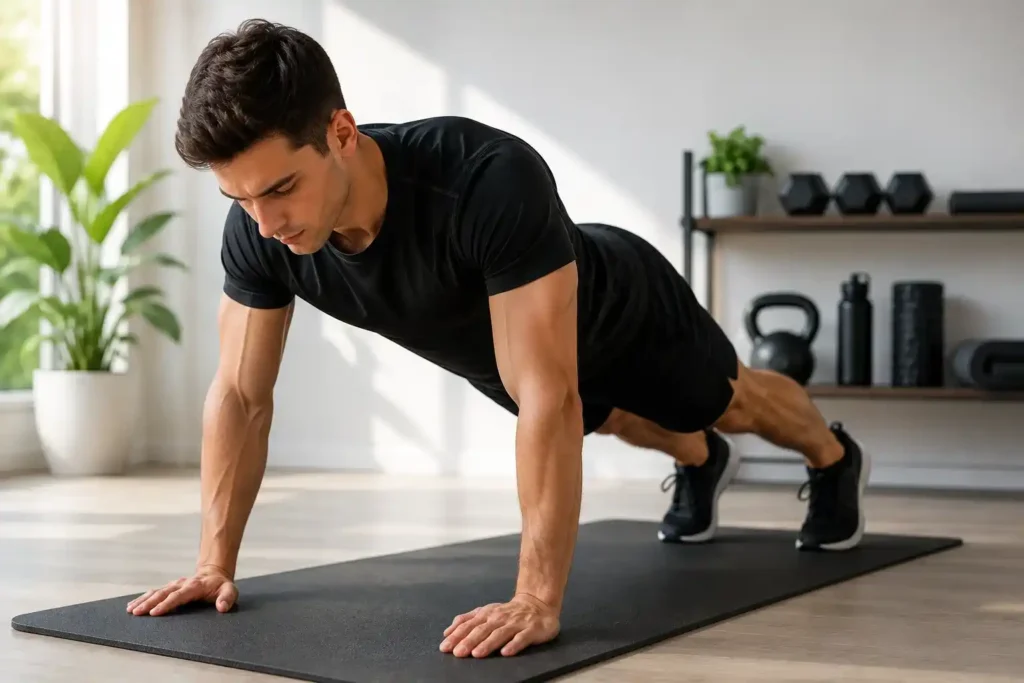
3. Wall or Incline Push-Ups
Traditional push-ups can be challenging for beginners. Wall push-ups or incline push-ups provide easier alternatives.
They primarily train the chest, shoulders, arms, and core.
As your strength improves, you can gradually progress from wall push-ups to incline push-ups and eventually standard push-ups if appropriate.
4. Glute Bridges
Glute bridges are a beginner-friendly bodyweight exercise that targets the muscles around the hips and buttocks.
Perform the movement slowly and focus on controlled motion rather than trying to complete as many repetitions as possible.
5. Step-Ups
Step-ups can help train the legs while adding a cardiovascular component to your workout.
Use a stable, appropriate-height platform and begin slowly. If balance is difficult, choose an easier variation.
6. Planks
Planks are commonly used to train the core.
Beginners can start with a short hold and gradually increase the duration as they become more comfortable.
If a standard plank is too difficult, an easier variation can be used.
7. Cycling
Cycling can be a useful low-impact aerobic activity.
You can cycle outdoors or use a stationary bike. Begin at a comfortable intensity and gradually increase your duration.
8. Swimming
Swimming and water-based activities can provide aerobic exercise while placing relatively low impact on the joints.
Beginners should choose a pace and duration appropriate for their current fitness and swimming ability.
Beginner Exercise Routine: A Simple Weekly Plan
A beginner does not need to exercise intensely every day.
Here is a simple example of a weekly routine:
| Day | Activity |
| Monday | 20–30 minute brisk walk + light mobility |
| Tuesday | Beginner strength workout |
| Wednesday | Rest or easy walking |
| Thursday | 20–30 minute cardio activity |
| Friday | Beginner strength workout |
| Saturday | Easy walk, cycling, or recreational activity |
| Sunday | Rest and recovery |
This is an example rather than a requirement. Your routine should be adjusted according to your fitness level, schedule, preferences, and physical abilities.
Beginner Full-Body Strength Workout
You can start strength training without a gym by using bodyweight exercises.
A simple beginner session might include:
- Bodyweight squats
- Wall or incline push-ups
- Glute bridges
- Step-ups
- Plank or modified plank
- Light mobility exercises
Start with manageable sets and repetitions. The goal during the first few weeks is to learn proper movement patterns and establish consistency.
As your fitness improves, you can gradually increase repetitions, sets, resistance, or exercise difficulty.
How Long Should a Beginner Workout?
A beginner workout does not need to last an hour.
For many people, 20–30 minutes is a practical starting point.
A simple session could look like:
- 5 minutes: warm-up
- 10–15 minutes: main workout
- 5 minutes: easy movement and cooldown
If you currently do very little physical activity, even a shorter session can be a useful starting point. The important thing is to build your activity gradually.
Should You Exercise Every Day?
You can be physically active every day, but that does not mean you need to perform intense workouts every day.
Daily activity could include:
- Walking
- Light cycling
- Household activities
- Mobility exercises
- Recreational activities
Strength workouts may require recovery between sessions, especially when you are new to resistance training.
A balanced routine usually includes a combination of activity and recovery.
Exercise for Weight Loss
Exercise can contribute to weight management, but it is only one part of the equation.
Your energy balance is influenced by how many calories you consume and how much energy your body uses through resting metabolism, physical activity, exercise, and other daily activities.
For people interested in weight management, understanding calorie needs can make an exercise plan more useful.
You can use the Weight Checker TDEE Calculator to estimate your total daily energy expenditure and the Weight Loss Calculator to explore estimated calorie needs for weight loss.
You can also use the Calories Burned Calculator to estimate energy expenditure associated with different physical activities.
Remember that calculator results are estimates rather than exact measurements.
Exercise and Calories Burned
Different activities require different amounts of energy.
Calories burned during exercise can vary based on factors such as:
- Body weight
- Exercise type
- Workout duration
- Exercise intensity
- Fitness level
- Individual differences
For example, a brisk walk generally requires less energy than vigorous running, while a longer workout generally requires more energy than a shorter session.
However, beginners should not focus exclusively on maximizing calories burned. Fitness, strength, consistency, and enjoyment are also important.
How to Warm Up Before Exercise
A warm-up prepares your body for physical activity.
A beginner warm-up can include 5–10 minutes of easy movement, such as:
- Easy walking
- Gentle cycling
- Arm movements
- Hip movements
- Controlled bodyweight movements
The goal is to gradually increase activity rather than immediately beginning with high-intensity exercise.
Why Recovery Matters
Recovery is an important part of a beginner exercise program.
Your body needs time to adapt to new physical demands.
Good recovery habits include:
- Getting adequate sleep
- Drinking enough fluids
- Eating a balanced diet
- Taking rest days when needed
- Avoiding sudden increases in training volume
- Allowing muscles to recover after challenging workouts
If you are extremely sore or unusually fatigued, reducing workout intensity or taking additional recovery time may be appropriate.
How to Progress Your Exercise Routine
One of the biggest beginner mistakes is doing too much too soon.
Instead, increase your activity gradually.
You can progress by changing one factor at a time:
- Exercise for a few more minutes
- Add a small number of repetitions
- Add another set
- Increase walking speed
- Choose a slightly more challenging variation
- Add light resistance
For example, if you currently walk for 15 minutes, you might gradually progress to 20 minutes and later 25–30 minutes.
The exact progression should depend on your starting fitness level and how your body responds.
Common Beginner Exercise Mistakes
Starting Too Intensely
Trying to exercise as hard as possible during your first workout can make the routine difficult to maintain.
Start at a manageable level.
Ignoring Technique
Good movement technique is generally more important than completing a large number of repetitions.
Learn the basic movement before increasing difficulty.
Exercising Without Recovery
More exercise is not always better. Recovery allows your body to adapt to training.
Focusing Only on Cardio
Cardiovascular activity is valuable, but strength training is also an important part of a balanced fitness routine.
Expecting Immediate Results
Fitness improvements take time. Focus on consistent habits rather than expecting dramatic changes after a few workouts.
Comparing Yourself With Other People
Everyone starts from a different fitness level. Your goal should be to improve your own strength, endurance, mobility, and consistency.
How to Stay Consistent With Exercise
The best workout routine is one you can maintain.
Try these strategies:
- Choose activities you enjoy.
- Schedule workouts in advance.
- Start with realistic goals.
- Keep workouts simple.
- Track your progress.
- Exercise with a friend if it helps motivation.
- Avoid trying to change everything at once.
- Celebrate consistency rather than perfection.
The CDC also recommends choosing physical activities that you enjoy and that match your abilities because this can help you stick with physical activity.
Exercise, Nutrition, and Weight Management
Exercise works best as part of an overall healthy lifestyle.
For weight management, consider the bigger picture:
- Regular physical activity
- Appropriate calorie intake
- Adequate protein
- Balanced nutrition
- Sufficient hydration
- Quality sleep
- Stress management
- Consistent habits
Weight Checker provides several tools that can help users understand these areas, including the BMR Calculator, TDEE Calculator, Protein Calculator, Macro Calculator, and Water Intake Calculator.
When Should You Talk to a Healthcare Professional?
Most healthy adults can benefit from becoming more physically active, but some people should seek professional guidance before beginning or significantly changing an exercise program.
Consider speaking with a qualified healthcare professional if you:
- Have a medical condition that may affect exercise
- Have significant joint or mobility limitations
- Experience unexplained chest pain
- Experience severe or unusual shortness of breath
- Have an injury that affects movement
- Are unsure which activities are appropriate for your circumstances
The CDC advises adults with chronic health conditions or disabilities to be as active as their abilities allow and recommends consulting a healthcare professional or physical-activity specialist when appropriate.
Beginner Exercise Guide: Key Takeaways
Starting an exercise routine does not have to be complicated.
If you are a complete beginner:
- Start with manageable activities such as walking.
- Add basic strength exercises.
- Aim for consistency rather than extreme workouts.
- Gradually increase duration and intensity.
- Include recovery days.
- Work toward at least 150 minutes of moderate aerobic activity per week.
- Include muscle-strengthening activity on at least 2 days per week.
- Combine exercise with balanced nutrition and adequate recovery.
- Track progress over time rather than expecting instant results.
For adults, WHO recommends 150–300 minutes of moderate aerobic activity or 75–150 minutes of vigorous activity per week, plus muscle-strengthening activities involving the major muscle groups on at least 2 days per week.
Most importantly, you do not need to be perfect to get started. Begin with what you can do today, build gradually, and make physical activity a sustainable part of your lifestyle.
About Weight Checker
Weight Checker provides free health and fitness calculators designed to help users understand metrics related to weight, calories, nutrition, body composition, and fitness.
Explore the Weight Checker health calculators to estimate BMI, BMR, TDEE, calories, protein, body fat, water intake, and other health-related metrics.
Frequently Asked Questions About Beginner Exercise
What is the best exercise for beginners?
Walking is one of the easiest activities for beginners, while bodyweight exercises such as squats, wall push-ups, glute bridges, and modified planks can provide a simple introduction to strength training.
The best exercise is ultimately one that matches your current ability and that you can perform consistently.
How many days a week should a beginner exercise?
A beginner can start with around 3–5 days of physical activity per week, depending on the type and intensity of exercise. Over time, adults should work toward recommended activity levels, including at least 150 minutes of moderate aerobic activity and muscle-strengthening activity on at least 2 days per week.
How long should a beginner workout?
Around 20–30 minutes can be a practical starting point for many beginners. You can gradually increase workout duration as your fitness improves.
Can beginners exercise at home?
Yes. Many beginner exercises can be performed at home without gym equipment, including squats, wall push-ups, glute bridges, planks, step-ups, walking, and mobility exercises.
Is walking enough exercise for beginners?
Walking is an excellent starting activity and contributes to aerobic physical activity. However, a balanced long-term routine should also include muscle-strengthening activities.
Can exercise help with weight loss?
Exercise can support weight loss by increasing energy expenditure, but weight management also depends on food intake and overall energy balance. Combining regular physical activity with an appropriate nutrition strategy can be more effective than relying on exercise alone.
Should I exercise before or after eating?
There is no single timing rule that works for everyone. Some people prefer exercising before eating, while others feel better after a meal. Experiment with timing and choose what feels comfortable for your body and workout.
Should I exercise every day to lose weight?
You do not need intense exercise every day to manage your weight. A consistent combination of aerobic activity, strength training, daily movement, appropriate nutrition, and recovery is generally more sustainable.
What should I do if I am completely new to exercise?
Start with simple activities such as walking and basic bodyweight movements. Keep the intensity manageable, learn proper technique, allow time for recovery, and gradually increase your activity.