When it comes to nutrition, three nutrients provide most of the energy your body uses every day: protein, carbohydrates, and fat. These are known as macronutrients, or simply macros.
But when comparing protein vs carbs vs fat, which one is the most important? Which is best for weight loss? And how much of each should you eat?
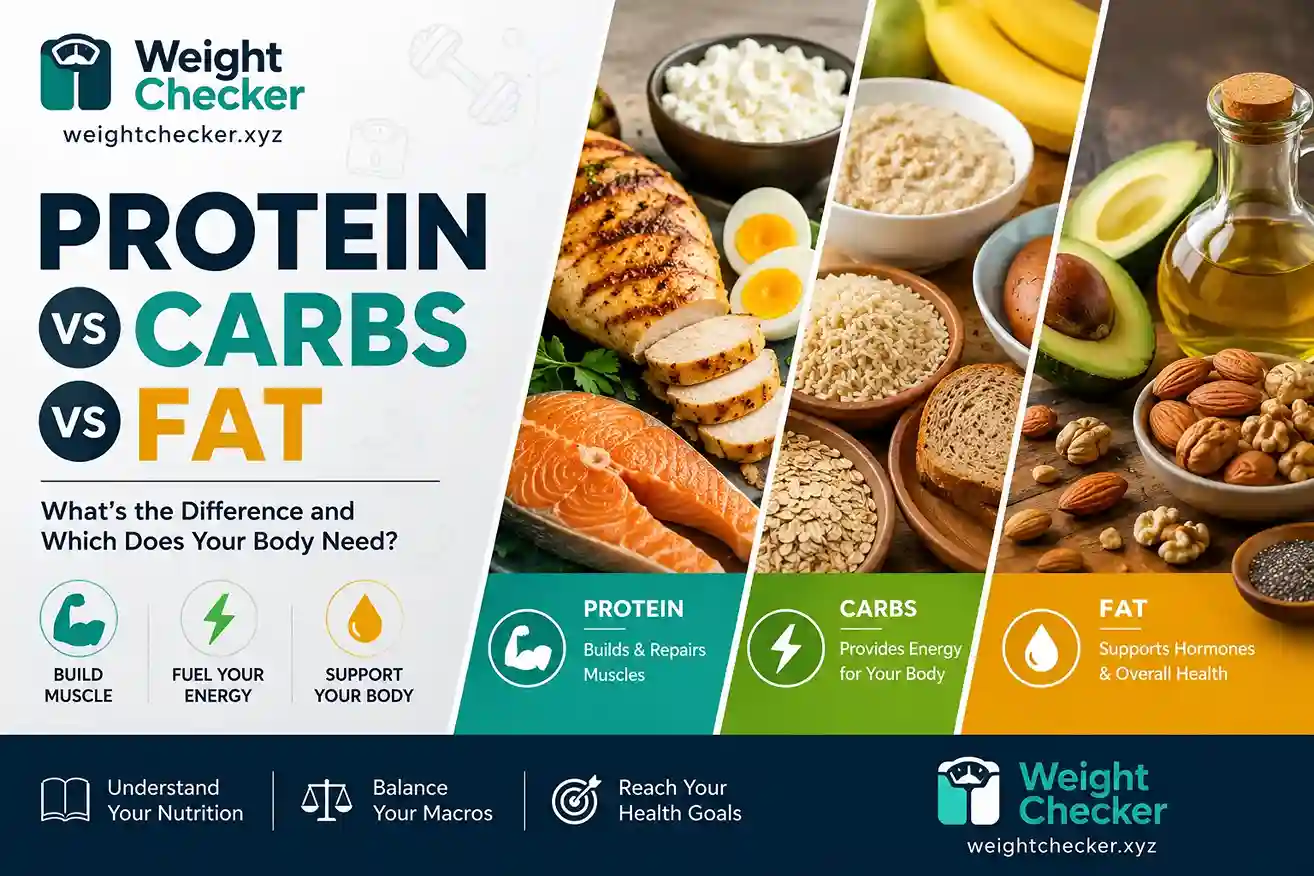
The simple answer is that all three macronutrients have important but different jobs. Protein primarily supports muscle growth and repair, carbohydrates are a major source of energy, and dietary fats support hormones, cell function, and nutrient absorption.
The best balance depends on factors such as your:
- Age
- Body weight
- Activity level
- Fitness goals
- Total calorie needs
- Overall health
This guide from Weight Checker explains the differences between protein, carbs, and fat, including calories per gram, benefits, food sources, and how to balance your macros.
Quick Answer: Protein vs Carbs vs Fat
Protein, carbohydrates, and fats are the three main macronutrients your body needs.
- Protein provides 4 calories per gram and helps build and repair muscles and other tissues.
- Carbohydrates provide 4 calories per gram and are an important source of energy.
- Fat provides 9 calories per gram and supports energy storage, hormones, cells, and the absorption of certain vitamins.
None of these macronutrients is automatically “bad.” A healthy diet usually includes a balance of all three.
What Are Macronutrients?
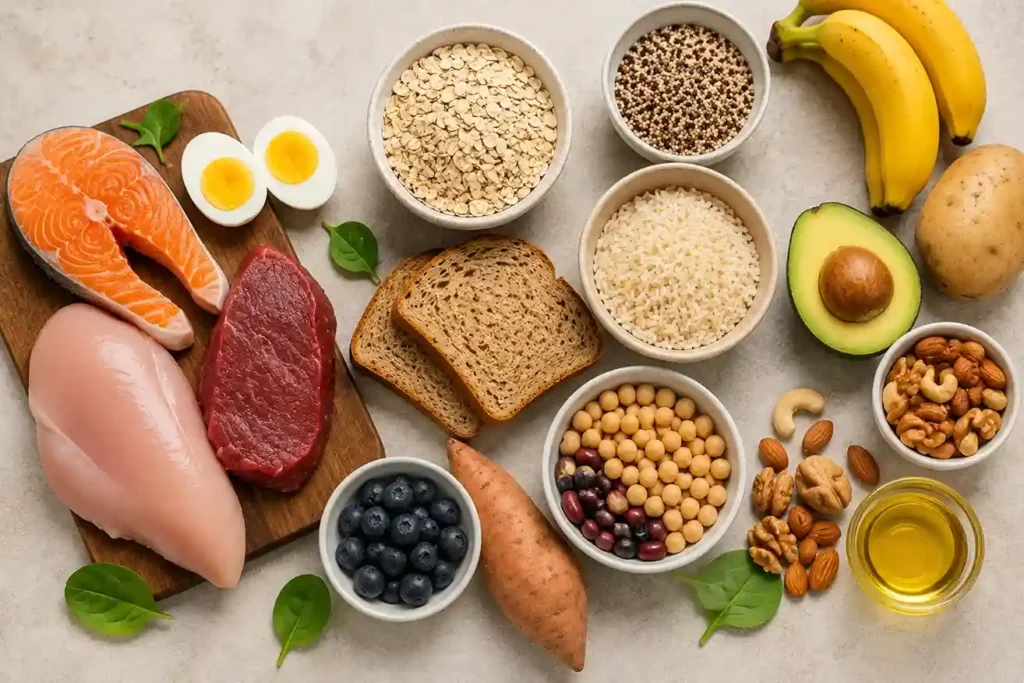
Macronutrients are nutrients that your body needs in relatively large amounts. They provide energy or support essential functions.
The three primary macronutrients are:
- Protein
- Carbohydrates
- Fat
Alcohol also provides calories, but it is not generally considered one of the essential macronutrients needed for optimal nutrition.
Your total intake of protein, carbs, and fat contributes to your daily calorie intake.
Calories Per Gram of Each Macronutrient
| Macronutrient | Calories Per Gram | Main Role |
| Protein | 4 calories | Muscle and tissue repair |
| Carbohydrates | 4 calories | Energy |
| Fat | 9 calories | Hormones, cells and energy storage |
Because fat contains more than twice as many calories per gram as protein or carbohydrates, portion sizes can make a significant difference to your total calorie intake.
Protein: The Macronutrient for Growth and Repair
Protein is made up of smaller components called amino acids. Your body uses amino acids to build, maintain, and repair tissues.
Protein is especially important for:
- Muscle growth and maintenance
- Recovery after exercise
- Tissue repair
- Enzyme production
- Hormone production
- Immune function
- Maintaining lean body mass
How Many Calories Are in Protein?
Protein provides approximately 4 calories per gram.
For example:
- 25 grams of protein = approximately 100 calories
- 50 grams of protein = approximately 200 calories
Common Sources of Protein
Good protein sources include:
- Chicken
- Turkey
- Fish
- Eggs
- Lean meat
- Greek yogurt
- Milk
- Cottage cheese
- Lentils
- Beans
- Chickpeas
- Tofu
- Soy products
- Nuts and seeds
Different protein foods can also provide carbohydrates or fat, so the total nutrition profile depends on the food.
Is Protein the Best Macronutrient for Weight Loss?
Protein can be particularly useful during weight loss because it may help support lean muscle mass and can be filling compared with many lower-protein foods.
However, eating more protein alone does not guarantee weight loss. Your overall calorie intake, food choices, activity level, and long term consistency also matter.
Carbohydrates: Your Body’s Main Energy Source
Carbohydrates are broken down into glucose, which can be used by the body for energy.
Carbs are particularly useful for:
- Daily physical activity
- Exercise performance
- High intensity training
- Brain and nervous system function
- Replenishing muscle glycogen
How Many Calories Are in Carbohydrates?
Carbohydrates provide approximately 4 calories per gram.
For example:
- 25 grams of carbs = approximately 100 calories
- 100 grams of carbs = approximately 400 calories
Types of Carbohydrates
Carbohydrates can generally be divided into several categories.
Sugars
Sugars are simple carbohydrates found naturally in foods such as:
- Fruit
- Milk
They are also found in many processed foods and sweetened drinks.
Starches
Starches are complex carbohydrates found in foods such as:
- Rice
- Potatoes
- Oats
- Bread
- Pasta
- Beans
Fiber
Fiber is a type of carbohydrate that plays an important role in digestive health and can help increase the feeling of fullness.
Common sources include:
- Vegetables
- Fruits
- Beans
- Lentils
- Whole grains
- Nuts
- Seeds
Are Carbs Bad for Weight Loss?
No. Carbohydrates are not automatically bad for weight loss.
Weight gain or weight loss is influenced by overall energy balance and many other factors. The type and quantity of carbohydrates you eat can also affect how satisfying and nutrient-dense your diet is.
For many people, choosing more fiber-rich carbohydrate sources can be a useful strategy.
Examples include:
- Oats
- Brown rice
- Potatoes
- Beans
- Lentils
- Fruits
- Vegetables
- Whole grains
Fat: Essential for Hormones and Healthy Body Function
Dietary fat is often misunderstood because it contains more calories per gram than protein or carbohydrates.
However, fat is an essential part of the diet and supports several important functions.
Dietary fat helps with:
- Energy storage
- Cell structure
- Hormone production
- Absorption of fat soluble vitamins
- Protection of organs
- Insulation and temperature regulation
How Many Calories Are in Fat?
Fat provides approximately 9 calories per gram.
For example:
- 10 grams of fat = approximately 90 calories
- 20 grams of fat = approximately 180 calories
This makes fat more calorie-dense than protein or carbohydrates.
Healthy Sources of Dietary Fat
Examples of nutrient rich fat sources include:
- Avocados
- Nuts
- Seeds
- Olive oil
- Fatty fish
- Nut butters
- Olives
Because fats are calorie dense, portion awareness can be useful when you are trying to manage your calorie intake.
Protein vs Carbs vs Fat: The Main Differences
Here is a simple comparison of the three macronutrients.
| Feature | Protein | Carbohydrates | Fat |
| Calories per gram | 4 | 4 | 9 |
| Primary role | Growth and repair | Energy | Hormones, cells and energy storage |
| Supports muscle | Yes | Indirectly | Indirectly |
| Main energy source | Can provide energy | Major energy source | Energy and storage |
| Essential for body function | Yes | Important | Yes |
| Common food sources | Meat, fish, eggs, beans | Rice, oats, fruit, potatoes | Nuts, seeds, oils, avocado |
The important point is that these macronutrients work together.
For example:
- Protein helps support and maintain muscle.
- Carbohydrates can provide energy for daily activities and training.
- Fat supports hormones, cells, and nutrient absorption.
A diet does not necessarily need to eliminate one macro to be effective.
Which Is Best: Protein, Carbs, or Fat?
There is no single macronutrient that is universally “best.”
The right balance depends on your goal.
For Muscle Building
Protein is particularly important because your body needs amino acids to build and repair muscle tissue.
However, carbohydrates and fats also play important roles in providing energy and supporting overall nutrition.
A muscle-building diet generally focuses on:
- Adequate protein intake
- Sufficient total calories
- Carbohydrates to support training
- Healthy dietary fats
- Resistance training
- Recovery and sleep
For Weight Loss
No single macro automatically causes fat loss.
Weight loss generally requires a sustained calorie deficit, meaning that you consistently consume less energy than your body uses.
Protein may be useful for supporting muscle retention during weight loss, while fiber-rich carbohydrates and appropriate amounts of healthy fats can help create a satisfying diet.
For Energy and Exercise
Carbohydrates can be particularly useful for activities that require quick or high-intensity energy.
However, the ideal amount of carbohydrates depends on factors such as:
- Training intensity
- Exercise duration
- Overall calorie intake
- Individual preferences
For Overall Health
A balanced approach that includes protein, fiber rich carbohydrates, and healthy fats is often easier to maintain than eliminating an entire macronutrient group.
Protein vs Carbs vs Fat for Weight Loss
When your goal is weight loss, the most important factor is usually creating an appropriate calorie deficit while still getting sufficient nutrition.
Instead of asking:
“Should I completely remove carbs or fat?”
A more useful question is:
“Can I create a sustainable calorie deficit while getting enough protein, fiber, vitamins, minerals, and healthy fats?”
A practical approach may include:
- Prioritizing protein-rich foods
- Eating plenty of vegetables and fiber rich foods
- Including carbohydrates based on your activity and preferences
- Including reasonable portions of healthy fats
- Monitoring total calorie intake when necessary
You can use the Weight Checker tools and calculators to estimate your calorie needs and better understand your nutrition targets.
Protein vs Carbs vs Fat for Muscle Gain
Building muscle requires more than simply eating a large amount of protein.
Your overall plan should include:
1. Adequate Protein
Protein provides amino acids that support muscle repair and growth.
2. Enough Calories
Consistently eating too little may make it more difficult to support muscle growth.
3. Carbohydrates for Training
Carbohydrates can help provide energy for workouts and may support performance during demanding training sessions.
4. Healthy Dietary Fats
Fat is important for normal body function and should not automatically be eliminated from a muscle-building diet.
5. Resistance Training
Nutrition works alongside a progressive resistance training program.
Can You Lose Weight Without Carbs?
Yes, it is possible to lose weight on a lower carbohydrate diet if your overall calorie intake supports a calorie deficit.
However, you do not need to completely eliminate carbohydrates to lose weight.
Some people prefer lower carb diets, while others find moderate- or higher-carbohydrate eating patterns easier to maintain.
The best approach is usually one that:
- Meets your nutritional needs
- Supports your lifestyle
- Provides enough energy
- Is enjoyable enough to maintain
- Helps you reach your calorie and fitness goals
Can You Lose Weight Without Fat?
Fat intake should not be unnecessarily eliminated because dietary fat has important functions in the body.
Because fat contains 9 calories per gram, reducing very high-fat foods may help some people lower their calorie intake. However, this is different from trying to eliminate fat completely.
A balanced approach usually includes reasonable amounts of dietary fat from nutritious food sources.
How Much Protein, Carbs, and Fat Should You Eat?
There is no single macro ratio that works perfectly for everyone.
Your ideal intake depends on:
- Body weight
- Age
- Sex
- Activity level
- Exercise routine
- Weight-loss or muscle-gain goals
- Total calorie needs
- Food preferences
Instead of copying someone else’s exact macro numbers, start by estimating your daily calorie needs.
Then consider:
- Setting an appropriate protein target.
- Including sufficient dietary fat.
- Using carbohydrates to fill the remaining calorie needs based on your activity and preferences.
This approach can be more flexible than following one fixed percentage for everyone.
How to Calculate Your Macros
You can calculate your macros using the calorie values of each macronutrient:
- Protein: 4 calories per gram
- Carbohydrates: 4 calories per gram
- Fat: 9 calories per gram
Example
Suppose your daily calorie target is 2,000 calories.
Imagine your macro plan includes:
- 150 grams of protein
- 60 grams of fat
First, calculate the calories:
Protein:
150 × 4 = 600 calories
Fat:
60 × 9 = 540 calories
Total from protein and fat:
600 + 540 = 1,140 calories
Remaining calories:
2,000 − 1,140 = 860 calories
Carbohydrates:
860 ÷ 4 = 215 grams of carbohydrates
This is only an example. Your personal macro targets may be different.
Simple Protein vs Carbs vs Fat Meal Example
A balanced meal might contain all three macronutrients.
For example:
- Grilled chicken for protein
- Rice or potatoes for carbohydrates
- Vegetables for fiber and micronutrients
- Olive oil or avocado for dietary fat
Another example could be:
- Greek yogurt
- Oats
- Berries
- Nuts or seeds
The goal is not necessarily to separate macros. Many whole foods naturally contain a combination of nutrients.
Common Myths About Protein, Carbs, and Fat
Myth 1: Carbs Make You Fat
Carbohydrates alone do not automatically cause body-fat gain. Total energy intake and overall dietary patterns matter.
Myth 2: Eating Fat Makes You Fat
Dietary fat is calorie-dense, but eating fat does not automatically mean you will gain body fat.
Myth 3: More Protein Is Always Better
Protein is important, but extremely high intake is not automatically necessary for everyone. Your ideal amount depends on your body and goals.
Myth 4: You Should Completely Avoid One Macronutrient
Most people do not need to eliminate an entire macronutrient group. A sustainable and nutritionally adequate diet is generally more important than following extreme rules.
How to Balance Protein, Carbs, and Fat
A practical way to build your diet is to focus on food quality first and then adjust your macro intake according to your goals.
A Simple Approach
Prioritize protein:
Include protein-rich foods in your meals.
Add fiber rich carbohydrates:
Choose foods such as vegetables, fruits, beans, oats, potatoes, and whole grains.
Include healthy fats:
Add reasonable portions of foods such as nuts, seeds, avocado, olive oil, and fatty fish.
Monitor total calories:
Your calorie intake is particularly important when your goal is weight loss or weight gain.
Adjust based on results:
Your body weight, performance, energy levels, hunger, and progress can help you determine whether your nutrition plan needs adjustment.
Which Macronutrient Is Most Important for Weight Loss?
There is no single “magic” macronutrient for weight loss.
A calorie deficit is generally required for fat loss. However, protein is often prioritized because it can help support lean mass while dieting.
The best macro balance is usually one that allows you to:
- Maintain an appropriate calorie deficit
- Eat enough protein
- Get sufficient fiber
- Meet essential nutrient needs
- Feel satisfied
- Maintain the plan consistently
Which Macronutrient Is Most Important for Muscle Gain?
Protein is essential for muscle growth and repair, but successful muscle gain also depends on:
- Adequate calorie intake
- Effective resistance training
- Carbohydrates and fats as part of overall nutrition
- Recovery
- Consistency
In other words, protein is crucial, but muscle growth does not depend on protein alone.
Final Thoughts: Protein vs Carbs vs Fat
When comparing protein vs carbs vs fat, the winner is not one macronutrient it is the right balance for your body and goals.
Here is the simple breakdown:
- Protein supports muscle growth, repair, and other essential body functions.
- Carbohydrates provide energy and can support physical activity and exercise.
- Fat supports hormones, cells, energy storage, and nutrient absorption.
For weight loss, focus on creating a sustainable calorie deficit while consuming sufficient protein and nutrient-rich foods.
For muscle gain, combine adequate protein and calories with consistent resistance training and recovery.
Instead of eliminating carbs or fearing dietary fat, focus on building a balanced eating pattern that you can maintain long term.
Use Weight Checker to better understand your calorie needs, protein intake, and other nutrition targets. Once you understand how protein, carbohydrates, and fat work together, you can make more informed decisions based on your personal health and fitness goals.
Frequently Asked Questions About Protein vs Carbs vs Fat
Is protein better than carbs?
Neither is universally better. Protein is especially important for muscle maintenance and repair, while carbohydrates are an important source of energy. Your ideal intake depends on your goals and activity level.
Are carbs or fats better for weight loss?
Both can fit into a weight-loss diet. The most effective approach is usually one that helps you maintain a calorie deficit while meeting your nutritional needs and remaining sustainable.
Does fat contain more calories than protein and carbs?
Yes. Fat provides approximately 9 calories per gram, while protein and carbohydrates each provide approximately 4 calories per gram.
Should I eat more protein than carbs?
Not necessarily. The right balance depends on your calorie needs, activity level, training, and goals. Highly active individuals may require more carbohydrates than less active people.
Can I eat carbs and still lose belly fat?
Yes. You can eat carbohydrates while losing body fat. Spot reduction is not generally possible, so overall fat loss occurs according to your body’s individual pattern.
What happens if I eat too much protein?
Eating more protein than your body needs does not automatically produce additional muscle. Total calorie intake and individual circumstances still matter.
Should I avoid fat when trying to lose weight?
No. Dietary fat performs important functions in the body. Because it is calorie-dense, portion awareness may be helpful when managing calorie intake.
Can I build muscle on a low carb diet?
It is possible to build muscle with different dietary approaches, including lower-carbohydrate diets. However, some people find that adequate carbohydrate intake supports their training performance.
What is the best ratio of protein, carbs, and fat?
There is no universal best ratio. The ideal balance depends on your individual calorie needs, activity level, health, and goals.