
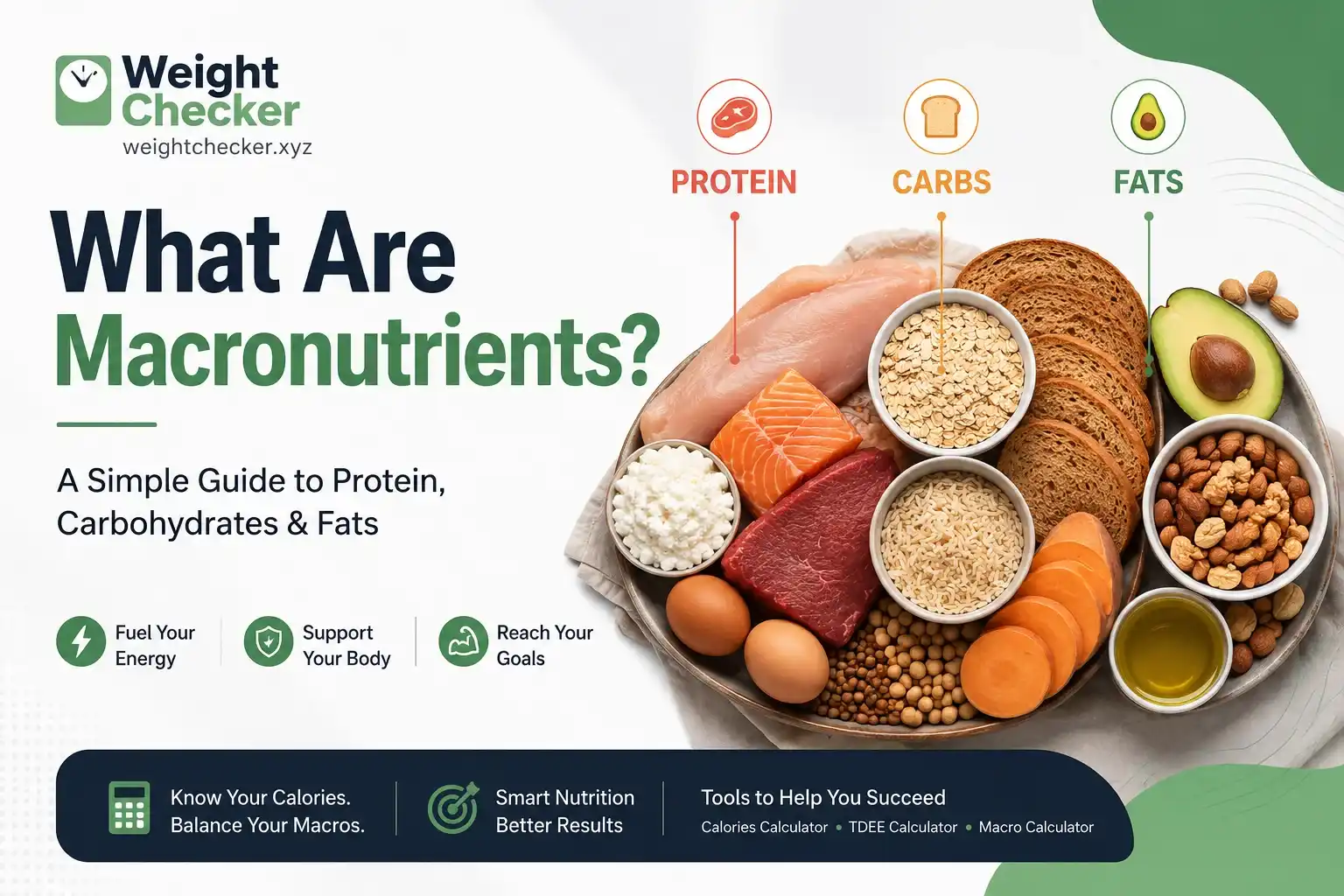
Macronutrients are nutrients that your body needs in relatively large amounts to provide energy, support growth, repair tissues, and maintain essential body functions. The three main macronutrients are protein, carbohydrates, and fats.
Understanding what macronutrients are can make it easier to manage your calories, build a balanced diet, support muscle growth, and work toward weight-loss or weight-gain goals.
In simple terms:
- Protein helps build and repair muscles and other tissues.
- Carbohydrates are the body’s main source of readily available energy.
- Fats provide concentrated energy and support hormones, cells, and vitamin absorption.
This guide from Weight Checker explains what macronutrients are, what each one does, how many calories they provide, and how they fit into a healthy diet.
What Are Macronutrients?
Macronutrients are nutrients that the body requires in larger quantities compared with micronutrients such as vitamins and minerals. They provide energy and supply the building blocks your body needs for normal function.
The three primary macronutrients are:
- Protein
- Carbohydrates
- Fat
Alcohol can also provide calories, but it is not considered one of the three essential macronutrients.
The amount of each macronutrient you need can vary depending on factors such as your age, body size, activity level, health needs, and fitness goals.

The 3 Main Macronutrients
1. Protein
Protein is an essential macronutrient made up of amino acids. Your body uses protein to build and repair tissues, including muscles.
Protein is particularly important for people who exercise regularly or are trying to maintain muscle while losing weight.
Good sources of protein include:
- Chicken and other poultry
- Fish and seafood
- Eggs
- Milk and yogurt
- Beans and lentils
- Tofu and other soy foods
- Nuts and seeds
- Lean meats
Protein provides approximately 4 calories per gram.
2. Carbohydrates
Carbohydrates are an important source of energy. Your body breaks down many carbohydrates into glucose, which can be used by cells for fuel.
Carbohydrates are found in foods such as grains, fruits, vegetables, legumes, and dairy products.
Examples of carbohydrate-rich foods include:
- Rice
- Oats
- Potatoes
- Whole-grain bread
- Fruits
- Vegetables
- Beans
- Lentils
Carbohydrates provide approximately 4 calories per gram.
Not all carbohydrate foods have the same nutritional value. Foods such as whole grains, fruits, vegetables, and legumes can provide fiber and other important nutrients.
3. Fat
Fat is another essential macronutrient. Although it contains more calories per gram than protein or carbohydrates, dietary fat plays several important roles in the body.
Fat helps:
- Provide energy
- Support cell structure
- Produce certain hormones
- Absorb fat-soluble vitamins
- Protect organs
- Support normal body functions
Sources of dietary fat include:
- Avocados
- Nuts
- Seeds
- Olive oil
- Peanut butter
- Fatty fish
- Eggs
- Dairy products
Fat provides approximately 9 calories per gram.
Choosing mostly unsaturated fats, such as those found in nuts, seeds, fish, and many plant oils, can be part of a heart-healthy eating pattern.
How Many Calories Are in Each Macronutrient?
Each macronutrient provides a different amount of energy.
| Macronutrient | Calories per gram |
| Protein | 4 calories |
| Carbohydrates | 4 calories |
| Fat | 9 calories |
For example, a meal containing 20 grams of protein provides about 80 calories from protein alone.
The calculation is:
20 × 4 = 80 calories
Similarly, 10 grams of fat provide approximately:
10 × 9 = 90 calories
This is why understanding macronutrients can be useful when managing your overall calorie intake.
Why Are Macronutrients Important?
Macronutrients provide more than just calories. Each one has a specific role in keeping your body functioning properly.
Protein supports muscle and tissue
Your body needs protein to maintain and repair tissues. Adequate protein intake can be particularly important during resistance training, muscle-building programs, and calorie-restricted diets.
Carbohydrates provide energy
Carbohydrates can provide readily available fuel for everyday activities and exercise. The body’s glucose and stored carbohydrate reserves can be used when energy is needed.
Fat supports essential functions
Dietary fat contributes to cell structure, hormone production, energy storage, and absorption of vitamins A, D, E, and K.
A balanced diet generally includes all three macronutrients rather than eliminating an entire macronutrient category without a specific reason.
Macronutrients vs. Micronutrients
The main difference is the amount your body needs.
Macronutrients are needed in larger amounts and include:
- Protein
- Carbohydrates
- Fat
Micronutrients are needed in much smaller amounts and include:
- Vitamins
- Minerals
Both are important. Macronutrients primarily provide energy and building materials, while micronutrients support numerous processes involved in health and normal body function.
How Do Macronutrients Affect Weight Loss?
Macronutrients can influence the quality, fullness, and nutritional value of your diet, but total calorie intake is an important factor in body-weight change.
For weight loss, many people focus on creating a sustainable calorie deficit while consuming adequate protein and a balanced mix of carbohydrates and fats.
For example, a balanced weight-loss diet may emphasize:
- Adequate protein
- High-fiber carbohydrate sources
- Nutrient-dense foods
- Healthy sources of dietary fat
- Appropriate portion sizes
- A sustainable calorie intake
You can use the Weight Checker calorie and TDEE tools to estimate your energy needs and then consider how your macronutrients fit within your calorie target.
How Do Macronutrients Affect Muscle Gain?
Macronutrients also matter when your goal is to build muscle.
Protein provides amino acids needed for muscle repair and growth, while carbohydrates can help provide energy for training. Dietary fat supports important biological functions and contributes to your overall calorie intake.
For muscle gain, a balanced approach can include:
- Sufficient protein
- Enough total calories
- Carbohydrates to support training
- Dietary fats for overall nutrition
- Regular resistance training
- Adequate sleep and recovery
Simply eating more protein does not automatically result in muscle growth. Training, total calorie intake, recovery, and overall diet quality also matter.
How Should You Balance Your Macronutrients?
There is no single macronutrient ratio that is perfect for everyone.
Your ideal balance can depend on:
- Age
- Sex
- Height
- Weight
- Physical activity
- Training style
- Weight-loss goals
- Muscle-building goals
- Personal food preferences
Instead of focusing only on a fixed percentage, consider your overall calorie needs, protein requirements, food quality, and lifestyle.
For a more personalized starting point, you can use a TDEE calculator to estimate how many calories your body may use each day and then determine an appropriate calorie and macronutrient strategy.
A Simple Macronutrient Example
Suppose someone follows a diet providing 2,000 calories per day.
One possible example is:
- 30% protein: 600 calories ÷ 4 = 150 grams
- 40% carbohydrates: 800 calories ÷ 4 = 200 grams
- 30% fat: 600 calories ÷ 9 ≈ 67 grams
This is only an example, not a universal recommendation. Individual macronutrient needs can vary considerably.
Do You Need to Track Macronutrients?
Not everyone needs to track macros.
Some people find tracking useful because it helps them understand how much protein, carbohydrate, and fat they consume. Others prefer a simpler approach based on balanced meals and portion awareness.
Macro tracking may be useful if you:
- Have a specific fitness goal
- Want to monitor protein intake
- Are following a structured nutrition plan
- Want greater awareness of your food intake
- Are working toward a particular body-composition goal
If tracking causes unnecessary stress, a balanced eating pattern without detailed macro counting may be a better approach.
The Bottom Line
So, what are macronutrients? They are the three major nutrients your body needs in relatively large amounts: protein, carbohydrates, and fat.
Protein supports tissue maintenance and repair, carbohydrates provide an important source of energy, and fats support cell function, vitamin absorption, and other essential processes.
Understanding macronutrients can help you make more informed nutrition decisions, whether your goal is weight loss, maintaining your weight, or building muscle.
For a more personalized approach, use the tools available from Weight Checker to estimate your calorie needs and better understand how nutrition fits into your fitness goals.
Frequently Asked Questions
What are macronutrients?
Macronutrients are nutrients your body needs in relatively large amounts. The three main macronutrients are protein, carbohydrates, and fat. They provide energy and support important functions such as tissue repair, physical activity, and normal body processes.
What are the 3 main macronutrients?
The three main macronutrients are protein, carbohydrates, and fat. Protein and carbohydrates provide about 4 calories per gram, while fat provides about 9 calories per gram.
Which macronutrient is most important?
There is no single macronutrient that is universally the most important. Protein, carbohydrates, and fat each perform different roles, and a balanced diet can include all three.
How many calories are in protein?
Protein provides approximately 4 calories per gram.
How many calories are in carbohydrates?
Carbohydrates provide approximately 4 calories per gram.
How many calories are in fat?
Fat provides approximately 9 calories per gram, making it the most calorie-dense of the three main macronutrients.
Do macronutrients matter for weight loss?
Yes. Macronutrients influence the nutritional quality of your diet, protein intake, fullness, and energy intake. However, overall calorie balance is an important factor in weight management.
Do I need to count macros to lose weight?
No. Counting macros is optional. Some people find it helpful, while others can reach their goals by focusing on appropriate portions, nutritious foods, protein intake, and overall calorie intake.