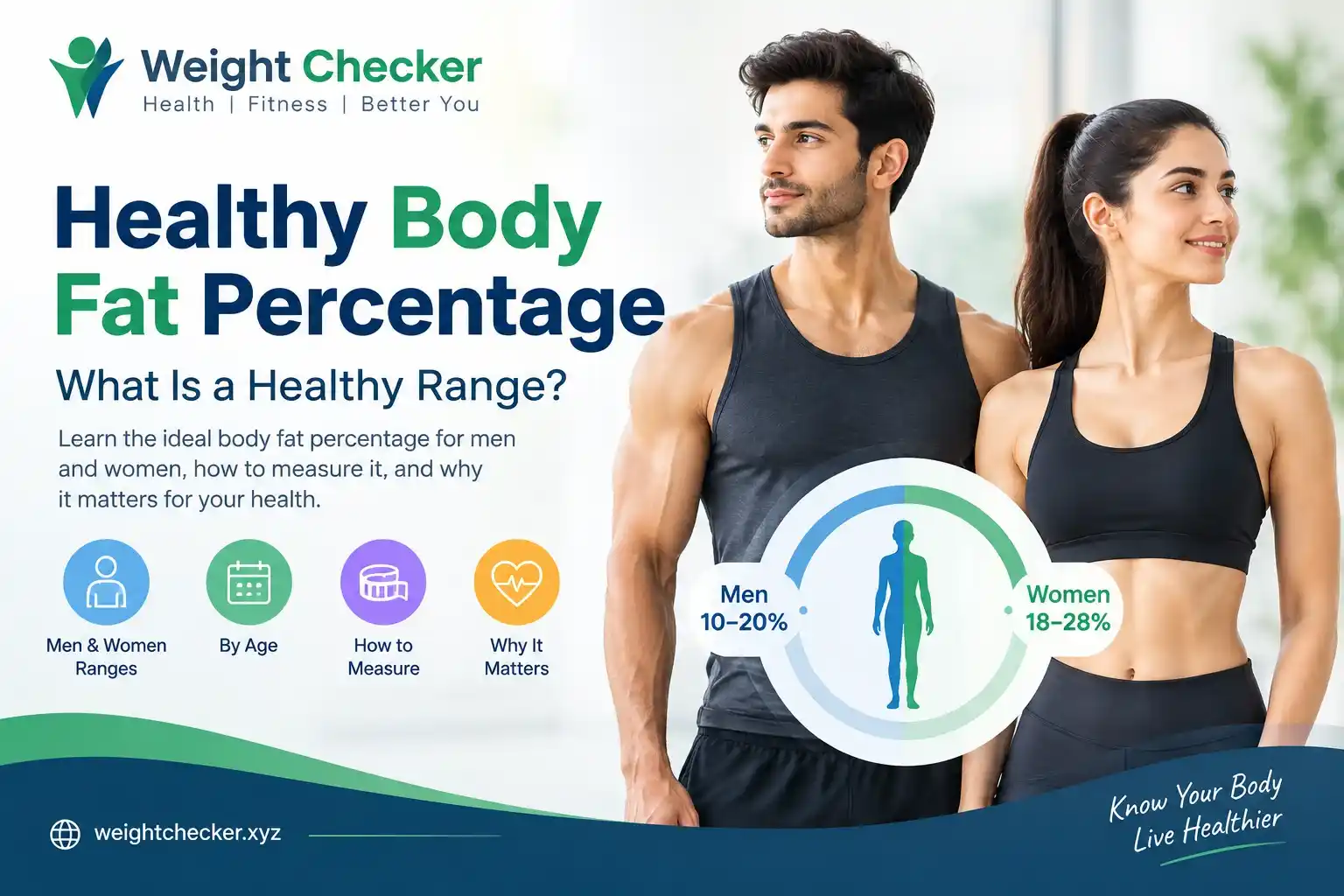
Body fat percentage is the amount of your total body weight that comes from fat. Having some body fat is essential because your body needs fat for energy storage, hormone production, insulation, and protecting organs.
So, what is a healthy body fat percentage?
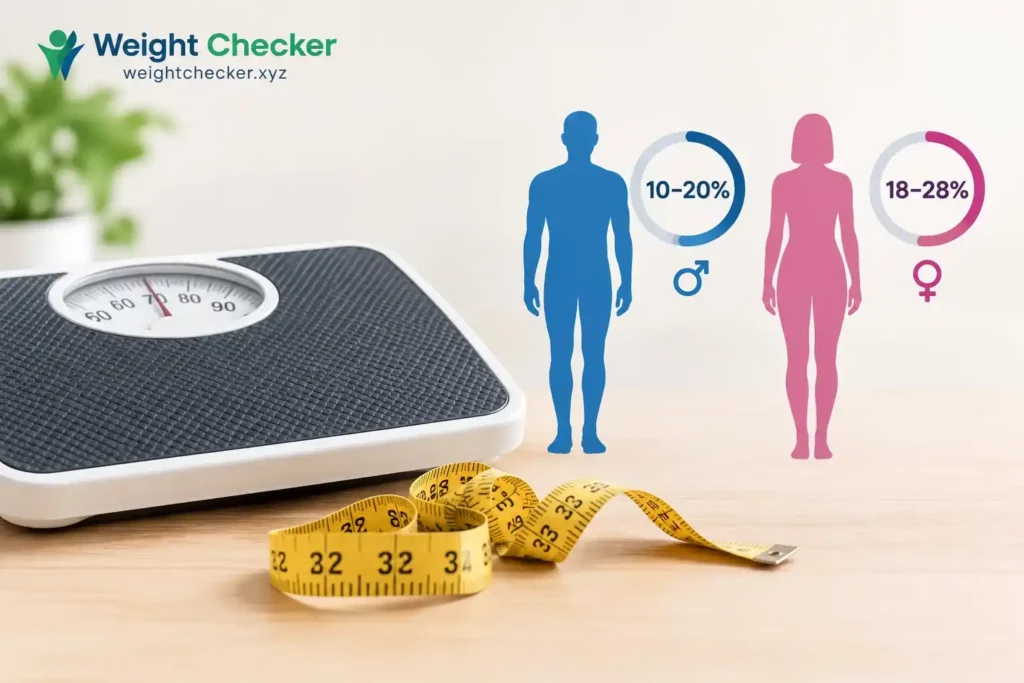
For many adults, a body fat percentage somewhere around 10–20% for men and 18–28% for women is often considered a healthy general range, although the appropriate range varies with age, sex, genetics, fitness level, and other factors.
Body fat percentage is only one measure of health. It should be considered alongside factors such as waist circumference, BMI, fitness, nutrition, blood pressure, and overall lifestyle.
What Is Body Fat Percentage?
Body fat percentage refers to the percentage of your total body weight that is fat.
For example, if someone weighs 80 kg and has a body fat percentage of 20%, approximately 16 kg of their body weight is fat.
The remaining weight includes:
- Muscle
- Bones
- Organs
- Water
- Connective tissue
- Other lean body tissues
Body Fat Percentage Formula
You can estimate body fat percentage using:
Body Fat % = (Body Fat Weight ÷ Total Body Weight) × 100
However, accurately determining body fat weight can be difficult without an appropriate measurement method.
What Is a Healthy Body Fat Percentage?
There isn’t one body fat percentage that is perfect for everyone.
A healthy range depends on several factors, including:
- Sex
- Age
- Genetics
- Activity level
- Muscle mass
- Fitness goals
- Overall health
As a general reference, many adult men may fall within approximately 10–20%, while adult women may commonly fall within approximately 18–28%.
These figures should be treated as general guidance rather than strict medical cutoffs.
Healthy Body Fat Percentage for Men
Men generally have lower essential body fat requirements than women.
A general guide is:
| Body Fat % | General Description |
| Below 6% | Very low |
| 6–13% | Athletic/very lean |
| 14–17% | Lean/fit |
| 18–24% | Generally healthy range for many adults |
| 25%+ | Higher body fat |
The exact interpretation can vary depending on age and the measurement method.
Very low body fat isn’t automatically healthier. Maintaining extremely low body fat for long periods may be difficult and can potentially affect normal body functions.
Healthy Body Fat Percentage for Women
Women naturally require a higher percentage of body fat than men because body fat plays important physiological and reproductive roles.
A general guide is:
| Body Fat % | General Description |
| Below 14% | Very low |
| 14–20% | Athletic/very lean |
| 21–24% | Lean/fit |
| 25–31% | Generally healthy range for many adults |
| 32%+ | Higher body fat |
Again, these categories are approximate. Age, genetics, pregnancy, fitness level, and measurement technique can all affect interpretation.
Healthy Body Fat Percentage by Age
Body fat percentage often changes naturally as people get older.
As age increases, people may:
- Lose muscle mass
- Become less physically active
- Store more body fat
- Experience changes in metabolism and hormones
Because of this, a body fat percentage that is considered reasonable for a younger adult may not have the same interpretation in an older adult.
Instead of focusing on one “perfect” number, it is usually more useful to monitor long term trends.
For example, if your body fat percentage gradually increases while your activity decreases and waist circumference increases, that trend may be more meaningful than a single measurement.
Why Is Body Fat Important?
Body fat isn’t simply something that should be eliminated.
Your body needs a certain amount of fat to function properly.
Healthy levels of body fat can support:
- Energy storage
- Hormone production
- Temperature regulation
- Protection of internal organs
- Absorption of fat-soluble vitamins
- Normal cellular function
- Reproductive health
The goal isn’t to have zero body fat. The goal is to maintain a level that supports your health and lifestyle.
Essential Fat vs. Stored Body Fat
Not all body fat serves exactly the same purpose.
Essential Fat
Essential fat is the minimum amount of fat your body needs for normal physiological function.
It plays an important role in:
- Hormonal function
- Cell membranes
- Organ protection
- Reproductive function
- Nervous system function
Stored Fat
Stored fat is additional energy stored in fat tissue.
Your body can use stored fat as an energy source when energy intake is lower than energy expenditure.
Having too much stored body fat, particularly around the abdomen, can be associated with increased health risks.
Is Lower Body Fat Always Better?
No. Lower body fat is not always healthier.
This is an important point when setting fitness goals.
Extremely low body fat may be difficult to maintain and can sometimes be associated with:
- Low energy
- Poor recovery
- Hormonal changes
- Reduced performance
- Difficulty maintaining normal physiological functions
Instead of trying to achieve the lowest possible body fat percentage, focus on a healthy and sustainable range.
How Is Body Fat Percentage Measured?
There are several methods for estimating body fat.
1. Skinfold Measurements
A caliper is used to measure the thickness of skinfolds at specific locations on the body.
Advantages:
- Affordable
- Portable
- Quick
Limitations:
- Requires proper technique
- Results can vary between testers
- Less reliable when measurements are performed incorrectly
2. Bioelectrical Impedance Analysis
Many smart scales and body composition devices use BIA.
The device sends a very small electrical current through the body and uses impedance measurements to estimate body composition.
Results can be influenced by:
- Hydration
- Food intake
- Exercise
- Time of day
- Recent fluid consumption
Therefore, consistency is important when tracking changes.
3. DEXA Scan
DEXA can provide detailed information about body composition and can estimate:
- Fat mass
- Lean mass
- Bone mineral content
It is generally more sophisticated than home body fat scales but is less convenient and more expensive.
4. Body Circumference Measurements
Certain formulas can estimate body fat using measurements such as:
- Waist circumference
- Neck circumference
- Height
- Hip circumference in some cases
These methods provide estimates, not exact measurements.
Body Fat Percentage vs. BMI
Body fat percentage and BMI are not the same thing.
BMI uses your height and weight to calculate a numerical value:
BMI = Weight (kg) ÷ Height² (m²)
BMI does not directly measure how much of your body weight is fat.
For example, someone with a lot of muscle may have a relatively high BMI despite having a healthy body fat percentage.
That’s why body composition can provide additional information that BMI alone cannot.
You can also use the Weight Checker BMI Calculator alongside body-fat information to get a broader picture of your measurements.
What Is a Healthy Body Fat Percentage for Muscle Gain?
If your goal is to build muscle, you don’t necessarily need to maintain extremely low body fat.
A sustainable approach usually involves:
- Eating enough protein
- Consuming adequate calories
- Performing resistance training
- Getting enough sleep
- Allowing adequate recovery
- Monitoring changes in body weight and body composition
The goal is generally to build muscle while avoiding unnecessary increases in body fat.
For beginners, focusing on strength, consistency, nutrition, and recovery can be more useful than obsessing over a specific body fat number.
What Is a Healthy Body Fat Percentage for Weight Loss?
If you want to lose body fat, a gradual approach is generally more sustainable than trying to lose weight extremely quickly.
Helpful habits include:
- Maintaining a moderate calorie deficit
- Eating adequate protein
- Strength training regularly
- Staying physically active
- Getting sufficient sleep
- Drinking enough water
- Tracking progress consistently
Remember that scale weight can fluctuate because of water, glycogen, food intake, and other factors.
Therefore, consider multiple measurements rather than relying only on the scale.
How to Reduce Body Fat Safely
If your body fat percentage is higher than you’d like, focus on sustainable lifestyle changes.
1. Create a Moderate Calorie Deficit
Fat loss generally requires your body to use more energy than you consume over time.
A moderate calorie deficit can be easier to maintain than an extremely restrictive diet.
2. Eat Enough Protein
Protein helps support muscle maintenance and recovery.
Good protein sources include:
- Eggs
- Chicken
- Fish
- Greek yogurt
- Milk
- Beans
- Lentils
- Tofu
- Lean meat
3. Strength Train
Resistance training can help preserve or build muscle while you’re working toward fat loss.
Exercises can include:
- Squats
- Push-ups
- Rows
- Lunges
- Pull-ups
- Shoulder presses
- Deadlifts
4. Stay Active
You don’t need to spend hours in the gym.
Walking, cycling, sports, and other physical activities can help increase daily energy expenditure.
5. Prioritize Sleep
Poor sleep can make healthy eating and exercise more difficult.
Aim for a consistent sleep schedule and adequate sleep each night.
How to Maintain a Healthy Body Fat Percentage
Once you reach a body composition you’re comfortable with, maintaining it usually comes down to consistent habits.
Focus on:
- Balanced nutrition
- Regular exercise
- Strength training
- Adequate protein
- Daily movement
- Good sleep
- Stress management
- Regular progress tracking
You don’t need to follow a perfect diet.
Consistency over time matters more than perfection.
How Accurate Are Body Fat Calculators?
Body fat calculators provide an estimate, not an exact measurement.
Different methods can produce different results because body composition measurements are affected by factors such as:
- Hydration
- Measurement technique
- Device accuracy
- Time of day
- Recent exercise
- Food intake
- Individual body composition
For this reason, it’s better to use the same method consistently when tracking changes.
A single body fat percentage should not be treated as a definitive diagnosis of health.
What Body Fat Percentage Should You Aim For?
There is no universal “perfect” body fat percentage.
A reasonable target should depend on:
- Your age
- Sex
- Current body composition
- Fitness goals
- Lifestyle
- Personal preferences
- Overall health
For many people, maintaining a moderate, sustainable body fat level is more realistic and beneficial than trying to achieve an extremely lean physique.
If you’re an athlete or have a specific performance goal, your appropriate range may be different.
Final Takeaway
A healthy body fat percentage isn’t about reaching the lowest possible number.
Your ideal range depends on your sex, age, genetics, muscle mass, activity level, and overall health. For general adult guidance, approximately 10–20% for men and 18–28% for women can be used as a broad reference, but these numbers shouldn’t be treated as strict medical limits.
For a better understanding of your overall health and body composition, consider body fat percentage alongside BMI, waist circumference, activity level, nutrition, fitness, and other health indicators.
At Weight Checker, our goal is to make health and body composition information easier to understand so you can make more informed decisions about your fitness and wellness journey.
Explore more health and fitness guides at Weight Checker — weightchecker.xyz.
Frequently Asked Questions About Healthy Body Fat Percentage
What is a healthy body fat percentage?
A commonly used general range is around 10–20% for adult men and 18–28% for adult women, but healthy levels vary based on age, genetics, fitness, and other factors.
Is 20% body fat healthy?
For many adult men, 20% body fat can fall within a generally healthy range. For women, 20% is relatively lean. Individual health should not be judged from body-fat percentage alone.
Is 15% body fat healthy?
For many men, 15% body fat is considered relatively lean and can be compatible with good health. For women, 15% is quite lean and may not be appropriate for everyone.
Is 25% body fat healthy?
It depends on sex and age. Around 25% may fall within a commonly used healthy or moderate range for many women, while it is generally higher for men. Context matters.
What is a healthy body fat percentage for men?
A broad general range for many adult men is approximately 10–20%, although the appropriate range varies by age and individual factors.
What is a healthy body fat percentage for women?
A broad general range for many adult women is approximately 18–28%, although individual needs vary.
Can you have a healthy BMI but high body fat?
Yes. BMI doesn’t directly measure body fat. Someone can have a BMI within the normal range while having relatively high body fat, sometimes referred to as “normal-weight obesity.”
Is body fat percentage better than BMI?
Neither measurement is perfect. Body fat percentage provides information about body composition, while BMI is a simple screening measure based on height and weight. Using both can provide more context than relying on either one alone.
How can I lower my body fat percentage?
A combination of a moderate calorie deficit, adequate protein, strength training, regular physical activity, sufficient sleep, and consistency can help reduce body fat over time.
Can body fat percentage change from day to day?
Yes. Measurements can fluctuate because of hydration, food intake, exercise, and measurement conditions. It’s better to monitor trends over time.