
If you are tracking your body composition, you may have come across terms such as lean body mass, lean mass, fat free mass, and muscle mass. These terms can sound similar, but they do not necessarily mean the same thing.
So, what is the difference between lean body mass vs muscle mass?
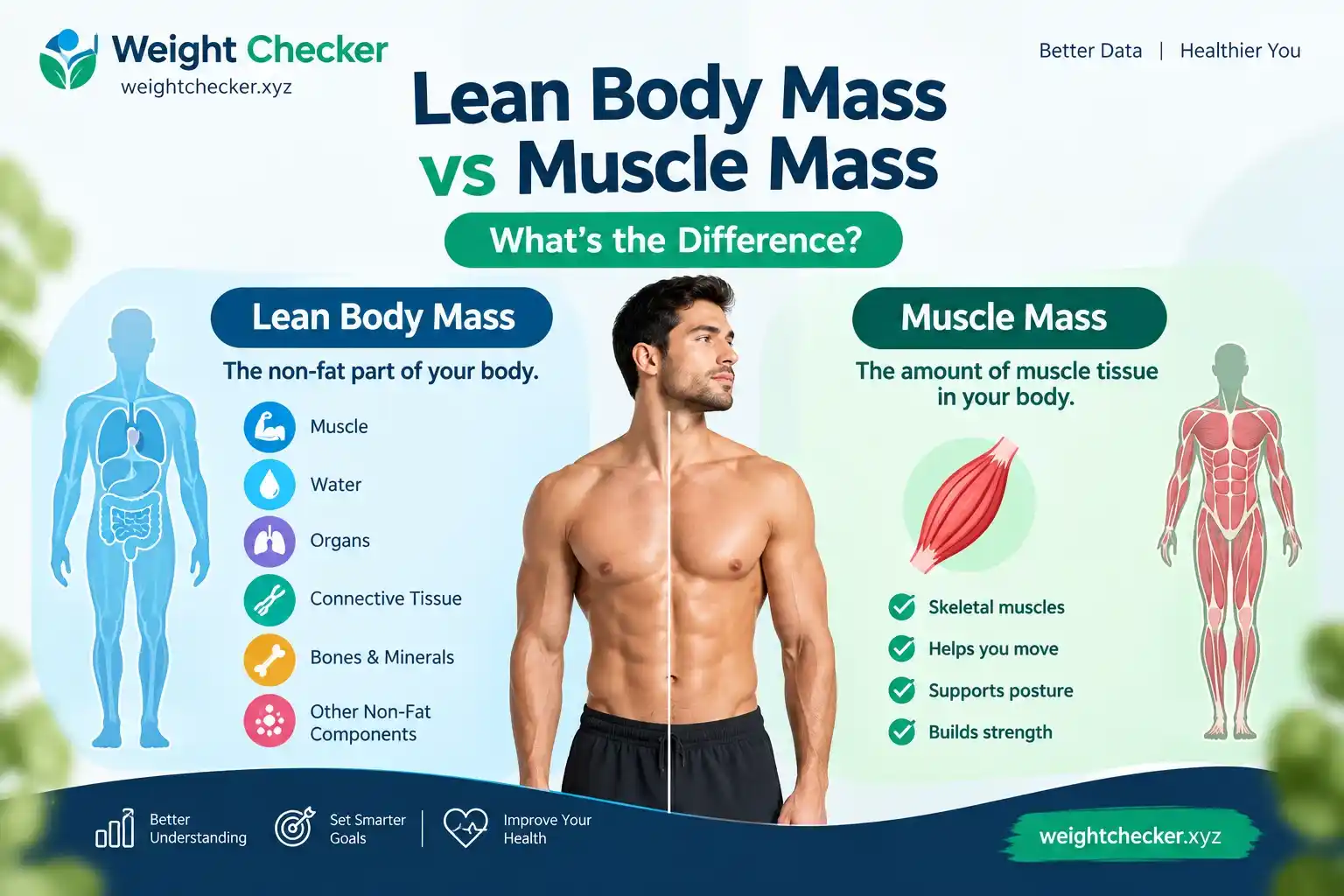
Lean body mass refers broadly to the non-fat portion of your body, while muscle mass specifically refers to the amount of muscle tissue in your body. Muscle is therefore one important component of your lean mass, but lean mass also includes other tissues and substances such as water, organs, connective tissue, minerals, and other non-fat components.
Understanding this difference can help you interpret body composition measurements more accurately and set better fitness, weight loss, or muscle building goals.

What Is Lean Body Mass?
Lean body mass (LBM) is a commonly used term for the portion of your body that is not stored body fat.
Depending on the measurement method and terminology being used, lean body mass can include:
- Skeletal muscle
- Body water
- Organs
- Connective tissue
- Bones and minerals
- Glycogen and other non-fat components
Modern body composition research often prefers the more precise term fat free mass (FFM) because “lean body mass” has historically been used in different ways. Contemporary scientific literature distinguishes fat-free mass, lean soft tissue, and skeletal muscle rather than treating them as identical measurements.
For everyday health and fitness discussions, however, LBM is still widely used.
Simple Example
Imagine two people who each weigh 80 kg.
They could have very different body compositions:
Person A
- 20 kg body fat
- 60 kg lean mass
Person B
- 10 kg body fat
- 70 kg lean mass
Even though both people weigh 80 kg, Person B has a greater amount of non-fat mass.
This is one reason why body weight alone does not tell you how much muscle you have.
What Is Muscle Mass?
Muscle mass refers specifically to the amount of muscle tissue in the body.
When people talk about gaining muscle at the gym, they are usually talking about increasing skeletal muscle mass.
Skeletal muscles are the muscles attached to your bones that help you:
- Move your body
- Maintain posture
- Produce force
- Perform exercise
- Support physical activity
Muscle mass is therefore much more specific than lean body mass.
Research on body composition emphasizes that skeletal muscle is a tissue level component and should not simply be treated as identical to lean mass or fat free mass.
Lean Body Mass vs Muscle Mass: Key Difference
The easiest way to understand the difference is:
Lean body mass = many non-fat components of your body
Muscle mass = muscle tissue specifically
In other words, muscle mass is part of your lean body composition, but your lean body composition is not made up entirely of muscle.
Lean Body Mass vs Muscle Mass Comparison
| Feature | Lean Body Mass | Muscle Mass |
| Main meaning | Non-fat portion of the body | Amount of muscle tissue |
| Includes muscle | Yes | Yes |
| Includes water | Yes | Muscle contains substantial water, but muscle mass measurements depend on the method |
| Includes organs | Generally yes | No |
| Includes connective tissue | Yes | No |
| Measures body fat | No | No |
| Specific to muscle | No | Yes |
| Useful for | Overall body composition | Muscle-building and muscular health |
The exact components included in a reported “lean mass” number can vary according to the technology and definition used, which is why measurements from different devices should not always be compared directly.
Is Lean Body Mass the Same as Muscle Mass?
No. Lean body mass and muscle mass are not the same.
This is one of the most important points to remember.
Your lean body composition includes much more than muscle. For example, your body contains water, organs, connective tissues, minerals, and other non-fat components.
Therefore:
Lean body mass > muscle mass
This does not mean that every measurement device literally reports lean mass as a larger number than a particular muscle estimate. Different technologies use different definitions and estimation methods. The important point is that the concepts measure different things.
Why Does the Difference Matter?
Understanding lean body mass vs muscle mass becomes especially useful when you are trying to:
- Build muscle
- Lose body fat
- Maintain muscle during weight loss
- Monitor fitness progress
- Understand body composition reports
- Track changes over time
For example, suppose your body weight decreases by 5 kg.
That does not automatically mean you lost 5 kg of fat.
The change could involve different amounts of:
- Body fat
- Water
- Glycogen
- Lean tissue
- Muscle tissue
This is why looking only at the scale can sometimes give an incomplete picture of your progress.
Can You Have High Lean Body Mass Without Having a Lot of Muscle?
Yes.
Lean body mass includes components other than muscle. A person can have a relatively high lean mass because of body size, body water, bone mineral content, organs, connective tissue, and muscle.
This is also why a lean-mass number from a smart scale should not automatically be interpreted as “how many kilograms of muscle you have.”
Different body-composition technologies estimate different compartments, and some consumer devices use prediction equations rather than directly measuring individual tissues.
Can You Gain Muscle Without Gaining Much Weight?
Yes.
Muscle gain does not always result in a large increase on the scale.
For example, someone who begins resistance training may:
- Gain muscle
- Lose some body fat
- Maintain approximately the same body weight
This is sometimes described as body recomposition.
That is why progress should ideally be evaluated using multiple indicators rather than body weight alone.
Useful indicators can include:
- Body weight trends
- Waist circumference
- Body fat estimates
- Strength improvements
- Training performance
- Progress photos
- Muscle measurements
- How clothing fits
How Is Lean Body Mass Measured?
There is no single method that perfectly measures every component of lean body mass in everyday situations.
Common body composition methods include:
1. Bioelectrical Impedance Analysis
BIA devices send a small electrical current through the body and use the body’s electrical properties, along with other information, to estimate body composition.
Many smart scales use BIA.
BIA can be useful for tracking trends, but measurements can be affected by factors such as:
- Hydration
- Food intake
- Exercise
- Skin temperature
- Timing of measurement
Therefore, consistency is important when using BIA to monitor changes.
2. DEXA/DXA
Dual-energy X-ray absorptiometry (DXA) can provide estimates of body fat, lean soft tissue, and bone mineral content.
DXA is commonly used in clinical and research settings for detailed body-composition assessment.
However, even DXA terminology can vary between reports and manufacturers, so it is important to understand exactly what a reported “lean mass” value represents.
3. MRI and Other Imaging Methods
Imaging methods such as MRI can be used to evaluate skeletal muscle and other tissues more specifically.
Research identifies MRI as one of the methods capable of directly assessing muscle-related body composition with high anatomical detail.
How Is Muscle Mass Measured?
Muscle mass can be estimated using several approaches.
Common methods include:
- MRI
- CT imaging
- DXA-derived measurements
- BIA-based estimates
- Anthropometric prediction equations
However, these methods do not necessarily measure the exact same thing.
For example, a device may report “skeletal muscle,” “muscle mass,” “lean mass,” or “lean soft tissue.” These terms should not automatically be considered interchangeable.
Scientific guidelines emphasize that the measurement method should be considered when interpreting muscle-mass data.
What Is the Difference Between Lean Mass, Lean Body Mass, and Fat-Free Mass?
These terms are often confusing.
Lean Body Mass
Lean body mass (LBM) is a traditional term generally used to describe the body’s non-fat portion, although its precise definition has varied historically.
Fat-Free Mass
Fat-free mass (FFM) refers to body mass excluding fat, primarily triglyceride storage fat.
Modern body-composition research increasingly prefers FFM because it provides a more precise terminology framework.
Lean Mass
“Lean mass” is also used inconsistently across different settings. In some contexts it is used as another term for fat-free mass, while certain DXA reports may use “lean” to refer specifically to lean soft tissue.
The key lesson: always check what a particular device or report means by “lean mass.”
Lean Body Mass vs Muscle Mass for Weight Loss
If your goal is weight loss, you generally want to reduce excess body fat while maintaining as much muscle and other healthy lean tissue as possible.
A sustainable approach usually includes:
- Adequate protein intake
- Resistance training
- Appropriate calorie control
- Regular physical activity
- Adequate sleep
- Proper hydration
Instead of asking only, “How much weight did I lose?”, consider asking:
“How much of my weight change came from fat, and how much came from lean tissue?”
That provides a more useful picture of body-composition changes.
Lean Body Mass vs Muscle Mass for Muscle Gain
If your goal is building muscle, muscle mass is the more specific measurement to focus on.
A muscle-building program typically includes:
- Progressive resistance training
- Sufficient protein
- Enough total calories
- Adequate recovery
- Consistent training
- Sufficient sleep
Your scale weight may increase during a muscle-building phase, but not every kilogram gained will necessarily be muscle.
Changes in water, glycogen, fat, and other tissues can also contribute to changes in body weight.
Does More Lean Mass Always Mean More Muscle?
No.
An increase in lean mass does not necessarily mean that all of the increase came from muscle.
Changes in hydration and glycogen can influence body-composition measurements. Some measurement methods may also classify various non-fat tissues together.
For this reason, it is better to look at trends over time rather than interpreting one isolated measurement.
What Should You Track?
For someone interested in improving body composition, a combination of measurements can be more useful than relying on one number.
Consider tracking:
- Body weight
- Body-fat percentage
- Waist circumference
- Lean mass estimates
- Strength
- Exercise performance
- Progress photos
- Muscle measurements
You can also use health and fitness calculators to better understand your overall body-composition and calorie needs.
At Weight Checker, the goal is to make health and fitness calculations easier to understand so you can use measurements as part of a broader picture rather than relying on one number alone.
A Simple Way to Remember the Difference
Think of your body as a collection of different components.
Body weight = fat + non-fat components
Within the non-fat components are things such as:
- Muscle
- Water
- Organs
- Connective tissue
- Minerals
- Other tissues
Therefore:
Muscle mass is one component of your body’s lean/non-fat mass.
That is the simplest way to remember the difference between lean body mass vs muscle mass.
Final Takeaway
The difference between lean body mass vs muscle mass is important when interpreting body-composition results.
Lean body mass is a broad term for the body’s non-fat components, while muscle mass specifically describes muscle tissue. Because lean mass can include water, organs, connective tissue, minerals, and other components, a lean-mass number should not automatically be interpreted as your muscle mass.
If you are trying to lose fat, gain muscle, or improve your overall fitness, look at several measurements together instead of relying only on body weight.
Understanding your body composition can help you make better decisions about nutrition, exercise, recovery, and long-term health.
For more helpful body-composition, calorie, nutrition, and fitness information, explore Weight Checker at weightchecker.xyz.
Frequently Asked Questions
Is lean body mass the same as muscle mass?
No. Lean body mass is a broader body-composition concept that includes muscle along with other non-fat components. Muscle mass specifically refers to muscle tissue.
Is muscle included in lean body mass?
Yes. Muscle is one of the major components included in the broader concept of lean or fat-free body mass.
Is higher lean body mass always better?
Not necessarily. Lean mass is only one part of overall health and body composition. What matters depends on factors such as your health, fitness goals, body-fat level, strength, and physical function.
Can you lose weight but gain muscle?
Yes. It is possible, particularly in beginners, people returning to resistance training, or people making effective changes to training and nutrition. Body weight can stay similar while body composition improves.
Does losing weight mean losing muscle?
Not necessarily. Weight loss can come from body fat, water, glycogen, and lean tissue. Appropriate nutrition and resistance training can help support muscle retention during fat loss.
How can I increase muscle mass?
Resistance training, sufficient protein, adequate energy intake, recovery, and consistency are key factors for supporting muscle growth.
Is lean mass a good indicator of muscle?
Lean mass can provide useful information about overall non-fat body composition, but it should not automatically be treated as a direct measurement of muscle. The measurement method and device definition matter.
Which is more important: lean body mass or muscle mass?
Neither is universally more important. Lean body mass is useful for understanding overall body composition, while muscle mass is more specific when your goal is muscle growth, strength, or maintaining skeletal muscle.
Can smart scales accurately measure muscle mass?
Smart scales commonly estimate body composition using bioelectrical impedance analysis. They can be useful for tracking trends under consistent conditions, but their muscle and body-fat estimates are not direct measurements and can vary with hydration and other factors.
What is the easiest way to understand lean body mass vs muscle mass?
Remember this:
Lean body mass is the broader category; muscle mass is specifically the muscle component.