
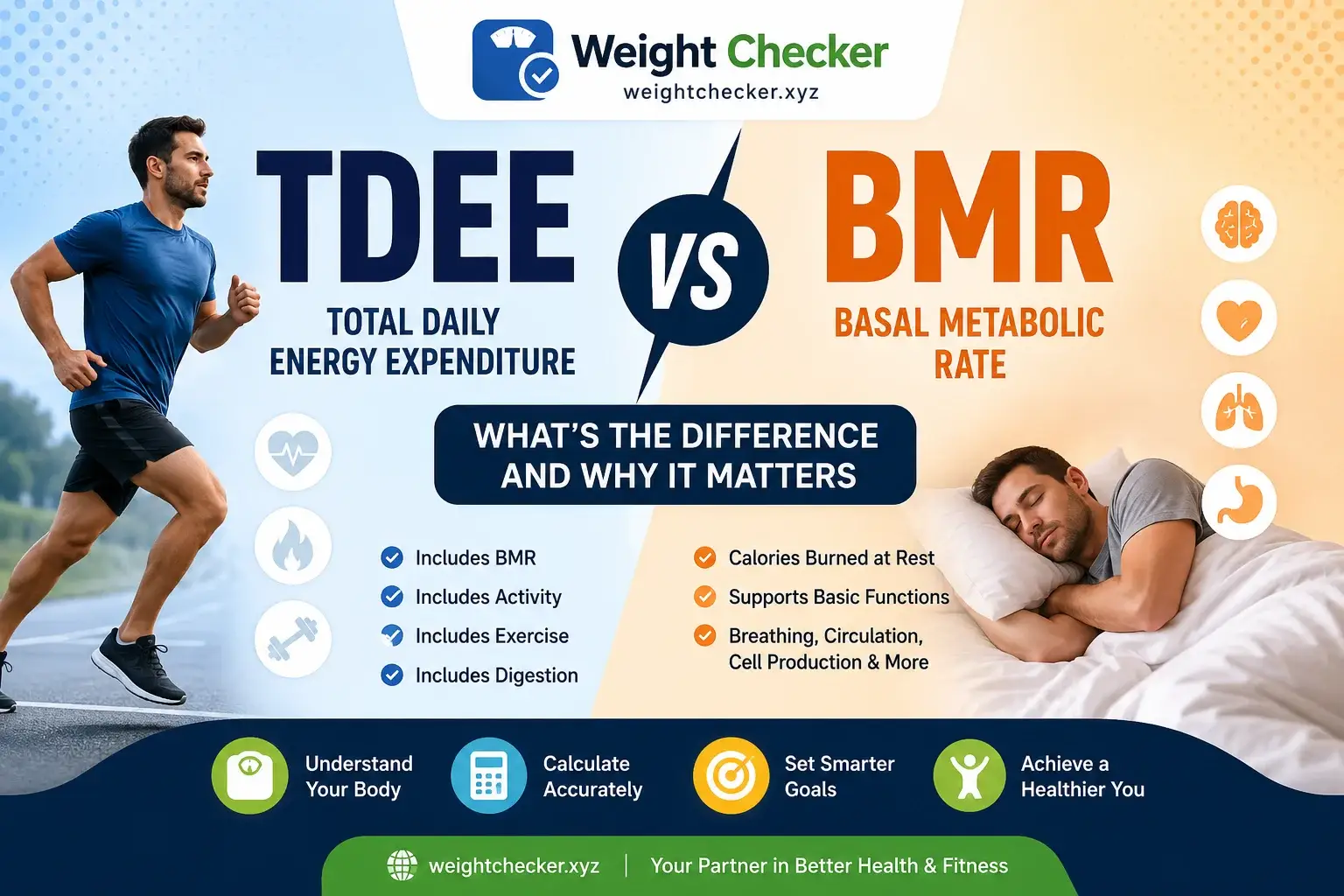
Whether you’re trying to lose weight, build muscle, or maintain your current weight, understanding TDEE vs BMR is one of the most important steps in creating an effective nutrition plan.
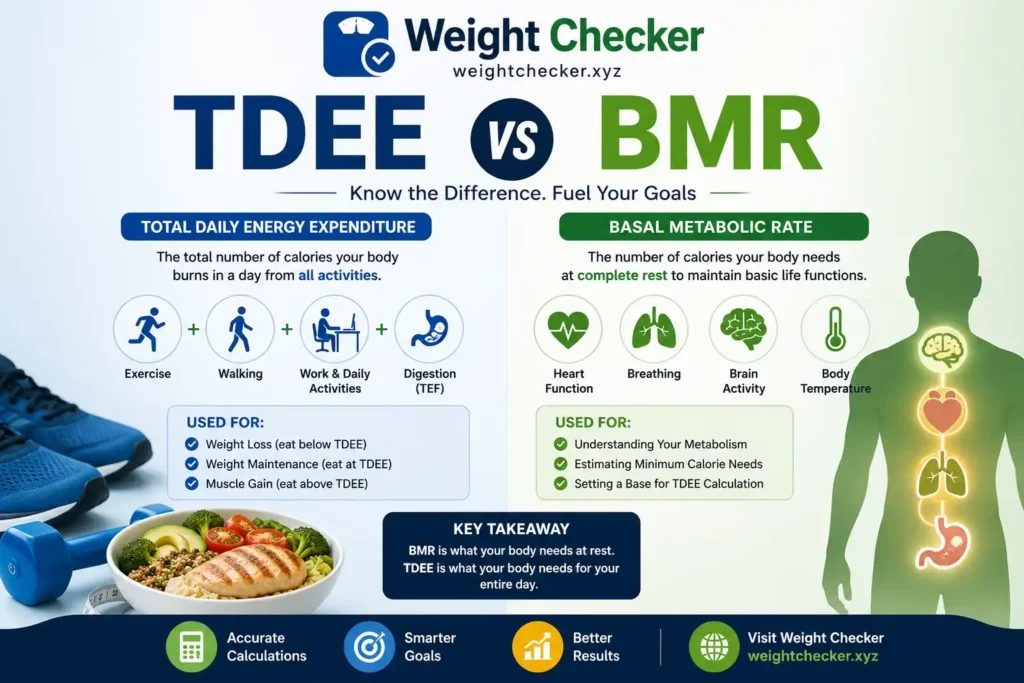
Many people confuse Basal Metabolic Rate (BMR) with Total Daily Energy Expenditure (TDEE). While both measure calorie expenditure, they serve different purposes. Your BMR represents the calories your body burns at complete rest, while your TDEE includes all the calories you burn throughout the day including exercise, walking, work, and digestion.
At Weight Checker (weightchecker.xyz), we help you understand these metrics so you can make informed decisions about your health and fitness goals.
Table of Contents
- What Is BMR?
- What Is TDEE?
- TDEE vs BMR: Quick Comparison
- How BMR Is Calculated
- How TDEE Is Calculated
- Activity Levels Explained
- Why Knowing Both Matters
- Which One Should You Use?
- TDEE vs BMR for Weight Loss
- TDEE vs BMR for Muscle Gain
- Common Mistakes
- Frequently Asked Questions
- Final Thoughts
What Is BMR?
Basal Metabolic Rate (BMR) is the number of calories your body burns while completely at rest.
These calories are required to support essential life functions such as:
- Breathing
- Blood circulation
- Brain activity
- Heart function
- Cell regeneration
- Hormone production
- Body temperature regulation
Imagine lying in bed all day without moving. Your body would still burn calories to keep you alive. That number is your BMR.
Factors That Affect BMR
Your BMR depends on several factors:
- Age
- Gender
- Height
- Weight
- Muscle mass
- Genetics
- Hormonal health
People with more muscle mass generally have a higher BMR because muscle tissue burns more calories than fat, even at rest.
What Is TDEE?
Total Daily Energy Expenditure (TDEE) is the total number of calories your body burns in an entire day.
Unlike BMR, TDEE includes every calorie burned through daily activities.
It consists of:
- Basal Metabolic Rate (BMR)
- Physical activity
- Exercise
- Walking
- Household chores
- Digestion of food (Thermic Effect of Food)
- Non-Exercise Activity Thermogenesis (NEAT)
If BMR is your resting calorie burn, TDEE is your complete daily calorie burn.
TDEE vs BMR: Quick Comparison
| Feature | BMR | TDEE |
| Meaning | Calories burned at complete rest | Total calories burned in a day |
| Includes exercise | ❌ No | ✅ Yes |
| Includes walking | ❌ No | ✅ Yes |
| Includes digestion | ❌ No | ✅ Yes |
| Changes with activity | No | Yes |
| Used for | Understanding metabolism | Calculating daily calorie needs |
| Higher value | Lower | Higher |
How Is BMR Calculated?
The most commonly used equation is the Mifflin-St Jeor Equation.
For Men
BMR = (10 × weight in kg) + (6.25 × height in cm) − (5 × age) + 5
For Women
BMR = (10 × weight in kg) + (6.25 × height in cm) − (5 × age) − 161
Example
A 30-year-old man:
- Weight: 75 kg
- Height: 175 cm
BMR = (10 × 75) + (6.25 × 175) − (5 × 30) + 5
BMR ≈ 1,699 calories/day
How Is TDEE Calculated?
TDEE is calculated by multiplying your BMR by an activity factor.
Formula:
TDEE = BMR × Activity Level
Standard Activity Multipliers
| Activity Level | Multiplier |
| Sedentary | 1.2 |
| Lightly Active | 1.375 |
| Moderately Active | 1.55 |
| Very Active | 1.725 |
| Extra Active | 1.9 |
Example
BMR = 1,700 calories
Moderately Active = ×1.55
TDEE = 2,635 calories/day
This means you burn approximately 2,635 calories every day.
Understanding Activity Levels
Choosing the correct activity level is essential for accurate TDEE calculations.
Sedentary
- Desk job
- Little or no exercise
Lightly Active
- Light exercise
- Walking a few days weekly
Moderately Active
- Moderate workouts
- Gym 3–5 days weekly
Very Active
- Intense workouts
- Physically demanding job
Extra Active
- Athlete
- Two workouts daily
- Heavy labor
Why Knowing Both BMR and TDEE Matters
Understanding both numbers allows you to create a realistic calorie plan.
If You Want to Lose Weight
Eat fewer calories than your TDEE.
If You Want to Maintain Weight
Consume calories close to your TDEE.
If You Want to Build Muscle
Eat slightly above your TDEE while following a strength-training program.
TDEE vs BMR for Weight Loss
Many beginners mistakenly eat fewer calories than their BMR, which may increase fatigue, hunger, and make it harder to meet nutritional needs.
A more sustainable approach is to create a moderate calorie deficit based on your TDEE.
For example:
- TDEE = 2,500 calories
- Weight loss target = 2,000 calories/day
This creates a 500-calorie daily deficit, which is commonly used for gradual, sustainable weight loss.
TDEE vs BMR for Muscle Gain
Muscle growth requires both resistance training and sufficient calories.
A common approach is to eat around 200–400 calories above your TDEE, while consuming adequate protein and following a progressive strength-training routine. This supports muscle gain while helping to limit unnecessary fat gain.
Common Mistakes People Make
Avoid these common errors:
- Confusing BMR with TDEE
- Selecting the wrong activity level
- Ignoring changes in weight and activity over time
- Eating below BMR without professional guidance
- Not tracking progress consistently
- Assuming online calculators are perfectly accurate for everyone
Tips to Improve Your Metabolism
While you can’t dramatically change your BMR, healthy habits can support your overall energy expenditure:
- Build muscle through resistance training
- Stay physically active throughout the day
- Eat enough protein
- Get adequate sleep
- Stay hydrated
- Manage stress
- Avoid overly restrictive diets
TDEE vs BMR: Which One Should You Use?
The answer depends on your goal.
Use BMR If:
- You want to understand your resting metabolism.
- You’re learning how many calories your body needs for basic functions.
- You’re estimating your minimum energy requirements.
Use TDEE If:
- You’re planning weight loss.
- You’re aiming to maintain your current weight.
- You’re trying to build muscle.
- You’re setting a daily calorie target.
For most people, TDEE is the more practical number for everyday nutrition planning because it reflects your total daily calorie expenditure.
Key Takeaways
- BMR is the number of calories your body needs to perform essential functions at rest.
- TDEE is the total number of calories you burn in a day, including activity and digestion.
- TDEE is calculated by multiplying BMR by an activity factor.
- Use BMR to understand your resting metabolism.
- Use TDEE to set calorie targets for weight loss, maintenance, or muscle gain.
- Recalculate your TDEE whenever your weight or activity level changes.
Conclusion
Understanding the difference between TDEE vs BMR is the foundation of effective calorie planning. While your BMR shows the minimum calories your body needs to function, your TDEE reflects your complete daily energy expenditure and is the better guide for setting calorie goals.
Whether you’re trying to lose weight, maintain your current physique, or build lean muscle, knowing both numbers allows you to make smarter, evidence-based decisions. At Weight Checker (weightchecker.xyz), using accurate calorie calculations alongside healthy eating and regular physical activity can help you stay on track toward your long-term health and fitness goals.
Frequently Asked Questions (FAQs)
Is TDEE the same as BMR?
No. BMR is the calories your body burns at complete rest, while TDEE includes BMR plus calories burned through activity, exercise, and digestion.
Which is higher, TDEE or BMR?
TDEE is always equal to or higher than BMR because it includes all daily energy expenditure.
Should I eat my BMR or my TDEE?
Most people should base their calorie intake on TDEE, adjusting it according to whether they want to lose, maintain, or gain weight. Eating below your BMR for extended periods may not be appropriate without medical supervision.
Can I lose weight using only BMR?
BMR alone is not the right target for planning weight loss. TDEE provides a more complete estimate of your daily calorie needs.
How often should I recalculate my TDEE?
It’s a good idea to recalculate after significant changes in body weight, activity level, or muscle mass, or every few months if your routine changes.
Does exercise increase BMR?
Exercise doesn’t instantly raise BMR, but building muscle through regular resistance training can gradually increase resting calorie expenditure over time.